 WELCOME TO OPEFE ARCHIVES
The Law and Piranhas
By Frank Magallanes, October 15, 2002
Revised 12/26/2011
FROM FRANK MAGALLANES
|
PIRANHA PROHIBITED BY STATE AND COUNTRY - Click here to access information |
"A fish only a foot long....They are the most ferocious fish in the world. Even the most formidable fish, the sharks or the barracudas, usually attack things smaller than themselves. But the piranhas habitually attack things much larger than themselves." (Theodore Roosevelt, in his 1914 book, "Through the Brazilian Wilderness" - Dr. George S. Myers, Piranha Book, 1977)....And so we commence the discussion of the fish we commonly call a piranha. This misunderstood fish has been feared by countless people in the United States and around the world, often without reason. Are they dangerous fish? Can they live in our waters? Perhaps the reader visiting this web site will come away with a better understanding of this legendary fish. Maybe even accepting the premise that this fishes reputation may someday be relegated to the myths and legends of monsters we have once believed in to be fact.
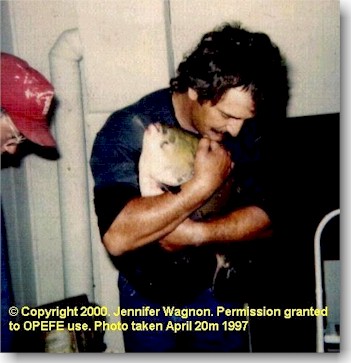
California, Texas and especially Florida have been dealing for years with non-native introduced species. Majority of captured fish were pacus (genera Colossoma and Piaractus). The infamous Piranha of Sacramento river was a pacu released by an idiot hobbyist (not the one shown above in the left corner).
The State of California Fish and Wildlife official, for example, was sued by a fish dealer in the 1970 because his piranhas were confiscated by California Fish and Wildlife authorities. In that testimony Dr. Herbert R. Axelrod of TFH Publications et al., was their expert witness for the State. See Cold Tolerance of Pygocentrus in the United States. ON-LINE VIEW to read Axelrod testimony for the State of California. Also included is my own court action; State of Oregon vs. Magallanes, 1993 with a different outcome VIEW.
Below is the actual case file. I have hi-lighted in RED the part that pertains to piranhas: Source of information VIEW:
OPEFE EDUCATIONAL USE ONLY
Adams v. Shannon (1970) 7 Cal.App.3d 427 , 86 Cal.Rptr. 641
[Civ. No. 35142. Court of Appeals of California, Second Appellate District, Division One. May 8, 1970.]
FRANK ADAMS, Plaintiff and Appellant, v. WALTER SHANNON, as Director, etc., Defendant and Respondent
(Opinion by Thompson, J., with Wood, P. J., and Gustafson, J., concurring.)
COUNSEL
Alfred D. Williams for Plaintiff and Appellant.
Thomas C. Lynch, Attorney General, Walter S. Rountree, Assistant Attorney General, and Walter E. Wunderlich, Deputy Attorney General, for Defendant and Respondent.
OPINION
THOMPSON, J.
Appellant is a dealer in tropical fish. He appeals from a judgment of the superior court denying him an injunction restraining the California Department of Fish and Game from enforcing statutes and regulations prohibiting the importation and possession of piranha. We affirm the judgment.
Statutory Scheme
Since 1961 the Fish and Game Code has contained a comprehensive scheme limiting the importation of wild animals (including fish) into California. The code (? 2118) prohibits the importation of specified species without a permit. It delegates to the Fish and Game Commission the responsibility for issuing permits for importation of the designated species and empowers the commission to issue regulations which may include a list of animals for which import permits will be issued and refused (?? 2120, 2122). The code specifies standards to be followed by the commission in promulgation of regulations and the issuing of import permits (?? 2123, 2150). Section 2150 of the code provides that a permit to import a species designated by the code may be issued "upon determination that the animal is not detrimental or that no damage or detriment can be caused to agriculture, to native wildlife, or to the public health or safety, as a result of such importation. ..."
Animals (and fish) imported without a permit are subject to destruction by an "enforcing officer" (? 2189). The contraband animal (or fish) may, however, on notice of violation from the enforcing officer be "shipped out of the State, returned to point of origin, or destroyed, ... at the option of the owner or bailee" (? 2188). [7 Cal.App.3d 431]
One of the species, the importation of which is prohibited except by permit, is the fish known as piranha. (Fish & G. Code, ? 2118, subd. (e).) Regulations of the commission provide that no permit will be issued for the importation of piranha except to a public aquarium for exhibition purposes (Cal. Admin. Code, tit. 14, ? 671) or to zoological gardens or for research (Cal. Admin. Code, tit. 14, ? 671.1).
Appellant's Violation
Appellant is a wholesale and retail dealer in tropical fish. In the normal course of his business and without claiming to have a permit to do so, he has imported piranha to California and sold the fish to the general public. On April 7, 1965, appellant had in his possession 140 piranha imported without a permit. On that date respondent, acting in his capacity as the Director of the Department of Fish and Game, served a notice of inspection upon appellant. The notice prohibited sale of the piranha and required that within 30 days appellant either ship the fish from California, destroy them, or donate them to a bona fide public aquarium or zoological garden. Appellant did not comply with the notice.
Nature of Litigation
On May 7, 1965, appellant filed his complaint commencing the proceedings in the case at bench. The complaint alleges that since 1964 appellant has sold approximately 4,000 piranha of a value of $50 to $100 each, and that he has customers for 1,000 more. The complaint states that the piranha cannot constitute "a threat of damage to the natural wildlife or agricultural interests of the State of California in private aquariums or if it were set at large." It claims, therefore, that "Regulation 670, et seq., Title 14 of the Administrative Code" which "denies" appellant's right to import and possess piranha is unreasonable because it is "arbitrary, capricious, unreasonable, ultra vires [and] does not further the object of the law being administered. ..."
The complaint in its first cause of action seeks to enjoin enforcement of the pertinent regulations. In its second cause of action, the complaint seeks a writ of mandate compelling the Fish and Game Commission to promulgate a finding that "the piranha is not inimical, dangerous or a threat to the natural wildlife or agricultural interests of this State from its existence at large or in any other environment." The second cause of action also seeks a writ of mandate directing respondent to issue a permit to appellant to import and sell piranha.
The joint pretrial statement of the parties includes the following as an admitted matter for the purposes of the litigation: "h. That sections 2118, [7 Cal.App.3d 432] 2120, 2150, 2188 and 2189 of the fish and Game Code of California are valid and constitutional and are promulgated pursuant to a valid exercise of the police power of the state." Consistent with that admission, appellant's separate pretrial statement states his contention that regulation 671, as it affects the importation of piranha, is "arbitrary and capricious" because it is not based upon any evidence that piranha could survive or become established in California
.
After receiving evidence in the form of exhibits, the trial court held for respondent. It denied appellant's prayer for an injunction and writ of mandate.
Issues on Appeal
On appeal, appellant departs drastically from his theory in the trial court. He now contends that the sections of the Fish and Game Code admitted to be valid for the purposes of this litigation are unconstitutional. He argues that the statutory scheme represents an improper exercise of the police power, that the statutes and regulations are overly broad when measured against their purpose, and that the statutes deprive him of property without due process of law. We conclude that appellant's arguments must be rejected.
Police Power
Appellant argues that the statutes and regulations which prohibit him from importing piranha for commercial purposes are unconstitutional because their enactment is beyond the police power of the state. We note at the outset that in the trial court appellant participated in the filing of a statement of agreed matters containing a declaration that the statutes he now contends are unconstitutional represent a valid exercise of the police power by the state of California. We do not, however, rest our decision solely on that procedural fact. [1] Appellant's contention is without merit as a matter of law. A state may prohibit the importation, possession, transportation, or sale of fish or game taken outside the state when its legislature reasonably determines that the action is needed to protect the local ecology. That action by a state does not violate the commerce clause of the United States Constitution and is a proper exercise of the police power of the state. (New York ex rel. Silz v. Hesterberg, 211 U.S. 31 [53 L.Ed. 75, 29 S.Ct. 10]; Johnson v. Gentry, 220 Cal. 231 [30 P.2d 400, 92 A.L.R. 1264]; note 92 A.L.R. 1267 and cases there cited.)
[2a] The record of the case at bench establishes that the action of the Legislature in enacting the pertinent statutes and of the commission in promulgating the implementing regulations are based upon a firm foundation [7 Cal.App.3d 433] in fact. There is an ample showing that the action is designed to protect the inland waters of California. The record contains qualified expert opinion that piranha, if introduced into the waters of California, could seriously endanger existing species of aquatic life. The evidence discloses that the piranha is an extremely voracious, aggressive, carnivorous fish. In its native habitat in South America it is a danger to other fish, to mammals, and to human beings. There is evidence also that piranha could establish themselves in the waters of California. The Legislature in enacting the pertinent statutes and the commission in adopting the questioned regulations were amply justified in determining that the danger to the inland ecology of California from the introduction of piranha is so great as to require that the importation of the species be drastically curtailed.
Appellant concedes that there is a factual basis for the legislation and regulation he contends are unconstitutional. He emphasizes, however, that there is also evidence that piranha could not survive and reproduce in the waters of California. He then argues that by reason of the conflict in evidence there is not a "clear and present danger" that the importation of piranha would endanger existing wildlife or agriculture. Appellant contends that absent a clear and present danger the enactment of the pertinent statutes and regulation is beyond the police power of the state.
Appellant misconceives the constitutional foundation for the legislative and regulatory action now before the court. In general, a legislative act is presumed to be constitutional and doubt must be resolved in favor of its validity. (Witkin, Summary of Cal. Law (1960) Constitutional Law, ? 20, and cases there cited.) [3] A limitation upon the general rule exists in the case of legislation impinging upon rights guaranteed by the First Amendment to the United States Constitution. If the limitation is applicable, the "clear and present danger test" is applied. That test is not otherwise applicable.
[4] In the case of an exercise of the state police power in a fashion designed to protect the natural environment, the test is not whether there is a clear and present danger to the environment which justifies the legislation. The test is rather whether the legislative body could have determined upon any reasonable basis that the legislation is necessary or desirable for its intended purpose. [2b] The evidence in the record of the case at bench constitutes such a reasonable basis. So also does ecological history. There are countless instances in which the introduction of a species exotic to an area has meant disaster to its natural environment. The Legislature of California might well have banned the importation of piranha based upon the [7 Cal.App.3d 434] experience of Australia with the importation of rabbits, fn. 1 the experience of Hawaii with the introduction of the mongoose, fn. 2 the experience of those parts of the United States in which the starling has become a nuisance. fn. 3 The validity of the legislation is confirmed by the experience of Florida with the walking catfish introduced into that state by dealers in tropical fish who imported it for sale to their trade. fn. 4
Classification
[5a] We find no
constitutional infirmity in the classification adopted by regulations 671 and
671.1 which authorize the granting of import permits for piranha to public
aquaria for exhibition purposes, to zoological gardens, and for research while
denying the granting of permits for other purposes. [6] Classification is not
per se prohibited by the equal protection clause of the Fourteenth Amendment to
the United States Constitution. (Lindsley v. Natural Carbonic Gas Co., 220 U.S.
61, 78 [55 L.Ed. 369, 31 S.Ct. 337].) "'When a legislative classification
is questioned, if any state of facts reasonably can be conceived that would
sustain it, there is a presumption of existence of that state of facts, and the
burden of showing arbitrary action rests upon the one who assails the
classification.'" (Ferrante v. Fish & Game Com.,
[5b] Here there is a clearly conceivable basis for the classification which has not been rebutted by appellant. The likelihood that piranha will be released into the waters of the state is small if the fish are imported by a responsible, knowledgeable scientific organization. It is much greater if the importation is for commercial purposes including the indiscriminate sale of live fish to the public.
Breadth of Statutes and Regulation
Appellant contends that the
pertinent statutes and regulations are unconstitutionally overly broad. He argues that the purpose of the statutes is to prevent the
release of piranha into the waters of the state, and that this purpose can be
accomplished by means short of the drastic restriction upon imports imposed by
the statute. He cites in support of his argument In re Hoffman,
[7] In matters not involving rights protected by the First Amendment to the United States Constitution, the test of validity of an exercise of the police power is its reasonableness in relation to the objective of the legislation. (Nebbia v. New York, 291 U.S. 502 [78 L.Ed. 940, 54 S.Ct. 505]; Marshall v. Sawyer (9th Cir. 1962) 301 F.2d 639, 652.) [8] Here the objective of the legislation is the prevention of the introduction of a noxious fish into the waters of California and the consequent harm to existing aquatic life. In view of the history of other species introduced as novelties or pets which have become established in a wild state to the detriment of previously existing wildlife, the action of the Legislature in prohibiting importation of piranha except under limited circumstances must be held to be reasonably adapted to the purpose of the legislation. (See Johnson v. Gentry, 220 Cal. 231 [30 P.2d 400, 92 A.L.R. 1264].)
Due Process
[9] Appellant contends that the legislation and regulations requiring destruction, shipment outside the state, or contribution to a public aquarium of piranha imported without a permit deprive him of property without due process of law. The contention is without merit.
Our Supreme Court has stated:
"If the legislative act is within the police power of the state, ... the
individual ... affected thereby ... cannot complain that his property is taken
without due process of law or without compensation first paid to him."
(Agricultural Prorate Com. v. Superior Court,
Precedent thus dictates the
rejection of appellant's contention. So also does logic. Property rights in wild
game and fish are of a limited character. They exist in California only to the
extent that they are not limited by legislation whether the fish or game is
taken originally within or without the state. (Takahashi v. Fish & Game
Com.,
Writ of Mandate
Appellant's brief contains no contention or argument with respect to the denial of the writ of mandate sought in his second cause of action. The action of the trial court denying the writ must be sustained for that reason.
Conclusion
The judgment is affirmed.
Wood, P. J., and Gustafson, J., concurred.
REFERENCES
?FN 1. Great Rabbit War, (Nov. 1967) Science Digest 62:18-20. Overbreeding Down Under, (Nov. 18, 1966) Time 88:120.
?FN 2. In Hawaii, Face To Face With A Mongoose, (Feb. 1967) Sunset 138:8.
?FN 3. New Weapon for Starling Sufferers, (Jan. 1967) Farm Journal 91:48.
?FN 4. Florida's Walking Catfish, (June 1969) National Geographic 135:846.
Additional references added by Frank Magallanes OPEFE 12/4/2011
Oral presentations - IX Meeting of the Neotropical Ichthyological Association, Antonio Machado-Allison and William L. Fink, Universidad Central de Venezuela, Museo de Biologia, Apto Correos 47058, Caracas, 1041-A. Venezuela.
Fink, William L. 1993. Revision of the Piranha Genus Pygocentrus (Teleostei, Characiformes). Copeia 3:665-686.
Fuller, P. L., L. G. Nico and J. D. Williams. 1999. Nonindigenous Fishes Introduced into Inland Waters of the United States. American Fisheries Society, Bethesda, Maryland.
Saint-Paul, Ulrich, Jansen Zuanon, Marle A. Correa, Marcelo Garcia, Nidia Fabre, etc. March 2000. Fish Communities in Central Amazonian White- and Blackwater floodplains. Environmental Biology of Fishes 57:235-250.
Sazima, Ivan and Francisco Machado. 1990. Underwater Observations of Piranhas in Western Brazil. Environmental Biology of Fishes 28:17-31.
Frank Magallanes, 2000 Cold Tolerance of Pygocentrus in the United States. ON-LINE VIEW
Frank Magallanes, 1993, State of Oregon takes Frank Magallanes to Court. ON-LIVE VIEW
FORBIDDEN BY STATE LAWS - United States
The map found at this web page VIEW is a replication of the written information provided by the American Fisheries Society (1996) which reported areas that piranhas could establish viable populations by using the mean temperature of January as the coldest time period. This cold indicator would give biologist a better idea in what parts of the United States piranhas could be established during the coldest time of the year. The coloration of the above map is my own interpretation of that information applied to this map.
This link is for the current list of States prohibiting piranha possession. Some of these states that are not prohibiting piranha, may require a permit to possess them, however, it is very unlikely any single one person could secure such a permit. Majority of these permits are approved for zoological parks and museums. Some States (State of Florida for example) don't even allow public exhibit of piranhas for fear they could escape from the public aquarium! Some States have stiff fines for possession of piranhas (ex: $500 per fish confiscated). See chart below for city, county, State ordinances.
In researching this data, some States and other countries are indeed promulgating new rules that will probably change this in the year 2003-2012. Recently Channa species are prohibited (USFW 2002) from importation into the United States. Some states mandate a stiff fine (5 years imprisonment and $5,000 fine) for possession of this fish. Even South America is not free from transplanted fish. Trout (Salmo species) have been introduced by conservationist to enhance sport fishing! This has produced problems with whirling disease (Heximita) and other non-native parasite problems. Piranhas are also introduced in non-native habitat range much like how they are introduced here in the United States. This has led to a mixture of species that is unnatural and caused scientists to pause and examine the origin when such fish are captured.
To read how modern scientists view the piranha today, click VIEW
REFERENCES
Oral presentations - IX Meeting of the Neotropical Ichthyological Association, Antonio Machado-Allison and William L. Fink, Universidad Central de Venezuela, Museo de Biologia, Apto Correos 47058, Caracas, 1041-A. Venezuela
Fink, William L. 1993. Revision of the Piranha Genus Pygocentrus (Teleostei, Characiformes). Copeia 3:665-686.
Fuller, P. L., L. G. Nico and J. D. Williams. 1999. Nonindigenous Fishes Introduced into Inland Waters of the United States. American Fisheries Society, Bethesda, Maryland.
Saint-Paul, Ulrich, Jansen Zuanon, Marle A. Correa, Marcelo Garcia, Nidia Fabre, etc. March 2000. Fish Communities in Central Amazonian White- and Blackwater floodplains. Environmental Biology of Fishes 57:235-250.
Sazima, Ivan and Francisco Machado. 1990. Underwater Observations of Piranhas in Western Brazil. Environmental Biology of Fishes 28:17-31.
Frank Magallanes, 2000 Cold Tolerance of Pygocentrus in the United States. ON-LINE VIEW
USE YOUR BACKSPACE OR CLICK HERE TO RETURN RESEARCH PAGE
TO RETURN HOME CLICK HERE.
The OPEFE web site and its contents; is disclaimed for purposes of Zoological Nomenclature in accordance with the International Code of Zoological Nomenclature, Fourth Edition, Article 8.3 and 8.4. No new names or nomenclature changes are available from statements at this web site.
Copyright© 1994-2012 Oregon Piranha Exotic Fish Exhibit (The OPEFE fish exhibit is permanently CLOSED as of 2000) Sutherlin, Oregon. Information posted on this web site is archival data on fish scientific classifications and other information. DISCLAIMER: The copyrighted material may not be used for any purpose other than private study, scholarship or research. Cited information requires credit and this link www.opefe.com. All rights reserved. All images shown (unless otherwise noted) is property of OPEFE.