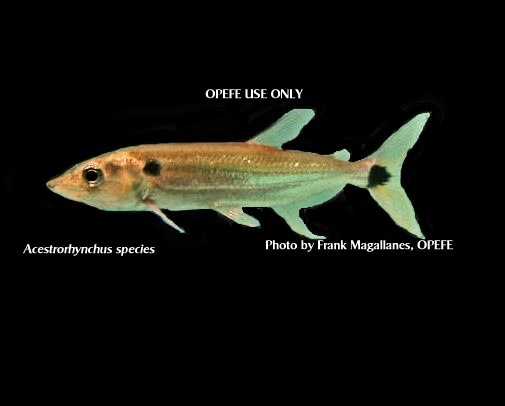
Keeping Freshwater Barracudas Acestrorhynchus
by Tom Lorenz
Keeping Freshwater Barracudas Acestrorhynchus
by Tom Lorenz
Commonly known as Barracuda, Cuda, Acestros, or Aces
Salt-water barracudas are remarkable predatory fish. This is demonstrated by their famous name, which is even used outside of fish references! They have no close fresh-water relatives but this doesn’t prevent the application of this descriptive moniker. Several fresh-water fish share the name barracuda. Livebearers of the genus Belonesox and gar characins of the genus Ctenolucius are two examples, both being sharp toothed freshwater predators that snatch food with speed.
The prize for speed and visible teeth, however, goes to a dozen or so characins belonging to the genus Acestrorhynchus. These fresh-water barracudas (or Acestrorhynchin or acestros or aces) are an exclusively South American group of small predators (usually under 12 inches) with huge eyes, toothy jaws, and a rapid attack largely reserved for fish prey. Their savage attacks and looks, as well as their common name, provide an idea of a fish quite different from what ends up in the aquarium. This creates many problems that often lead to the cuda demise in captivity. Fortunately, it is easy to avoid these pitfalls and enjoy a very unique animal.
About half of the fifteen species are found in the hobby. This is fine, considering that the range of body plans and sizes are still covered by what’s available. The biggest problem with finding cuda is that they are rarely in more than a couple locations at any given time. The other problem is, again, this name game. Often other fish are listed as fresh water barracudas, and 90% of the time sellers do not know which of the species they have. Understanding the names (common and scientific) of the more common cuda will help.
I divide Acestrorhynchus into three or four groups (by morphology, not necessarily taxonomy) for the purposes of determining what tank conditions to keep them in.
The first group would be the smaller sized animals that have longitudinal stripes. They are rarely over 6 inches, usually under 4 inches (with one exception). These fish include A. isalinae, A. nasutus, A. maculipinna, A. minimus, and A. briskii. Two important notes; A. nasutus actually gets large (up to 10 inches), but the only member of this group that you will likely ever see is A. isalinae.
A. isaline fresh-water barracuda is a beautiful species that has been reported to be a fin nipper (although I’ve never seen it). Like all Acestros, they prefer the security of a school (just three fish actually works). Unique to these small barracudas is the fact that they appreciate cover, which usually doesn’t members of this genus. Prey size is limited to the guppy/mosquitofish range and they become prey when kept with larger species of this genus!
A loosely organized second group could include the Acestrorhynchin that have a ‘humeral spot’ (a spot behind their gill plate). These fish are more robust, higher bodied, and larger. Examples include A. falcatus, A. lacustris, A. pantaneiro, and A. altus. The most common of these would be A. falcatus (but altus are occasionally available and A. pantaneiro is found in European aquaria). Acestrorhynchus falcatus is often listed as the red-tailed barracuda and is possibly the most available species of Acestrorhynchus. This is good because they are one of the hardiest members of the genus. Their size can reach 8 to 10 inches and the redness of the fins is complimented nicely by subtle iridescent hues in the body. They are impressive animals when kept in a pack, they excite each other at feeding time and are quick even at larger sizes. Because of their size and speed they need to be kept in large aquaria.
The third group includes one distinctive species, Acestrorhynchus falcirostris. This is the largest species of Acestrorhynchus (up to 12 inches). It also has the distinction of a hooked nose (hence the name falci-rostris = fake-nose) and a very slender body. They have huge eyes and a slight yellow tint to their tail. The common names and scientific names around this fish were a mess that took me some time to sort out. The classic common names are slender freshwater barracuda and yellow-tailed barracuda. The scientific name is often erroneously listed as A. falcatus or A. nasutus. This is strange when one considers how different of an animal this is from either of those fish.
Acestrorhynchus falcirostris is, by far, the most skittish of this already flighty genus! Their hunting technique is very slow and meticulously thought out. They abandon their eerie stalking of prey often enough to make even the most captivated human observer give up on watching them eat! They require a good deal of space as well.
A last group in my arbitrary organization contains a hodge-podge of fishes. Again, not necessarily a true evolutionary group, but they functionally work as a group for the hobbyist because they are all of intermediate size. They range in between the size of a A. falcatus and an A. isalinae (usually around 6 to 7 inches). Species that could be thrown in here include A. microlepis, A. grandoculis, A. apurensis, and A. guianensis.
The most notable of the group would be A. microlepis. This fish can look very different when seen from different locale and the question of where to draw species lines comes up with this species and it’s relatives. They are relatively slender fish but not as much as A. falcirostris. They are also more angular than A. falcirostris and lack the fake nose. Another member of this group would be A. grandoculis. This species is unique in that the species has an unusually large eye (but the higher body form like A. falcatus) and is occasionally available.
Out of all of the species in this genus, only half a dozen comprise what is available. In order, the most common fish I’ve seen are A. falcatus, A. falcirostris, A. isalinae, A. microlepis, A. altus, and A. grandoculis. A. falcatus and A. falcirostris probably constitute 90% of imported cuda.
So how do you care for these unusual predators? The water conditions are simple, you need to replicate a tropical South American river: pH from 6 to 7 and a temperature 78 to 82 degrees Fahrenheit. Clean water is best, make sure the tank is well established.
Most difficulties with Acestrohynchus are not water quality related, they are behavioral; namely, their flightiness and their feeding habits. Flightiness has to be the number one problem. It is, however, ridiculously easy to solve. These fish can be rather jumpy, and it varies with individuals and species (A. falcirostris is extremely flighty, for example). When smashing into the glass happens, it can turn a hard to acquire fish into the fish-equivalent of a car wreck. So what’s the simple solution?
The easiest way to understand a behavioral problem is to find out what causes it. Flightiness is first a natural behavior so it needs to be dealt with. It also is in response to aggression. Tank mates of all kinds work with these fish. However, aggressive tank-mates should be avoided in all but the very largest of tanks. Acestrohynchus are not aggressive at all, unless you fit in their mouth!
A lack of space for the fish not only causes panic, it also provides the increased opportunity of smashing into a glass wall. Sadly, many cuda end up with smashed or raw noses, which greatly reduces their appeal. The number one piece of advice I can give anyone for these fish is to provide a long tank (at least 5 feet). Besides all that space, there should also be a lack of cover. Yes, a lack of cover.
Sound strange? Imagine patterns in fish. If you live on rocks you have a blotchy pattern, if in weeds or plants you usually have stripes. Besides the little striped Acestrorhynchus, most of these fish are silvery. Where is silver an effective camouflage? In open water. Cover can actually make these fish nervous. I’ve kept them with sword plants and slate but have always had large open areas available to them. Guess where they spend all of their time? Feeder fish can even survive for a week or so if they figure this out and stay in the cover! This makes for a nice effect and more natural situation feeding-wise.
Along with having a long tank with open space, feeding techniques have made Acestrorhynchus the lowest maintenance fish I have. Funny thing that feeding is so often a complaint!
Feeding can be easy. Remember that you’re trying to keep an open water, fish-eating specialist in an aquarium. The extra room and a supply of healthy fish go a long way with members of this genus. Choosing what fish to feed, or attempting to get them off of live food is a little tricky.
Note that these fish go crazy for fish prey and that it’s an interesting aspect of their behavior. They are really really good at catching fish! Again, the tank mate issue comes up here. Tank mates need to be more than two thirds the length of the cuda or they will, in fact, become part of your feeding program. The good side of this is that they are not picky eaters as long as you are a fish!
My best results come from using shiners as feeders. I use mosquitofish to feed the juveniles and the small Acestrorhynchus species. Shiners can be purchased at bait shops and mosquitofish can be found wild if you live in the Southeastern United States. If you don’t, feeder guppies are a favorite. I choose against goldfish for a variety of reasons, including their spines. There is one more important step to this. These feeders should be quarantined. During this quarantine I feed the feeders dry pellet food and I remove any dead or diseased feeders. After a few days I introduce these fish into the aquarium and watch the incredible fireworks. The size of prey that they can consume is amazing, as are the bulges in their belly (that resemble silver balloons!).
Quarantines raise the nutritional value of the feeder significantly. It also seems to help with disease prevention. In general, I have only seen two disease factors that affect the genus Acestrorhynchus in captivity. One is parasites, the other is fin rot. Both are extremely preventable and even treatable.
The parasite load of my first Acestrorhynchus were so bad that nematodes protruded from their bodies. It is essential to know that they are currently all wild caught and that wild fish often carry parasites. A large amount of the scientific work on this genus is in fact describes the many parasites they carry! The key to dealing with parasites is how you feed the cuda once they are in your possession. It is most probable that they come to you with internal parasites. Medication always seemed to produce negative effects on my fish. After hearing about dry food anecdotally affecting parasite loads in some livebearers, I decided to take the next logical step and feed dry food to the feeders. The results were dramatic. I have never had a parasite problem since and I have dissected cuda that die by other causes (jumping out of the aquaria, smashing into the side of the tank) and have found them to be parasite free in their intestines. Either the quarantine removes sick fish, well fed feeders are healthier food, or (most likely) both of these things are true. Fin rot seems to be an issue when aquarium conditions really deteriorate or, more commonly, after a stressful shipping. For best results, Acestrorhynchus should be shipped with empty stomachs (not fed for two days or so) and as quickly as possible. They shouldn’t be chilled either. If any of these things stress them out, they can develop a terrifying case of fin rot. A bit of whiteness forms around the edges of the fins, most commonly the tail. Then it eats away the tissue and eventually reaches the body and kills the fish.
Although I prefer to improve tanks conditions to treat sick fish of other species, in this case immediate medical treatment is crucial. Fungus eliminator saved the lives of a couple of barracudas that I was sure were goners (and may have saved others if I had only known how treatable this was).
Enjoying your barracudas
The keys to enjoying the barracudas are partly up to you. You can go with a
species tank of falcatus, a mixed tank of similar sized A. falcatus and A.
falcirostris, or perhaps a planted tank with A. isalinae. Many people
would rather have a member of some other fish group, however! Again, the key
here is that the fish should be at least two-thirds the length of the cuda and
non-aggressive. If you are mean or small, cuda will respond to you as a bully or
a snack, respectively. Cichlid should be mixed in with caution. It’s been done
successfully many times, but if the Cichlid focus on the barracuda at all there
is little the Acestrorhynchus can do to defend itself (the teeth are to
hold prey, only!). Feeding fish is one of the most enjoyable aquarium
experiences that gets taken to another level with this lightning fast fish. I
once saw a young falcatus swim in three rapid circles trying to grab a guppy.
The fourth time it caught it. The amazing thing is that the guppy’s reflexes
couldn’t react at all to any of the four passes! That’s fast. Feeders also
can form schools that peacefully live alongside the cuda for a while. Not only
is this aesthetic, it also makes Acestrorhynchus very low maintenance
(just put in a school of fish and don’t worry about it for a week or two).
If you wish, different tricks can train your cuda to eat something besides live fish. You should not bet your life savings on this working ( have a plan regarding where you will be getting live fish from). Hunger helps, although these fish can fast for very long periods as adults. The other tricks involve presenting non-fish foods in a fishy fashion. Using a clear acrylic stick to make food move like a fish or presenting food in any way that moves like a fish can do the trick. I’ve had my fish eat shrimp and have even heard of them being trained for dry foods. Again, don’t count on this working every time, they are very highly evolved fish predators.
Spawning has been observed but no fry have been raised in aquaria. It is presumed that the best bet is to have multiple males vying for one female (as works in many other tetras). Perhaps a simulation of the dry and rainy seasons (water changes in spring, perhaps) could help with this behavior as well. Breeding is the ultimate complement from the fish to the aquarist, and successful rearing of fry is the ultimate complement from the aquarist to the fish. I hope that with Acestrorhynchus it is only a matter of time before someone achieves these goals using the tricks that I have listed in this article.
The tricks to keeping Acestrorhynchus are really not difficult when compared to other complicated fishes. A long tank with neutral to low pH, quarantining of feeders, and choosing tank mates wisely will go a long way towards successful keeping of these fishes.
CLICK TO RETURN ACESTRORHYNCHUS PAGE
TO RETURN HOME CLICK HERE.
The OPEFE web site and its contents; is disclaimed for purposes of Zoological Nomenclature in accordance with the International Code of Zoological Nomenclature, Fourth Edition, Article 8.3 and 8.4. No new names or nomenclature changes are available from statements at this web site.
Copyright© 1994-2012 Oregon Piranha Exotic Fish Exhibit (The OPEFE fish exhibit is permanently CLOSED as of 2000) Sutherlin, Oregon. Information posted on this web site is archival data on fish scientific classifications and other information. DISCLAIMER: The copyrighted material may not be used for any purpose other than private study, scholarship or research. Cited information requires credit and this link www.opefe.com. All rights reserved. All images shown (unless otherwise noted) is property of OPEFE.