 WELCOME TO OPEFE ARCHIVES
UNKNOWN CONVEX ANAL-FIN PIRANHA
Serrasalmus species
Herein not considered valid - Informational Purposes Only
ISSUE SEEMS RESOLVED - September 23, 2006
FROM FRANK MAGALLANES
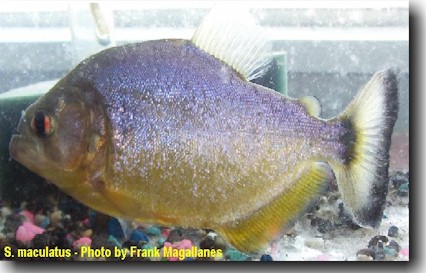
This fish has always been a question that I have wanted answered. No imports have been made that fit the description. However, I think the question has been answered. Restudying this photograph today and a live specimen I presently have in the aquarium convinces me that they are probably one and same. The only problem that remains unresolved is the anal fin. Why was it shaped odd? That may never be answered. Fink had (at that time) this to say: I have never seen an anal fin in a piranha with that type of morphology, and still presume that it is some kind of variant (or the result of damage).
|
|
|
|
HISTORICAL
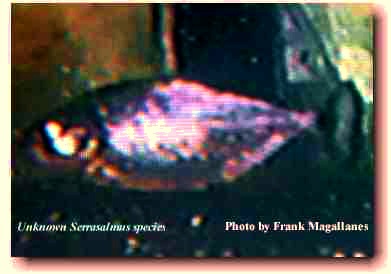
It's been 20 years now, since I first reported this species and as of this date, there is nothing new to suggest it is a known species. Having watched the import of species and many varieties of Serrasalmus and Pygocentrus, none has yet come close in appearance to the above fish. Perhaps the fish will remain an enigma to me and to those interested in this species. The advance of computer technology, including photo enhancement have produced little to help ID this species from the old Polaroid photograph. It is about as good as it gets. For now, I find myself agreeing with the authorities on piranhas, that this species is probably a member of the spilopleura complex. Albeit, an unseen one according to most exporters and importers in the fish industry. My drawing of the species, though amateurish is the best that I can do to show the main features of the fish. My only desire in life is my hope to finally solve this puzzle on this unknown Serrasalmus species.
INTRODUCTION
This
piranha example (1976) was lost many years ago and all that remains is the
drawing and two Polaroid images (both were given to Dr. W. L. Fink, University
of Michigan). The placement of this species in genus Serrasalmus is my
own opinion and does not reflect actual systematic placement by a competent
authority.
 It was most unfortunate that this live
species was lost. I was in Europe when it was reported to me that fish died in
captivity. I left instructions that it be kept frozen until my return. The fish
was some how destroyed and the remains deposed of before I had a chance to do a
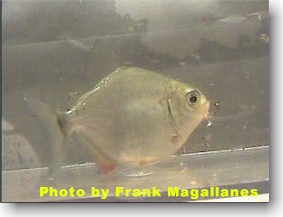
complete taxonomic count.The species is similar appearing to a juvenile
Pygocentrus as shown to the left, but with many other dissimilarities,
particularly the convex anal fin which is far-more rounded than this common
piranha. Also, the fish ground color was not as bright as this juvenile P.
nattereri. The lack of red on the fins and body of the convex piranha when
compared to other P. nattereri was also unusual. The body is more
elongated like those in S. spilopleura. Dr. William L. Fink (foremost
piranha authority) has the true copies of the Polaroid image which is not
clear enough to positively identify the species.
It was most unfortunate that this live
species was lost. I was in Europe when it was reported to me that fish died in
captivity. I left instructions that it be kept frozen until my return. The fish
was some how destroyed and the remains deposed of before I had a chance to do a
complete taxonomic count.The species is similar appearing to a juvenile
Pygocentrus as shown to the left, but with many other dissimilarities,
particularly the convex anal fin which is far-more rounded than this common
piranha. Also, the fish ground color was not as bright as this juvenile P.
nattereri. The lack of red on the fins and body of the convex piranha when
compared to other P. nattereri was also unusual. The body is more
elongated like those in S. spilopleura. Dr. William L. Fink (foremost
piranha authority) has the true copies of the Polaroid image which is not
clear enough to positively identify the species.
But he did have this to say...
I have examined the drawings and photographs of your piranha and can only say that it does resemble a Pygocentrus. Although the photos are not detailed enough for a really solid identification, it could be P. nattereri. Whatever it is, I have never seen an anal fin in a piranha with that type of morphology, and still presume that it is some kind of variant (or the result of damage). There is a complex of species which includes Serrasalmus spilopleura that somewhat resemble Pygocentrus, especially when young, and I suppose your fish could be one of those, but the anal fin is still a ringer there, too.
CONCLUSION
My own eye witness observation was the fin was not damaged nor showed any signs of a bite mark normally associated with such bites. Having kept many forms of genus Pygocentrus and being able to compare the fish side-by-side in life with those known to be Pygocentrus nattereri the fish was obviously not a Pygocentrus, especially not nattereri, in my opinion. The mystery will remain until another specimen is captured and compared with my description.
DESCRIPTION
The fish examined was approximately 10 cm SL. The eye is large and the body color being dusky. The anal (convex) fin is hyaline with a thin border. Only a small blemish of red is on the opercle. The rest dark grey with some metallic gold. Belly is grayish-black. Upper part of body (above lateral line) is silver. Spotting was small (oval) and not very pronounced on body, due more to the dark ground color. There was no humeral spot nor other markings on body. Eye color (orbit) was silver with a black band crossing the iris. The dorsal fin clear with no pigment and high. Pectoral and pelvic fins clear with no pigment. The lower mandible extending downward to the isthmus is gray. Upper and lower jaw anteriorly is olive-gray. The head is broad, but the body profile is long and the scutes large, but not prominent. The adipose fin did have a thin margin distally. The caudal fin with a black band distally to the edge of the fin and the hypural margin is black with a lighter stripe in the middle.
The fish was collected from a fish wholesale place back East in New Jersey, however, no other fish like this has ever been imported, nor have I seen any other like it. Originally, the fish was sold to me as a black piranha but looked nothing like S. rhombeus or any other black piranha-types.
USE YOUR BACKSPACE TO RETURN OR CLICK HERE TO RETURN SERRASALMUS LIST
USE THIS LINK TO RETURN TO RESEARCH PAGE.
The OPEFE web site and its contents; is disclaimed for purposes of Zoological Nomenclature in accordance with the International Code of Zoological Nomenclature, Fourth Edition, Article 8.3 and 8.4. No new names or nomenclature changes are available from statements at this web site.
Copyright© 1994-2012 Oregon Piranha Exotic Fish Exhibit (The OPEFE fish exhibit is permanently CLOSED as of 2000) Sutherlin, Oregon. Information posted on this web site is archival data on fish scientific classifications and other information. DISCLAIMER: The copyrighted material may not be used for any purpose other than private study, scholarship or research. Cited information requires credit and this link www.opefe.com. All rights reserved. All images shown (unless otherwise noted) is property of OPEFE.
Updated: 12/05/2015