|
Pictures of fin clipping for DNA research
Frank Magallanes, OPEFE
August 11, 2000
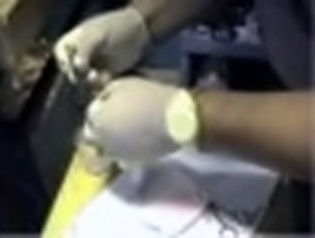
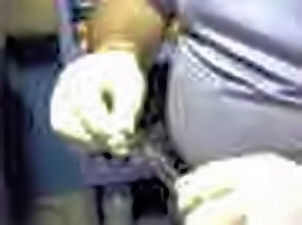
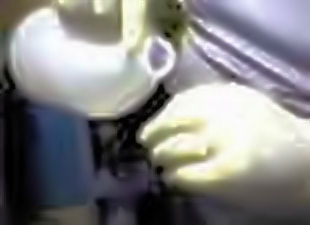
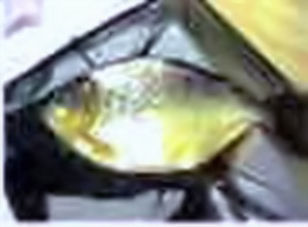
The above images are of me extracting live piranhas from the
aquarium for DNA research. The fins are clipped and then sent to the Orti Laboratory (School of Biological Science, University of
Nebraska-Lincoln) for testing. At no time is the fish significantly harmed
during the procedure.
WARNING: Piranhas have
razor sharp teeth and powerful jaws. Some images display me placing my
fingers in close proximity to the fishes mouth. Do not try this at home. I
have handled piranhas for over forty years and my experience has taught me
how to properly handle this type of fish outside of the aquarium.
-
TOP ROW: Image #1;
I'm extracting fish from the aquarium, Serrasalmus altuvei. Image
#2; The fish bit through the net, you can imagine what I'm thinking at this
time. I'm holding on to fish with my left hand. Image #3; I'm positioning
the fish for the photograph (Don't try this at home--keep your fingers away
from the fishes mouth! The teeth are sharp and the jaws strong). Image #4;
fish has calmed down some, but I'm not ready to let it go just yet for the
primary photograph.
-
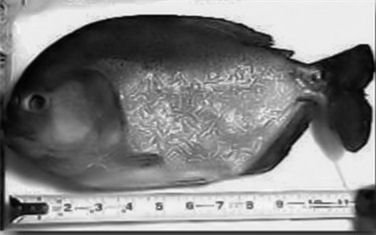
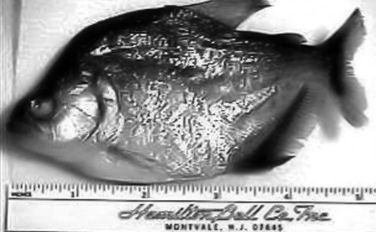
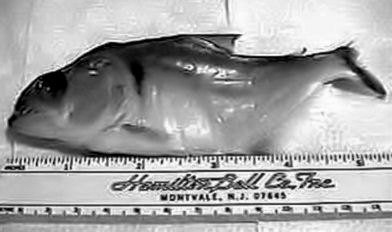
MIDDLE ROW: Pygopristis
denticulata Image #1; I'm clipping the edge of the caudal fin. The
scissors are very sharp. All the instruments are sterilized before I do any
cutting, this insures that no contamination is present. Also, sterile
gloves are worn at all times. I change these for each fish I clip. Image
#2; The cut fin is put into a small container for an ethanol bath. The fin
is rewashed several times. Image #3; I'm placing clipping into left hand to
position it for wiping. Image #4; I'm wiping the clipping with a dry
sterile gauze. This is done several times with a clean gauze to ensure no
contamination is present prior to placing it in the shipment vial.
-
BOTTOM ROW: Image #1;
I'm inserting the clipping to the vial using sterile tweezers. Image #2;
Ethanol is poured into vial then the vial is sealed. An identification
number is assigned and labeled to each vial with the scientific name of the
fish. Image #3; Pygopristis denticulata is positioned for having
its picture taken. Image #4; Final picture before fish is returned to the
aquarium. The fin grows back after a period of time. The fish is kept moist
at all times using an eye dropper, before and during the procedure. The eye
dropper has antibiotic (tetracycline) to help prevent infections. The
fishes cut caudal fin is the last part antibiotic is added just prior to
the fish going back into the aquarium. Stress Guard™ is added to the
aquarium water to help the fish recover from the stress of being handled
outside of the aquarium.
Additional specimens that were not live, but also sent for
DNA analysis (muscle tissue):
|

Pygocentrus piraya
|

Serrasalmus brandtii.
|

Serrasalmus manueli
|
|

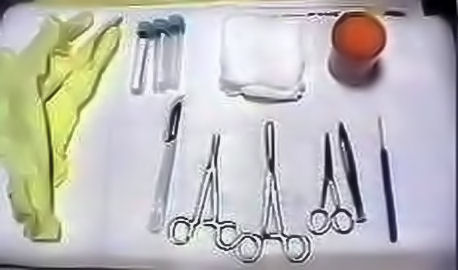
Instrument tray
|
EQUIPMENT:
-
2-sterile scissors
-
2-sterile tweezers
-
sterile gauze pads
-
1-2 inch diameter plastic tub to hold liquid for wash
-
2 pairs of latex gloves
-
scalpel
-
forceps
-
specimen needle
-
2-pre-sterilized vials & sterilized tops
-
1-encapsulated tetracycline, liquefied
-
1-sterile eye dropper (to hold liquid tetracycline)
-
Stress Guard™ formulation
Preliminary Results
(Samples provided for DNA fin clipping from OPEFE for these
results are Catoprion mento, Metynnis sp., Pygocentrus
nattereri, Myleus rubripinnes, and Piaractus brachypomus).
These were obtained from a commercial source, 1993.
Phylogeny of the Serrasalminae (Characiformes) based on
mitochondrial DNA sequences
Previous work (Ortí et al. 1995) based on DNA sequences of
mitochondrial (mt) rRNA genes showed three main groups within the subfamily
Serrasalminae:
(1) a basal clade of herbivores (Colossoma, Mylossoma,
Piaractus);
(2) the "Myleus" clade (Myleus, Mylesinus,
Tometes);
(3) the "piranha" clade (Serrasalmus,
Pygocentrus, Pygopristis, Pristobrycon, Catoprion, Metynnis). The genus Acnodon
was placed as the sister taxon of clade (1+2). However, poor resolution
within each clade was obtained due to low levels of variation among rRNA
sequences. Complete sequences of the hypervariable mtDNA D-loop are now
presented for a total of 40 taxa representing all genera in the subfamily to
address intragroup relationships. Phylogenetic analyses of these sequences
identify the same groupings as before and provide further evidence to
support the following observations:
(a) the genera Serrasalmus and Pristobrycon
are paraphyletic and form a group that also includes Pygocentrus;
(b) Catoprion, Pygopristis, and Pristobrycon striolatus
form a well supported clade, sister to the group described above in 'a';
(c) distinction of subgenera within Myleus (i.e., Myleus,
Prosomyleus, Myloplus) is not supported;
(d) Mylesinus and Myleus are paraphyletic,
since Tometes sp. is the sister taxon of Mylesinus
paraschomburgkii and Mylesinus paucisquamatus is most closely
related to other species of Myleus.

ADVISERS:
-
Dr. Paulo Petry, Bio-Amazonia International, provided the
vials and instructions to collect DNA samples.
-
Ortí, G., P. Petry, J. A. Porto, M. Jegú, and A. Meyer.
1996. Patterns of nucleotide change in mitochondrial ribosomal RNA genes
and the phylogeny of piranhas. Journal of Molecular Evolution 42 (2):
169-182.
CLICK HERE
TO RETURN RESEARCH PAGE
TO RETURN HOME CLICK HERE.
The OPEFE web site and its contents; is disclaimed for
purposes of Zoological Nomenclature in accordance with the International Code
of Zoological Nomenclature, Fourth Edition, Article 8.3 and 8.4. No new names
or nomenclature changes are available from statements at this web site.
Copyright© 1994-2009 Oregon Piranha Exotic Fish Exhibit (The
OPEFE fish exhibit is permanently CLOSED as of 2000) Sutherlin, Oregon.
Information posted on this web site is archival data on fish scientific
classifications and other information. DISCLAIMER: The copyrighted
material may not be used for any purpose other than private study,
scholarship or research. Cited information requires credit and this link
www.opefe.com. All rights reserved. All images shown (unless otherwise
noted) is property of OPEFE.
UPDATED: 07/10/2009
|