 WELCOME TO OPEFE
ARCHIVES
WELCOME TO OPEFE
ARCHIVESSerrasalmus hastatus
Fink and Machado-Allison 2001
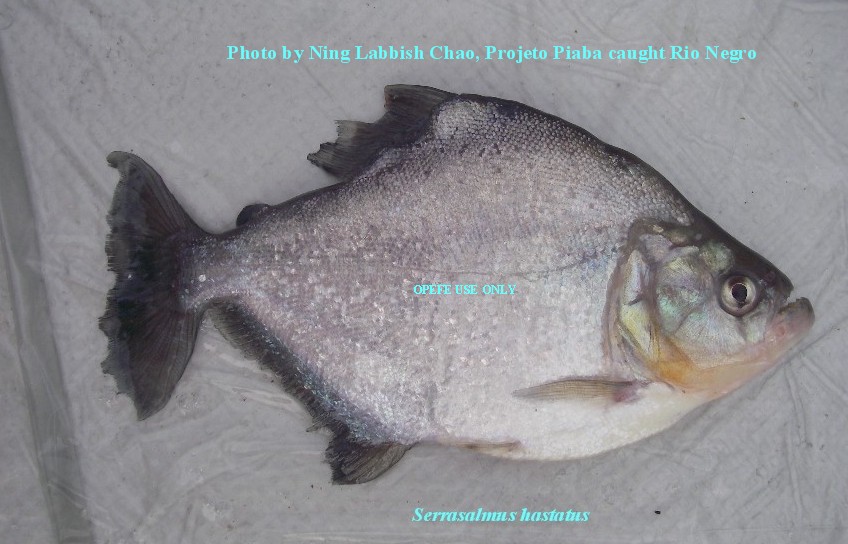
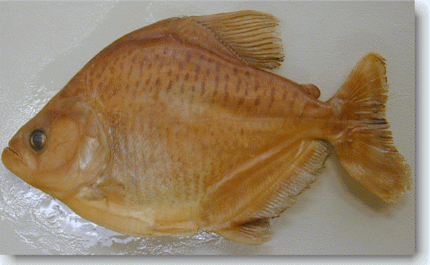
S. hastatus, specimen collected from the Rio Branco & Rio Negro intersection.
ETYMOLOGY: The name is derived from the Latin, hastatus, spear-shaped, referring to the pointed and highly compressed snout. (FINK, MACHADO-ALLISON, 2001)
From Frank Magallanes
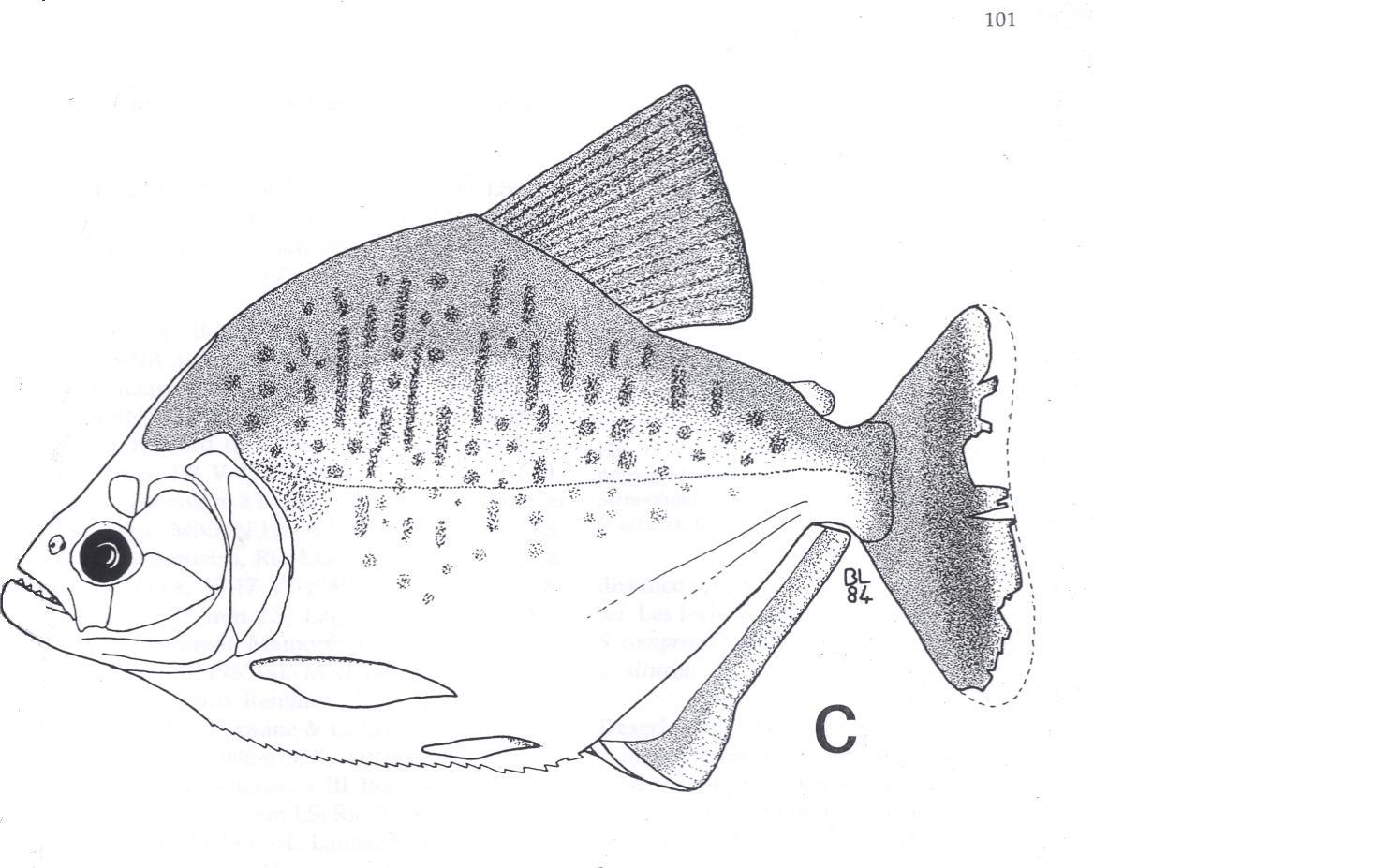
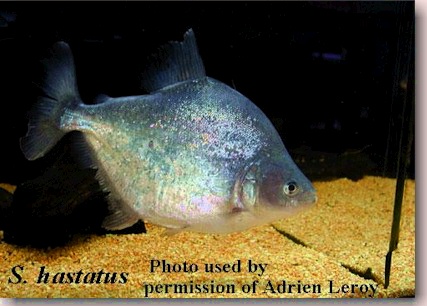
Recommend keeping as solitary species in home aquarium. Presently no information on care in the aquarium. It can be assumed the species behavior is probably the same as S. altuvei and S. compressus. Very likely a fin biter. I will attempt to collect more data as the fish becomes more available. S. hastatus (left) photo courtesy of Dr. William L. Fink. Serrasalmus hastatus is a new species of piranhas from Brazil. It is highly compressed, deep bodied fish and described from the Rio Branco and Rio Negro of Brazil. It also resembles several species of deep bodied, compressed Serrasalmus that have dorsoventrally elongate belly serrae (Fink and Machado-Allison 2001). These species include S. altispinis, S. altuvei, S. compressus, and S. geryi. M. Jegu sent me this paper and drawing of his Serrasalmus compressus, une espece nouvelle (1991). While reading the article, I noticed that the description and the drawing (seen below) didn't seem to match. I contacted Dr. William L. Fink (University of Michigan). He had no seen the paper. I told him, based on what I was seeing of the drawing it appeared odd. Not like Rameriz, 1965 of S. altuvei. FInk said that he thought I might have something there. Long story short, S. altuvei drawing was in error. The species is not found in rio Negro has described by Jegu. Both Fink and Machado-Allison were able to erect a new species S. hastatus from the Jegu misidentification.
|
|
 |
 |
|
The species differs from these species in having a much straighter dorsal head profile and in having thin, vertically elongate spots and stripes (Fink and Machado-Allison, 2001). The other species listed above have much more rounded spots on the body. Also, this species does not have distinct stripe along the head, under the mouth to the top of the dorsal fin, like S. geryi. There is overlap with S. compressus in terms of the distance of the head to the top of the dorsal profile. The jaw and gill area where it is joined, is shorter distance where the pectoral fin inserts which helps distinguish this species from S. compressus and S. altuvei. Large adults of S. altuvei sometimes show fainted spots forming short vertical stripes, but they are shorter and much less numerous than the vertical stripes of S. hastatus.
Color of Life
The entire body is bright silver, with bluish overtones. The eye is bluish silver, with darker grey-blue pigments dorsal and ventral to the pupil. The vertical fins are hyaline, but with pigment.
Measurements (meristic features)
Vertebrae: (37-38) Average; 37.2
Pre-Pelvic Serrae: (19-21) Average; 20.0
Serrae: (7-8) Average 7.6
Branched Anal Fin Rays: (31-34) Average; 32.8
Branched Dorsal Fin Rays: (15-17) Average; 16.0
DISTRIBUTION
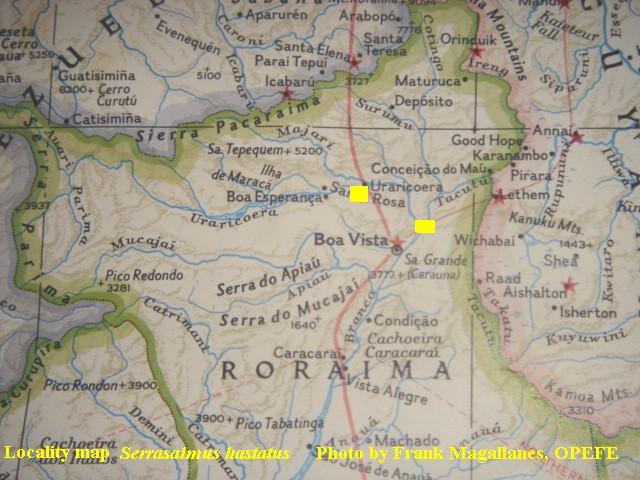
Described from the lower Rio Negro drainage, Both the Marara beach and Maguari flooded forest, from the mouth of the Rio Branco, Rio Uraricoera, Rio Solimoes near Manaus. Distribution; Rio Negro, basin. Brazil.
Contributors and Advisors
Fink, William L.
REFERENCES
Fink, W. L. and A. Machado-Allison 2001 (16 Mar.) Serrasalmus hastatus, a new species of piranha from Brazil, with comments on Serrasalmus altuvei and Serrasalmus compressus (Teleostei: Characiformes). Occas. Pap. Mus. Zool. Univ. Mich. No. 730: 1-18.
Reis, R. E. , S. O. Kullander, and C. J. Ferraris, Jr. 2003 Check list of the freshwater fishes of South and Central America. CLOFFSCA. Check list of the freshwater fishes of South and Central America. CLOFFSCA. 2003: i-xi + 1-729.
Machado-Allison, Antonio., Fink, William., 1996 Los Peces Caribes de Venezuela, Diagnosis, Claves, Aspectos Ecologicos Y Evolutivos.
Hubert, N. and J.-F. Renno 2010 Description of a new Serrasalmus species, Serrasalmus odyssei n. sp. [pp. 52-59]. In: Evolution of the neotropical ichthyofauna -- molecular and evolutionary perspectives about the origin of the fish communities in the Amazon. VDM Publishing House, Verlag Dr. Müller, Saarbücken, Germany. Evolution of the Neotropical Ichthyofauna.: 95 pp.
Jegu M., E. M. Leao and dos Santos, G. M. 1991, Serrasalmus compressus, une espece nouvelle du Rio Maderira, Amazonie (Pisces, Serrasalmidae), p 101, Ichthological Explorers, Freshwater, Vol. 2, No 2., pp. 97-108, July 1991.
USE YOUR BACKSPACE TO RETURN OR CLICK HERE TO RETURN SERRASALMUS LIST
USE THIS LINK TO RETURN TO RESEARCH PAGE.
The OPEFE web site and its contents; is disclaimed for purposes of Zoological Nomenclature in accordance with the International Code of Zoological Nomenclature, Fourth Edition, Article 8.3 and 8.4. No new names or nomenclature changes are available from statements at this web site
Copyrightİ 1994-2012 Oregon Piranha Exotic Fish Exhibit (The OPEFE fish exhibit is permanently CLOSED as of 2000) Sutherlin, Oregon. Information posted on this web site is archival data on fish scientific classifications and other information. DISCLAIMER: The copyrighted material may not be used for any purpose other than private study, scholarship or research. Cited information requires credit and this link www.opefe.com. All rights reserved. All images shown (unless otherwise noted) is property of OPEFE.
UPDATED: 12/10/2015