 WELCOME TO OPEFE ARCHIVES
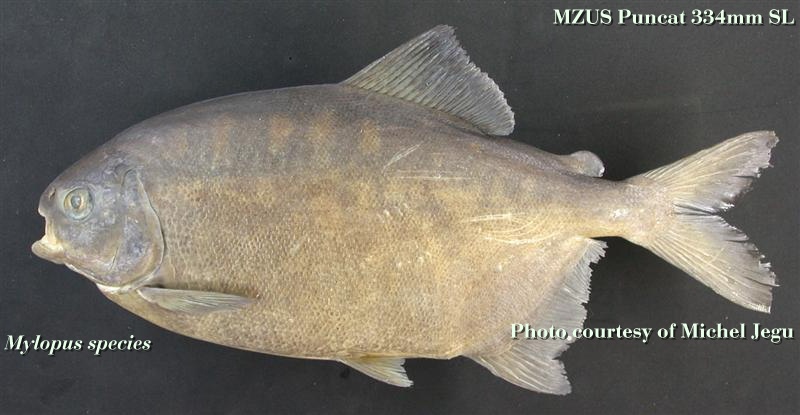
Genus Myloplus
Abstract - Revalidation of Myloplus asterias (Müller & Troschel, 1844), type-species of Myloplus Gill, 1896 and validation of the genus Myloplus Gill. (Characidae: Serrasalminae).
The examination of the ichthyologic collections of Berlin and London Museum makes it possible to locate the type series and to indicate the lectotypes of Myletes asterias Müller & Troschel, 1844, and Myletes rubripinnis Müller & Troschel, 1844, two species described from Guiana and placed in synonymy by the authors. Myletes asterias is type-species of Myloplus Gill, 1896, which is a declared sub-genus of Myleus Müller & Troschel, 1844. The examination of the types and of complementary material from Guyanas and Amazon Basin shows that Myletes asterias differs from M. rubripinnis by several characters of the neurocrane anatomy related to the reduced size of the frontal. Myletes asterias also differs from M. rubripinnis by some meristic and morphometric characters, and by the presence of a broad vertical black band on the eyes. Myletes ellipticus Günther, 1864, type-species of Orthomyleus Eigenmann, 1903, and Myloplus schulzei Ahl, 1938, are synonyms of M. asterias and Myletes luna Valenciennes, 1850, is synonym of M. rubripinnis.
Myloplus shares with Myleus, Tometes Valenciennes, 1850, Mylesinus Valenciennes 1850 and Ossubtus Jégu, 1992 the following characters: presence of a second anal lobulae in the males located at the level of the branched rays 15-19, presence of transformed anal and dorsal rays in males, wide opening orbitary fossae, and narrow dilatatory fossae. Myloplus shares several symplesiomorphies with the stem-group of Serrasalminae: tubular premaxillary, thin and pointed mesethmoïd in dorsal view, deep mesethmoïd in lateral view, broad and deep supraethmoïdal fossae, reduced olfactive fossae, and no hook at the tip of modified rays of the second anal lobe in males. In Myloplus and Myleus, only two or three premaxillary teeth are interlocked, and the other are laterally placed side by side. In Mylesinus, Tometes and Ossubtus all the teeth of upper and lower jaws are interlocked. Myleus, Tometes, Mylesinus and Ossubtus present a series of unique characters for Serrasalminae but not shared by Myloplus: premaxillary laminar and the two premaxillary series of teeth placed side by side, a posterior transverse process on the lingual face of premaxillary lateral process, premaxillary lateral process limited posteriorly to the last tooth; broad mesethmoid in dorsal view, thin to very thin mesethmoid in lateral view, reduced and shallow supraethmoidal fossae, olfactive fossae largely opened, and a double hook at the tip of the second anal lobe rays.
These elements support the paraphyly hypothesis of Myleus sensu Géry 1972 suggested by Ortí et al. (1996). Myloplus Gill is validated as a different genus from Myleus. Myletes asterias and M. rubripinnis are placed in Myloplus.
|
Myloplus asterias Müller & Troschel 1844
Amazon River basin, northern and eastern Guiana Shield rivers: Argentina, Brazil and Guyana |
Myloplus planquettei Jégu, Keith & Le Bail 2003
Mana and Maroni basins, French Guiana and Suriname, and Essequibo basin, Guiana |
Myloplus rubripinnis Müller & Troschel 1844
Guyana |
Abstract - Phylogeny of the Serrasalminae (Characiformes) based on mitochondrial DNA sequences
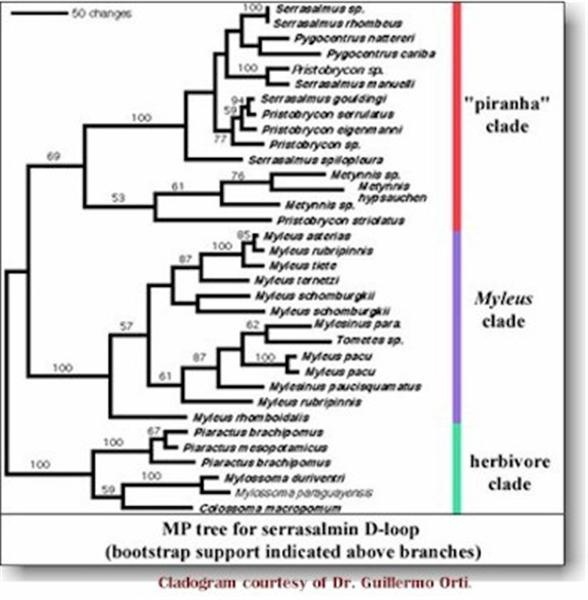
Previous work (Ortí et al. 1995) based on DNA sequences of mitochondrial (mt) rRNA genes showed three main groups within the subfamily Serrasalminae:
(1) a basal clade of herbivores (Colossoma, Mylossoma, Piaractus);
(2) the "Myleus" clade (Myleus, Mylesinus, Tometes);
(3) the "piranha" clade (Serrasalmus, Pygocentrus, Pygopristis, Pristobrycon, Catoprion, Metynnis). The genus Acnodon was placed as the sister taxon of clade (1+2). However, poor resolution within each clade was obtained due to low levels of variation among rRNA sequences
|
|
Complete sequences of the hypervariable mtDNA D-loop are now presented for a total of 40 taxa representing all genera in the subfamily to address intragroup relationships. Phylogenetic analyses of these sequences identify the same groupings as before and provide further evidence to support the following observations:
(a) the genera Serrasalmus and Pristobrycon are paraphyletic and form a group that also includes Pygocentrus;
(b) Catoprion, Pygopristis, and Pristobrycon striolatus form a well supported clade, sister to the group described above in 'a';
(c) distinction of subgenera within Myleus (i.e., Myleus, Prosomyleus, Myloplus) is not supported;
(d) Mylesinus and Myleus are paraphyletic, since Tometes sp. is the sister taxon of Mylesinus paraschomburgkii and Mylesinus paucisquamatus is most closely related to other species of Myleus.
REFERENCES
THATCHER, V.E., SEY, O. & M. JÉGU, 1996.- New Amphistome (Trematoda) genera and species from Serrasalmid fishes, Myleus (Myloplus). Acta Zool. Acad. Scientia. Hung. 42(4): 261-270.
JÉGU, M., 2001 Description complémentaire du type de Myloplus schulzei Ahl, 1938 (Characiformes: Characidae: Serrasalminae) et statut de l'espèce. Cybium, 25(4):
JÉGU, M. & G.M. dos SANTOS, 2002. Révision du statut de Myleus setiger Müller & Troschel, 1844 et de Myleus knerii (Steindachner, 1881) (Teleostei: Characidae: Serrasalminae) avec une description complémentaire des deux espèces. Cybium. 26(1): 33-57.
Géry, J., 1977. Characoids of the world.. T.F.H. Publications, Inc., N.J. pg: 672 (262-263), p: 665
Froese, R. and D. Pauly. Editors. 2002. FishBase.World Wide Web electronic publication. www.fishbase.org 13 November 2002
USE YOUR BACKSPACE TO RETURN OR CLICK HERE TO RETURN VALID SPECIES PHYTOPHAGOUS PAGE
USE THIS LINK TO RETURN TO RESEARCH PAGE
TO RETURN HOME CLICK HERE
The OPEFE web site and its contents; is disclaimed for purposes of Zoological Nomenclature in accordance with the International Code of Zoological Nomenclature, Fourth Edition, Article 8.3 and 8.4. No new names or nomenclature changes are available from statements at this web site.
Copyright© 1994-2012 Oregon Piranha Exotic Fish Exhibit (The OPEFE fish exhibit is permanently CLOSED as of 2000) Sutherlin, Oregon. Information posted on this web site is archival data on fish scientific classifications and other information. DISCLAIMER: The copyrighted material may not be used for any purpose other than private study, scholarship or research. Cited information requires credit and this link www.opefe.com. All rights reserved. All images shown (unless otherwise noted) is property of OPEFE.
UPDATED: 12/28/2011