 WELCOME TO OPEFE ARCHIVES
GENUS Mylossoma
Eigenmann & Kennedy 1903
Etymology: Greek, mylo = mill + Greek, soma = body
INTRODUCTION
Mylossoma are found mainly in the floodplains of the whitewater tributaries and they only move into the channel during dry season or spawning movements. They do not occur in the rio Negro (with the exception of the Manaus area), and they occur all the way up the Solimões into Peru (Iquitos). The distribution is similar to the endemic species Colossoma and Piaractus in the Pantanal.
The genus Mylossoma have a deep, compressed body, almost as disciform as the Metynnis species, chiefly when young. During growth, the depth of the body becomes comparatively less than its length, as was mentioned by L.P. Schultz concerning Venezuelan species. This growth phenomenon is called negative allometry. Mylossoma is easily distinguished from Colossoma by its shape, as mentioned, as well as by its long anal fin, almost entirely covered with minute scales.
|
|
VALID SPECIES LIST 2011
|
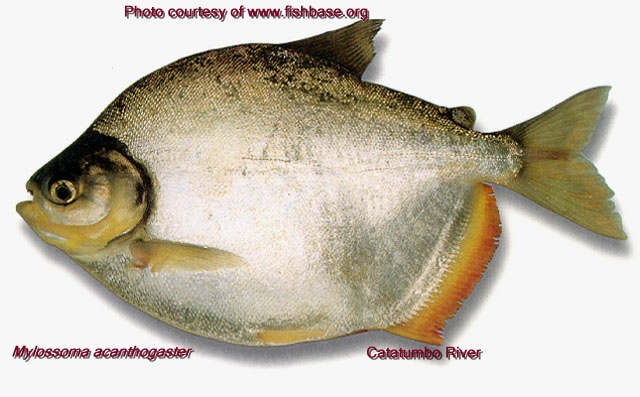
Mylossoma acanthogaster Valenciennes 1850
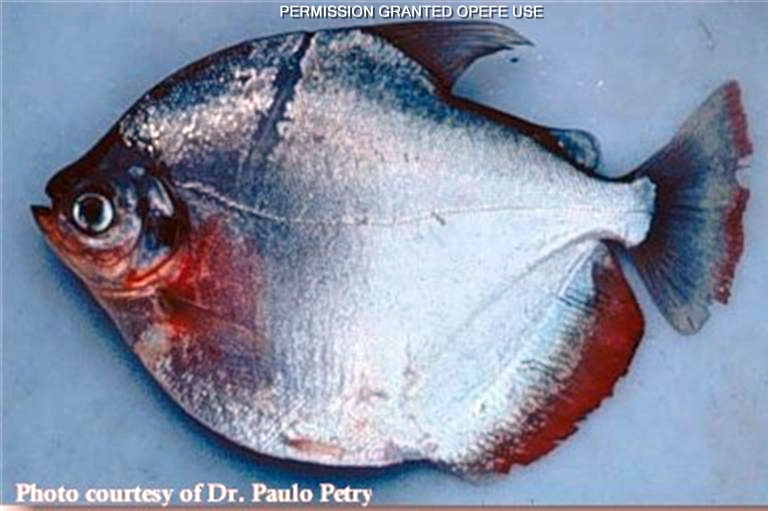
From Lake Maracaibo in Venezuela, is best identified by its short anal fin, sides are silvery, its eye and anal fin red. Current thought today implies that M. acanthogaster is valid (Machado-Allison). The species is considered rare. Fish grows to 28.5 SL based on a captured unsexed specimen. |
Mylossoma aureum Spix & Agassiz, 1829
Maximum growth of Mylossoma aureum is 20.0 cm TL based on an unsexed specimen. The climate for this fish is tropical 22 - 28°C and is found Amazonas Basin, Orinoco basin. Of minor commercial value. |
Mylossoma duriventre Cuvier, 1818
Mylossoma paraguayensis (Norman, 1929), was synonymized as M. duriventre by Antonio Machado-Allison. It in fact looks more like duriventris than aureum, it has the same ocellum on the side of the body and transversal dark bar along the body similar to juvenile M. duriventre. The distribution of M. duriventre is; Amazon, Orinoco and Paraguay-Paraná River basins: Argentina, Bolovia, Brazil, Colombia, Ecuador, Paraguay, Peru and Venezuelan.
Grows to 25.0 cm SL and maximum weight: 1,000 g. Important commercial and aquarium trade value. M. duriventre, originates over mud and silt in streams and lakes. Feeds on fish, insects, and plants. |
ADVISORY
Dr. Paulo Petry, Bio-Amazonia
REFERENCES
Ortega, H. and R.P. Vari, 1986. Annotated checklist of the freshwater fishes of Peru.. Smithson. Contrib. Zool. (437):1-25.
Galvis, G., J. I. Mojica and M. Camargo, 1997. Peces del Catatumbo.. Asociación Cravo Norte, Santafé de Bogotá, D.C., p. 188
Froese, R. and D. Pauly. Editors. 2002. FishBase. World Wide Web electronic publication. www.fishbase.org, 13 November 2002
USE YOUR BACKSPACE TO RETURN OR CLICK HERE TO RETURN VALID SPECIES PHYTOPHAGOUS PAGE
USE THIS LINK TO RETURN TO RESEARCH PAGE
TO RETURN HOME CLICK HERE
The OPEFE web site and its contents; is disclaimed for purposes of Zoological Nomenclature in accordance with the International Code of Zoological Nomenclature, Fourth Edition, Article 8.3 and 8.4. No new names or nomenclature changes are available from statements at this web site.
Copyright© 1994-2012 Oregon Piranha Exotic Fish Exhibit (The OPEFE fish exhibit is permanently CLOSED as of 2000) Sutherlin, Oregon. Information posted on this web site is archival data on fish scientific classifications and other information. DISCLAIMER: The copyrighted material may not be used for any purpose other than private study, scholarship or research. Cited information requires credit and this link www.opefe.com. All rights reserved. All images shown (unless otherwise noted) is property of OPEFE.
UPDATED: 12/28/2011