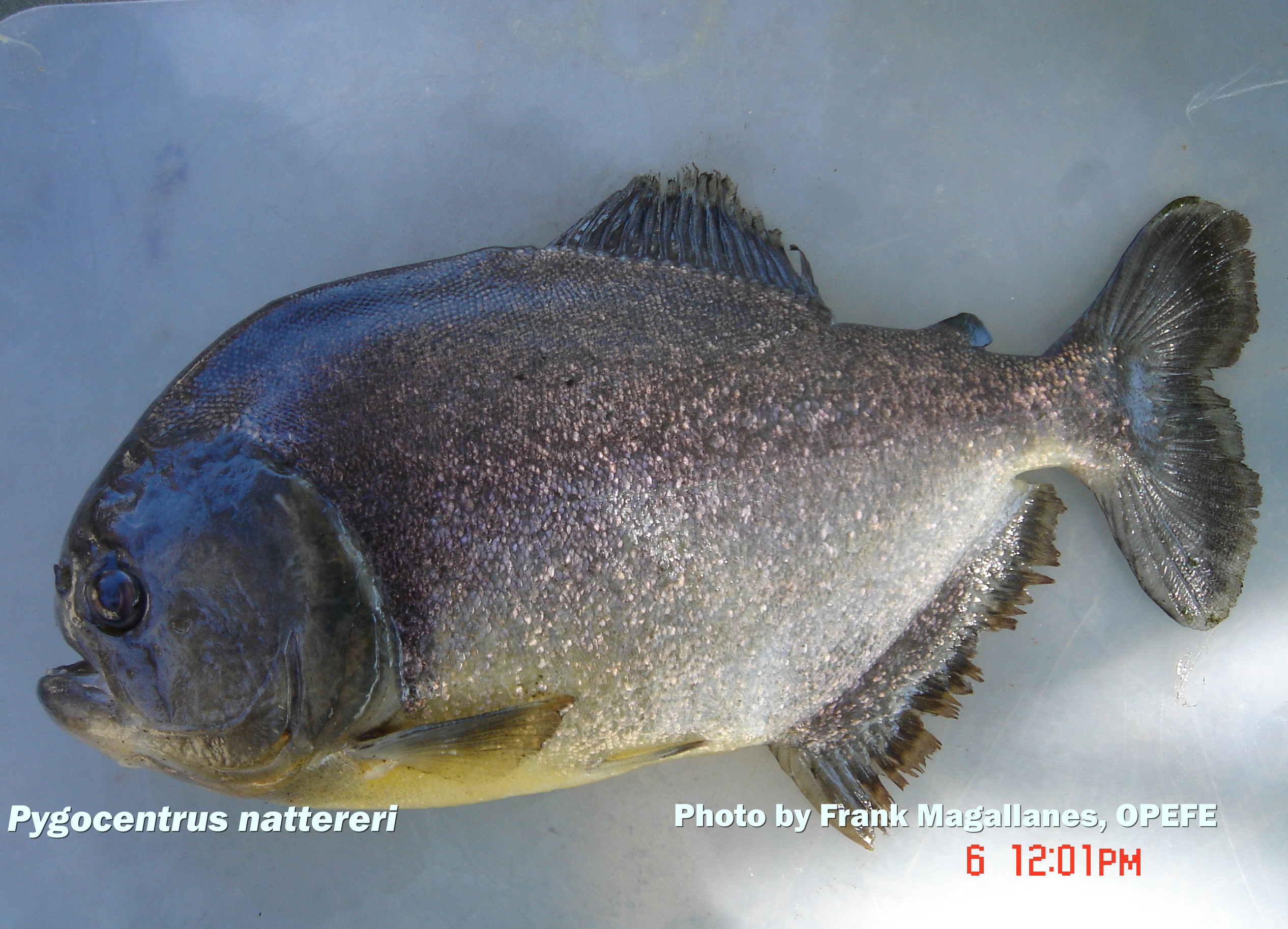
COLOR OF LIFE BY POPULATION
PLEASE READ FIRST
FROM FRANK MAGALLANES
The following information is taken from Fink - Revision of Pygocentrus, 1993 (see REFERENCES) and largely taken out of context in order to illustrate the variety of coloration and body pattern placement of Pygocentrus nattereri in its natural range. I have also taken care to make sure the order is in its proper placement as Fink described them. One should refer to the citation for accurate documentation and description. In some cases, I have placed my own opinion on some specimens of piranhas based on verbal communication with field experts on collections; particularly those from Bolivia and Argentina. Those fish from that locality have not been reviewed. Presently the Fink revision is the basis for the majority of this work on this page. Messr. Michel Jégu and Paulo Petry have been useful to me in presenting these fish in the proper order and locality issues.
Aquarium raised specimens will usually lose their brilliant color over time. The skeletal of aquarium raised fishes also exhibit numerous differences from wild caught (i.e. serrae counts usually more than recorded wild caught examples, body shape distorted, including head shape). It is my personal opinion wild caught fishes are a much better preferences than tank raised if one were to judge by color alone. The so-called aggressive behavior which is almost always highly exaggerated by hobbyists they keep in the home aquarium shows little to no difference from wild caught and is an individual trait.
Below are single examples of live fish captured from the certain regions. Some variance in body shape, spotting or coloration should be expected. None of the species shown here should be considered an exact replica of fish found in those regions (except as noted). The photos are solely a representation to help the hobbyist to see the variety of colors and body patterns of P. nattereri. The photos that are individually field numbered by science or locality area marked should be considered authentic on where it was captured. Other photos are aquarium raised fish and is only a representation of what it might look like from that region. Use caution when looking at the photo in comparison to the description.
|
ARGENTINA
Erroneously called Serrasalmus ternetzi by dealers and hobbists. |
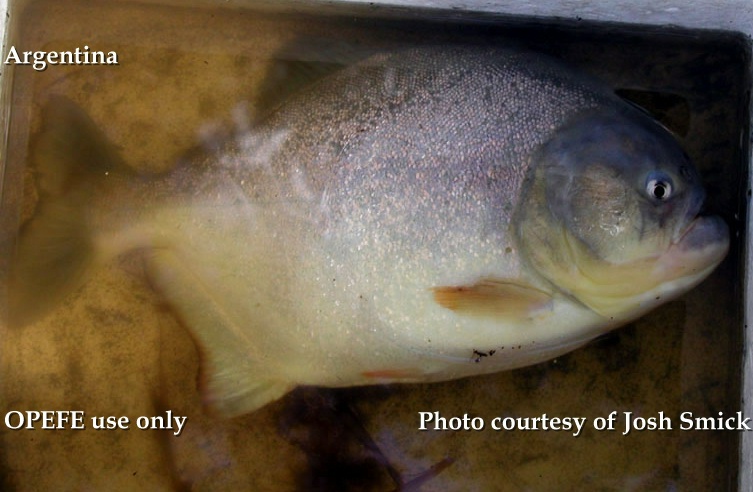
Since the availability of these fish became apparent in hobbyists aquarium's circa 1990's, hobbyists have called these fish ternetzi. However, the Argentina species was not named for Carl Ternetz in that region, but in Paraguay from the Rio Paraguay (Steindachner 1908) and was based on a damaged anal fin (See; PARAGUAY (Itenez/rio Guapore Paraguay). The Argentina fish are quite beautiful with their gleaming chrome yellow fins with a faint black margin on the tips and yellow belly. They also possess clear eyes, which is a plastic feature on most of these fishes known as true piranhas. Majority of this species of piranha grow somewhat larger, usually 2-5 mm larger. Much of this is more than likely due to diet, geography and lack of commercial over-fishing.
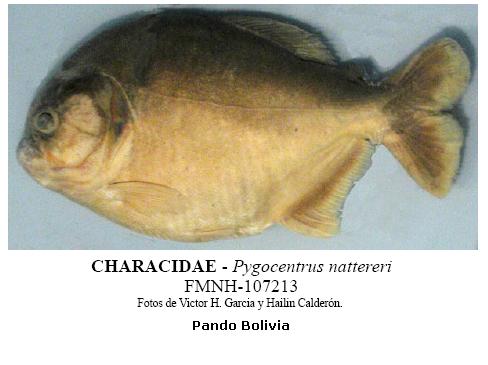
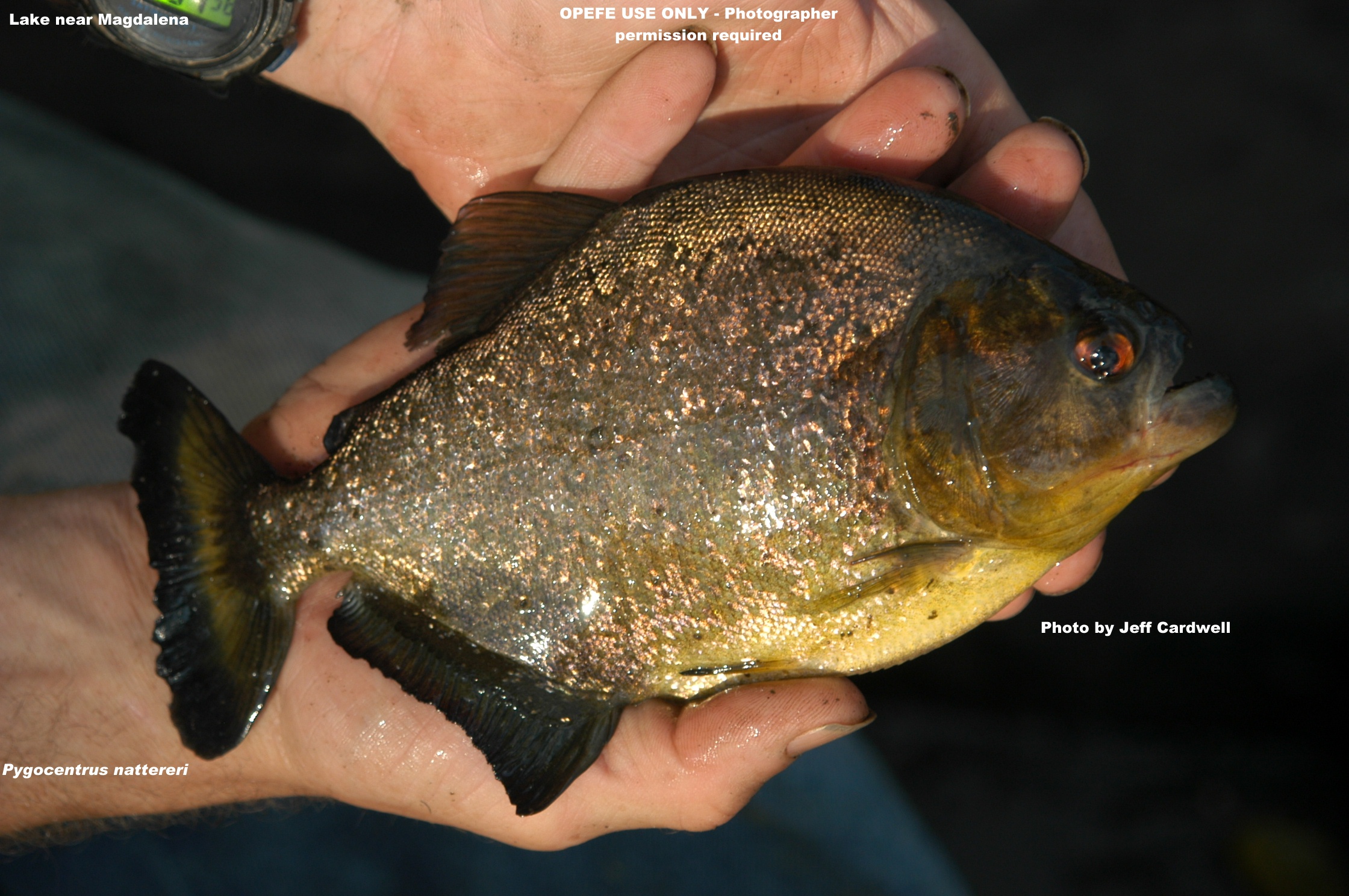
Recent 2005 discovery, presently, no information available on its description. Appears to be similar appearing to those from the Mato Grosso. Messr. Michel Jégu has made the following live color photos of Pygocentrus nattereri from Bolivia available for OPEFE readers. Image credit are on the photo itself.
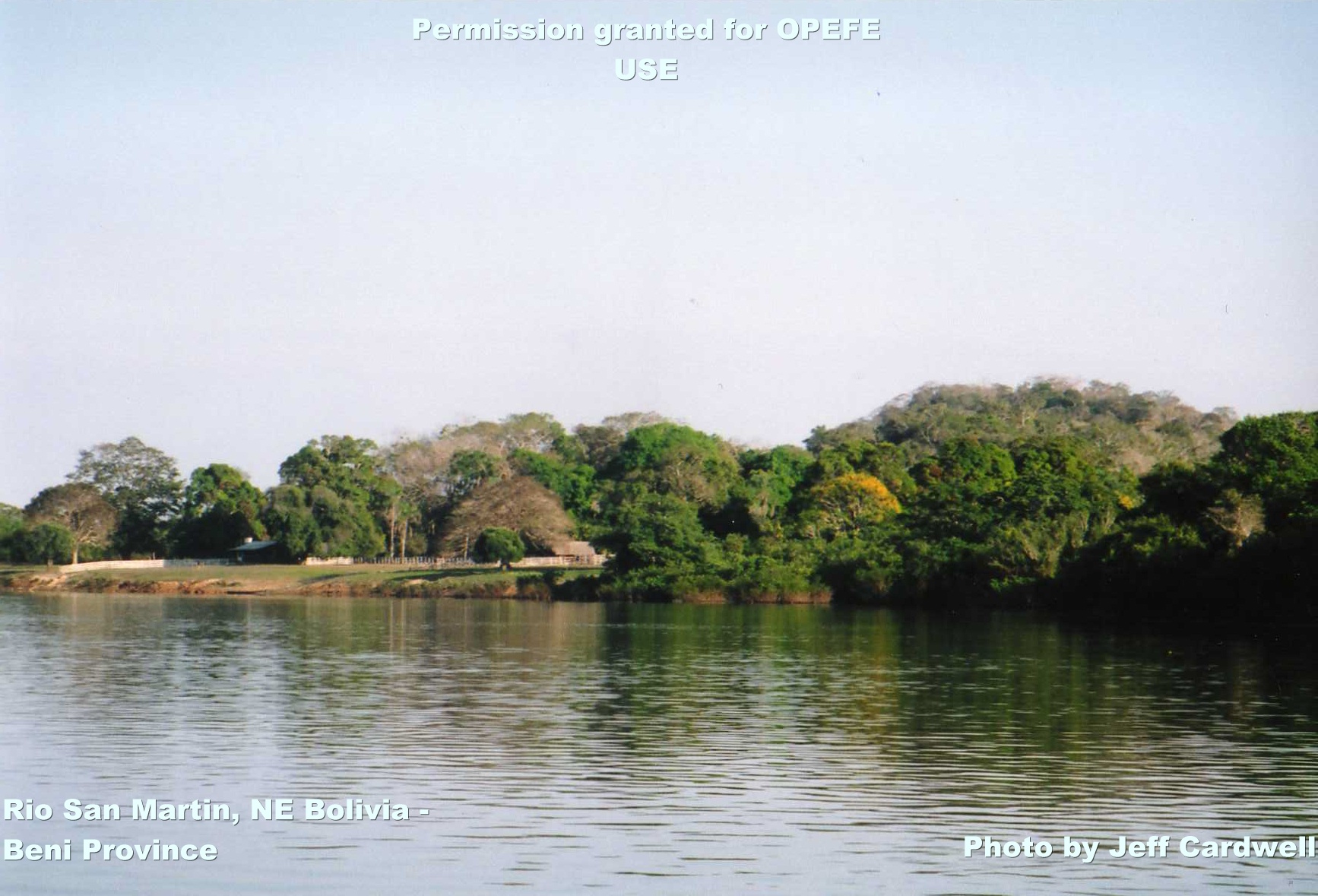
BOLIVIA - Rio Branco, Pando, Rio San Martin (photo) and Tucanare
|
|
|
|
Itenez, Rio Branco, Bolivia
|
Tucanare, Bolivia
|
Beni Province, Bolivia
|
Tucanare, Bolivia
|
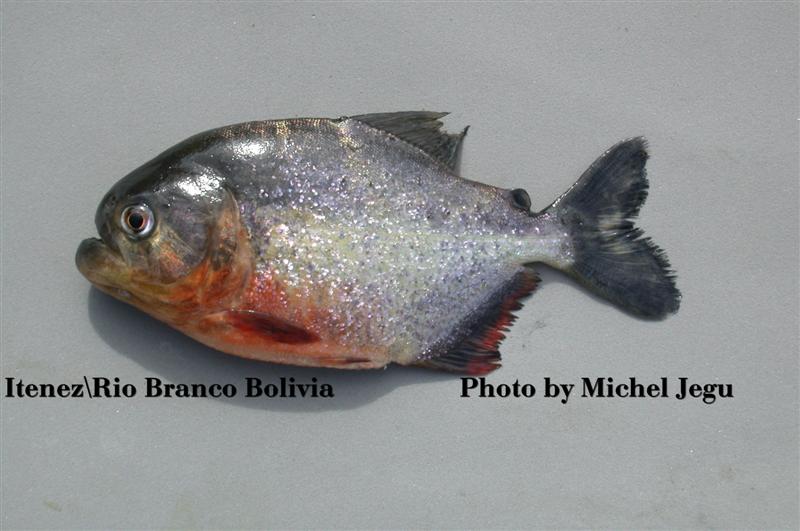
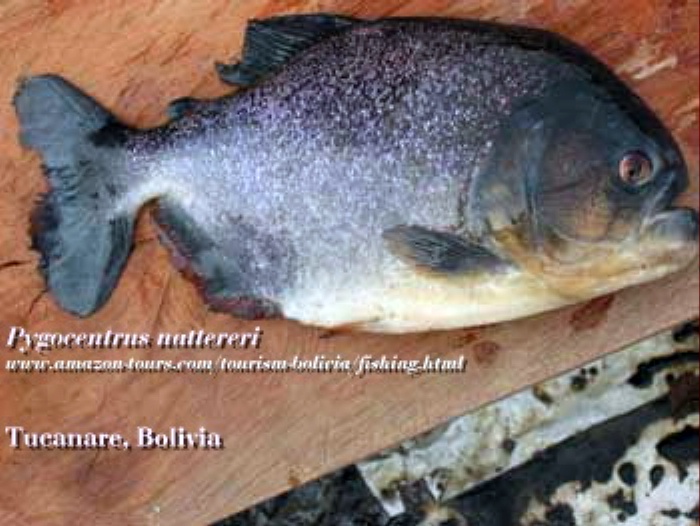
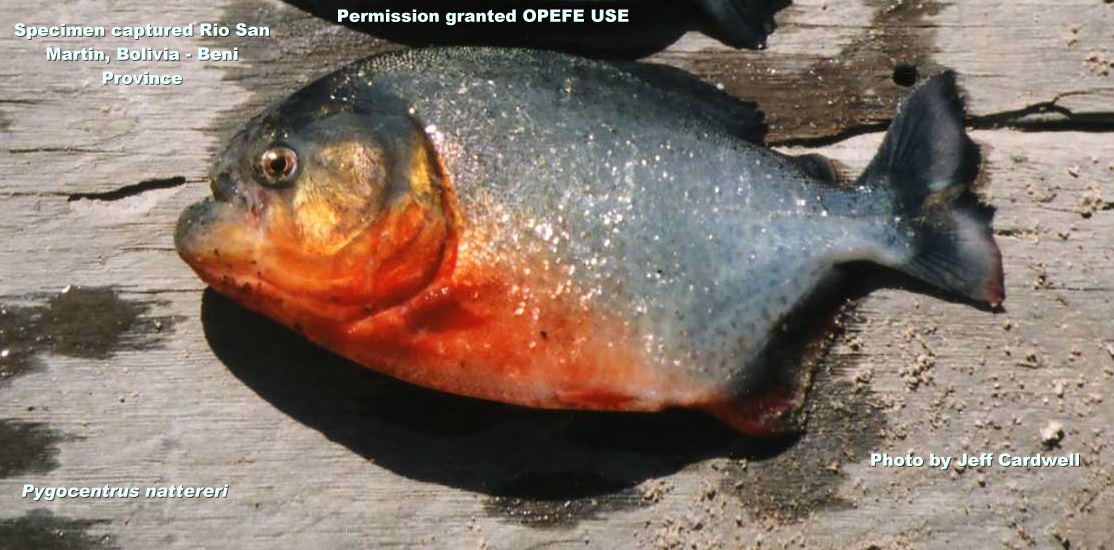
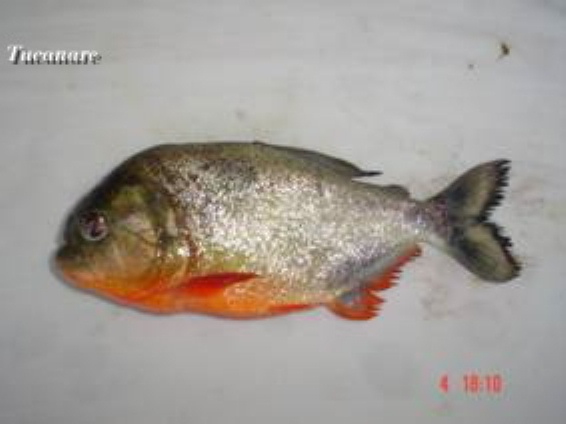
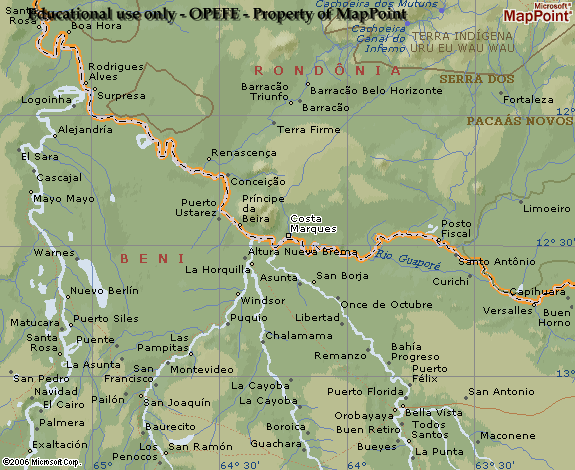
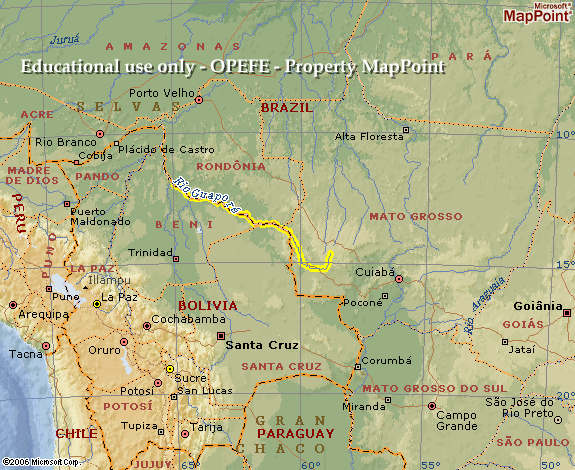
Guapore River (Itenez) - river flowing through northeastern Bolivia and west central Brazil. The river rises in the Serra (mountains) dos Parecis in Mato Grosso state, Brazil, and loops southward, westward, and then north-northwestward past Mato Grosso city. After receiving the Rio Verde, it continues northwestward, forming the border between Bolivia and Brazil and emptying into the Mamore River.
|
COLUMBIA Caquetá River
According to Nick Gardner these were being exported from this region as P. nattereri. Nick passed away before I could get a sample to confirm the species ID and exact collection point. Seasonal movements of less than 100 km by these fish have been reported for this region, but these are probably not strictly for reproduction. (Diaz-Sarmiento et al.) |
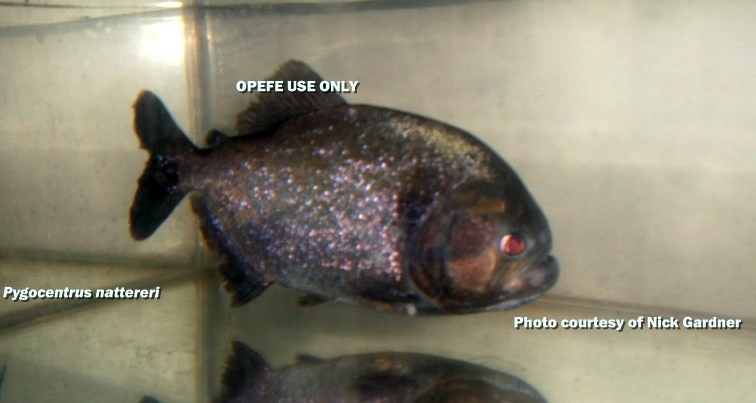
Rio Caquetá rises in the Andes Mountains near the southern Columbian city of Mocoa. It runs for some 600 miles southwest to the Brazilian border, where it becomes the Japurá river.
CENTRAL AMAZON BASIN - (Amazonas) (Locality: same as middle Amazon)
|
|
|
|
|
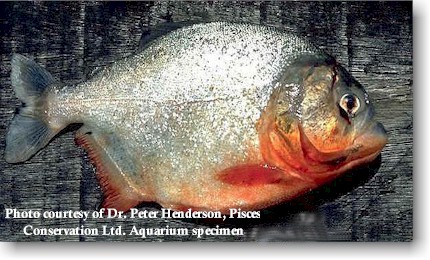
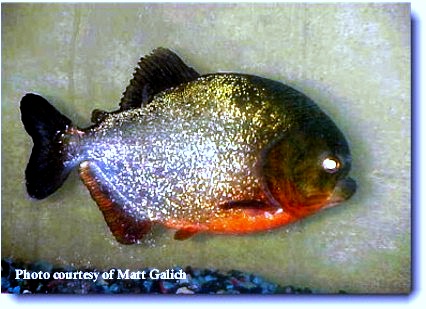
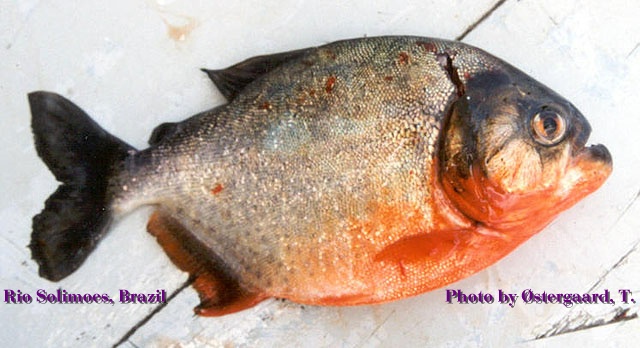
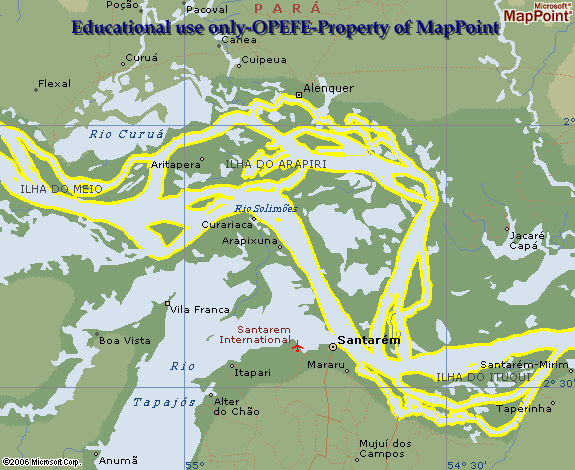
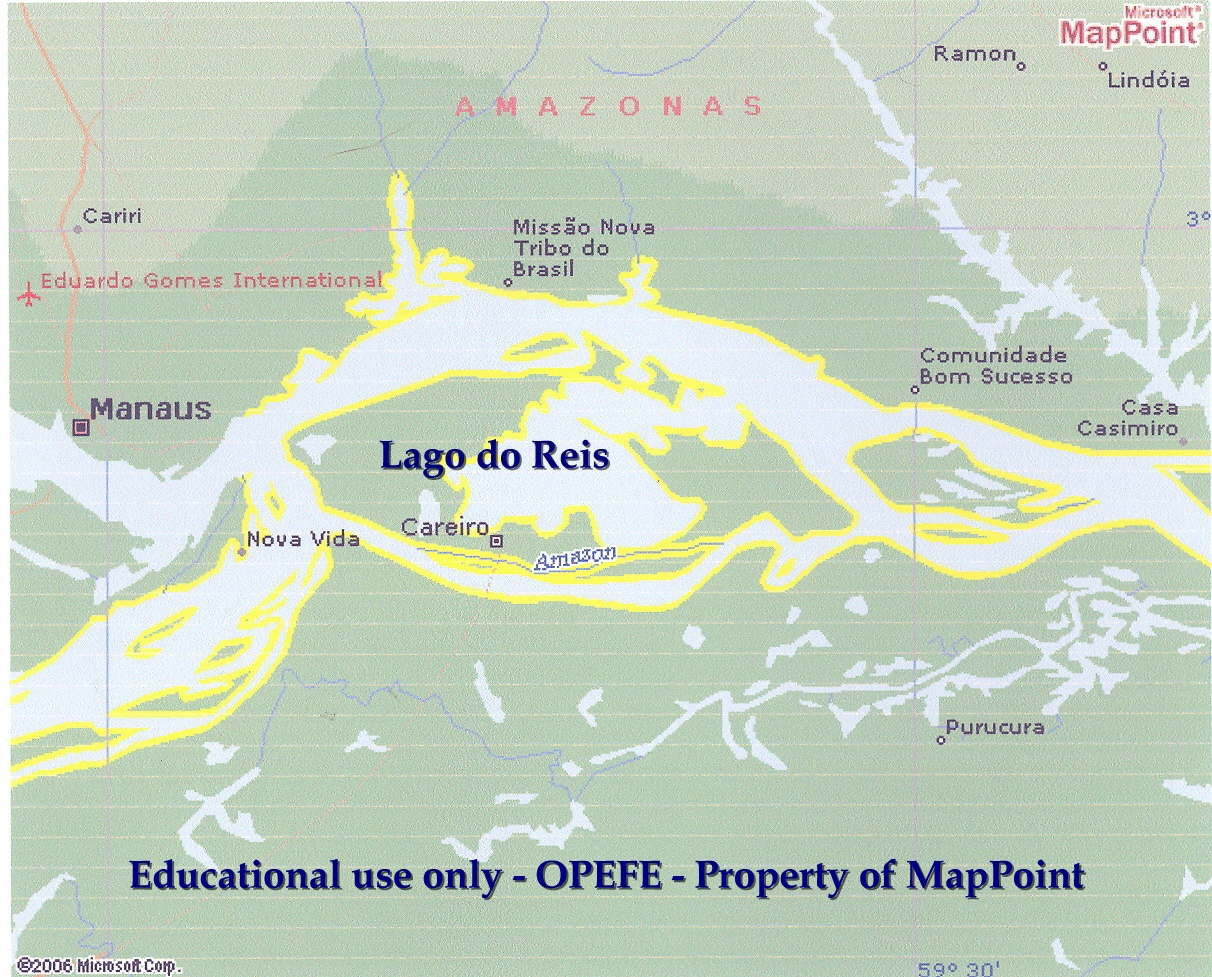
Occasional examples are called red spotted alenquer by hobbyists. The name Alenquer derives from town off Rio Solimoes (see map above - right). To view seed and nut eating habits VIEW
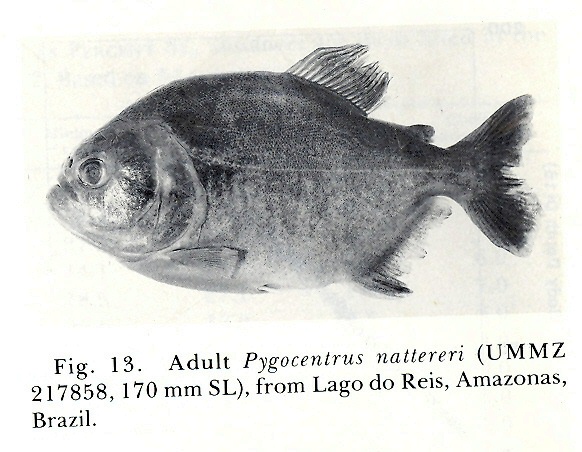
In specimens from the central Amazon area (fig. 13 above), the color pattern is much like those from the upper middle Amazon area, with a relatively broad band at the anal-fin base, and a concentration of melanophores distally on the anal fin. The caudal fin is less developed, but the anterior parts of the caudal lobes remain darkly pigmented; there is a posterior dark caudal band. The pectoral fin has melanophores only on the anterior margin of the first fin ray. The adipose is black-margined.
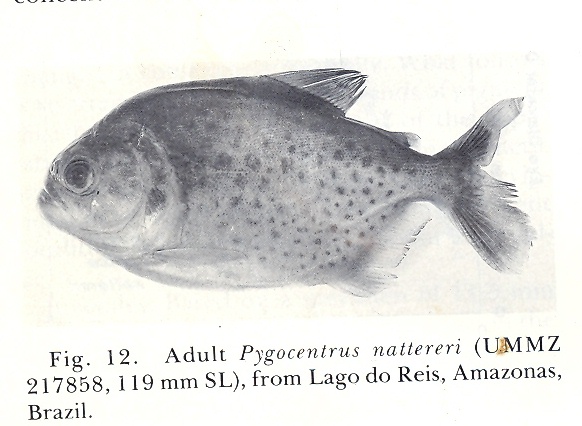
Specimens in the size range of 109-159mm SL have numerous tiny melanophores on the body, with concentrations under each scale (but not giving the reticulate pattern as described for middle Amazon fish). Spotting on the sides in specimens of this size range is in general much less distinct than on smaller specimens. The caudal spot is absent, but there is a black bar extending from the caudal-fin base onto the dorsal and ventral fin lobes. Most of the caudal fin is pigments, including the posterior border, but there is a small area proximal to the border which is relatively lighter. The dorsal fin is deeply pigmented, both on the fin rays and interradial membrane. The anal fin has a dark band along its base, in the scaled area, and a dark distal border; melanophores are scattered in both interradial membrane and the fin rays. The pelvic fin is unpigmented, with a few scattered melanophores on more posterior areas of the fin. In the largest specimens, body spotting is restricted to the area between the lateral line and the anal-fin base.
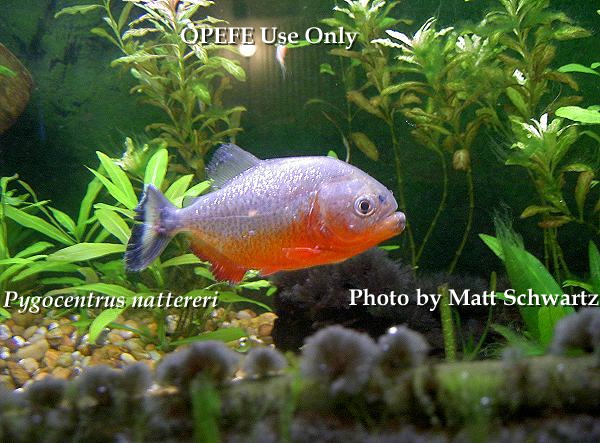
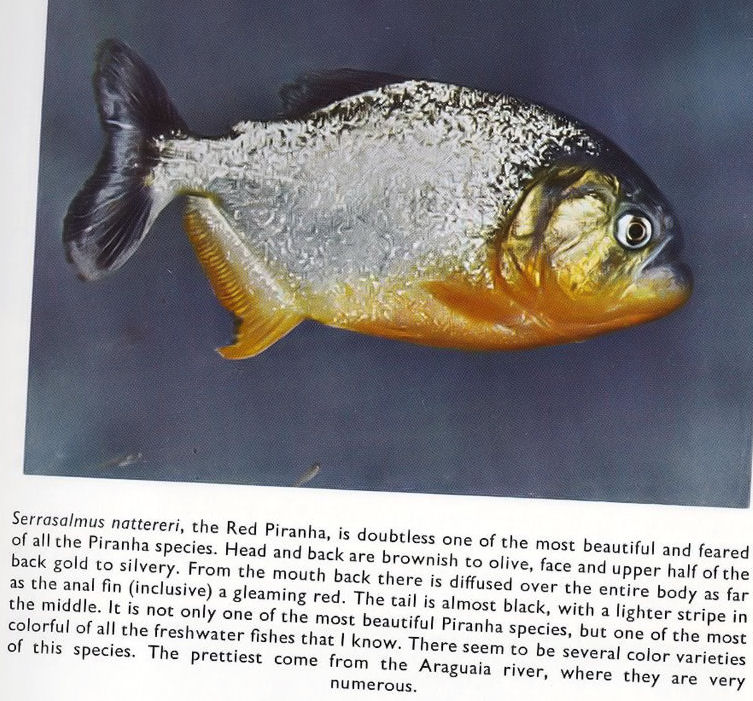
Color of Life; based on photographs of large juvenile and adult specimens from the Central Amazon (Lago do Reis, UMMZ 217858), the dorsal and lateral portions of the body from just behind the head to the caudal-fin base are silvery grey, with red or orange pigment suffused over the area, increasing in intensity in the belly region between the isthmus and anal fin. Head orange to red, more intense anteroventrally; most of the head is dorsally dark grey, suffused with orange or red, especially posteriorly and ventrally. Eye silvery, with reddish pigment anterior and posterior to the pupil, and with a dark vertical stripe. The lower jaw is anteriorly dark grey and posteriorly is the same red or orange as the abdomen. The pectoral and pelvic fins are red-orange; the dorsal fin is dark gray-black; the adipose fin is black proximally and hyaline distally; the caudal fin is blackish gray, with a pale subterminal or posterior border (some individuals from this and other localities have a relatively hyaline area lying midway between the dark fin base and the dark terminal band). The anal fin is black proximally in the area of the fin covered with small scales and with some black pigment scattered on the distal fin margin; otherwise the fin is red-orange.
|
Preserved example of a large black Pygocentrus nattereri. These are not seen very often in the aquarium trade. |
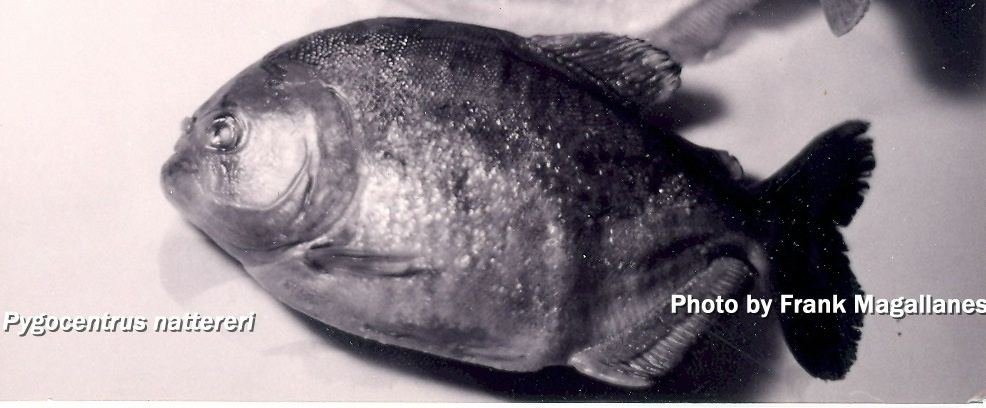
The extent and color of the belly pigmentation is variable ontogenetically, individually, geographically, and according to water conditions in which the fish live. For example, younger post juveniles tend to be brighter and have more coverage of red than larger adults; in many large specimens from throughout the range of this species, the red or orange color is pale and limited in area to the ventral belly. In large specimens, the body of the fish may be almost entirely black, with bright burnished-gold "spangles" over much of the lateral body. Specimens captured in clear, darker waters are often darkly pigmented, with reduced red or orange, at all ages. There are numerous photographs of living specimens in the aquarium literature, and the species is commonly held in public aquaria.
|
UPPER MIDDLE AMAZON OF PERU - (Locality: same as central Amazon)
Holotype of P. altus, Courtesy of W. L. Fink, UMMZ |
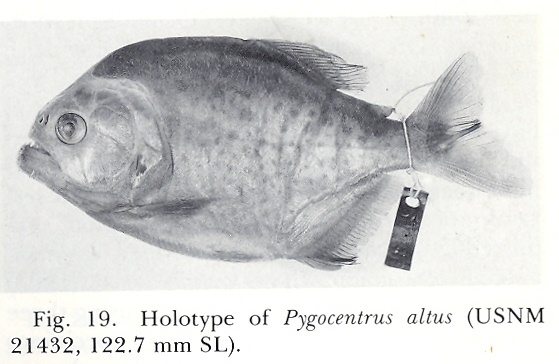
Serrasalmus altus was described in a paper on fishes of the upper Amazon (the bottle label states "Rio Marañon or Napo"), but Gill did little to justify its description, stating only that it was "Nearly related to P. scapularis (Serrasalmo scapularis...)." Fink found no attributes unique to populations of Pygocentrus from the upper Amazon, including specimens known to be from the Rio Napo and, thus, saw no basis for a species name for them, relative to the other Amazonian populations.
Some specimens from the upper middle Amazon of Peru are generally similar to those of the specimens of the middle Amazon (Lago Janauacá in the middle Amazon) described below. There are more melanophores over the entire body, including small peppery one's, even extending ventrally to the level of the pectoral fin over the abdominal area. The fins are relatively more dusky. In some specimens, there is a reticulated pattern on the body side, a fairly dense black band of pigment at the anal-fin base, and the caudal spot is quite large, extending onto the caudal-fin base and the anterior of the caudal-fin lobes. There is a fairly dense scattering of melanophores on the dorsal fin.
MIDDLE AMAZON - Lago dos Reis on the island of Careiro near the confluence of the Rio Negro and the Amazon River), Amazonas, Brazil (Locality: same as central Amazon).
|
|
|
|
|

 A subset of specimens (UMMZ
217858; 92-209mm SL) from a single population in the middle Amazon region
showed negative and positive allometry. Color in Preservative; There is a
great deal of color pattern variation, both within members of a population, and
between geographical localities. In addition, there are some significant changes
in color ontogenetically. Because of the dearth of ontogenetic series at any
particular location, these descriptions must refer to specimens from different
localities, entailing some doubt about their value. Juveniles based on a
specimen of 11.5 mm SL (MZUSP 19772, from Lago Janauacá in the middle Amazon),
ground color is creamy brown; small melanophores are scattered over the lateral
body, with the exception of the abdominal region from the lateral midline to the
ventrum. Specimens that are about 22 mm SL, one can see concentrations of
melanophores along the borders of the caudal fin and anal fin (in those
specimens or populations where there are such borders). In most cases, as the
fishes get larger, the concentrations of small melanophores increase, giving the
fish a distinct dusky hue, with the exception of the abdominal area, which
remains lightly pigmented. Larger specimens also have greater concentrations of
melanophores in the interradial membranes of the fins. Color pattern from
larger specimens 20-29mm SL (MZUSP 20065, also from the middle Amazon) is very
similar to that of the smaller specimens just described.
A subset of specimens (UMMZ
217858; 92-209mm SL) from a single population in the middle Amazon region
showed negative and positive allometry. Color in Preservative; There is a
great deal of color pattern variation, both within members of a population, and
between geographical localities. In addition, there are some significant changes
in color ontogenetically. Because of the dearth of ontogenetic series at any
particular location, these descriptions must refer to specimens from different
localities, entailing some doubt about their value. Juveniles based on a
specimen of 11.5 mm SL (MZUSP 19772, from Lago Janauacá in the middle Amazon),
ground color is creamy brown; small melanophores are scattered over the lateral
body, with the exception of the abdominal region from the lateral midline to the
ventrum. Specimens that are about 22 mm SL, one can see concentrations of
melanophores along the borders of the caudal fin and anal fin (in those
specimens or populations where there are such borders). In most cases, as the
fishes get larger, the concentrations of small melanophores increase, giving the
fish a distinct dusky hue, with the exception of the abdominal area, which
remains lightly pigmented. Larger specimens also have greater concentrations of
melanophores in the interradial membranes of the fins. Color pattern from
larger specimens 20-29mm SL (MZUSP 20065, also from the middle Amazon) is very
similar to that of the smaller specimens just described.
Fins are relatively more dusky. Some of the specimens have a reticulated pattern on the body side, a fairly dense black band of pigment on the anal-fin base, and the caudal spot is quite large, extending onto the caudal-fin base and the anterior of the caudal-fin lobes. There is a fairly dense scattering of melanophores on the dorsal fin, giving it a banded appearance. The pattern seems to diminish with age and the reticulated spots also fall back on intensity with age.
The specimens collected from the Lago do Reis (Fig 12,13 above), exhibit the dorsal and lateral portions of the body from just behind the head to the caudal-fin base are silvery grey, with red or orange pigment suffused over the area, increasing in intensity in the belly region between the isthmus and anal fin. Head orange to red, more intense anteroventrally ; most of the head is dorsally dark grey, suffused with orange and red, especially posteriorly and ventrally. Eye silvery, with reddish pigment anterior and posterior to the pupil, and with a dark vertical stripe. The lower jaw is anteriorly dark grey and posteriorly is the same red or orange as the abdomen. The pectoral and pelvic fins are red-orange; the dorsal fin is dark gray-black; the adipose fin is black proximally and hyaline distally; the caudal fin is blackish gray, with a pale subterminal or posterior border (some individual from this and other localities have a relatively hyaline area lying midway between the dark fin base and the dark terminal band). The anal fin is black proximally in the area of the fin covered with small scales and with some black pigment scattered on the distal fin margin, otherwise the fin is red-orange.
MATO GROSSO AND MATO GROSSO DO SUL
|
Rio Araguaia G. S. Myers, The Piranha Book (1972) pg.73
|
Rio Araguaia, Goias
|
Miranda River Mato Grosso do Sul
|
Cuiaba River, Pantanal
|
|
Itenez, Costa Marquez
|
Itenez, Costa Marquez
|
Syntype - Cuiaba?
|
Syntype - Cuiaba?
|
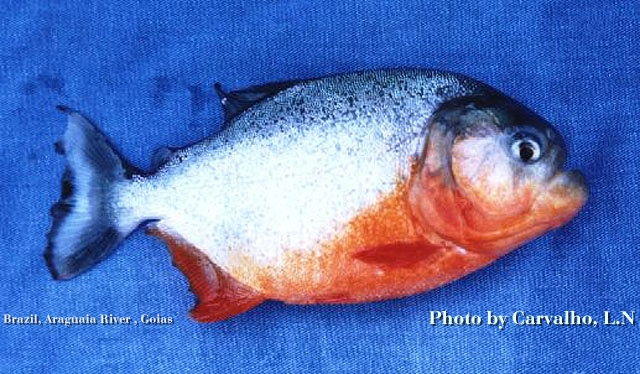
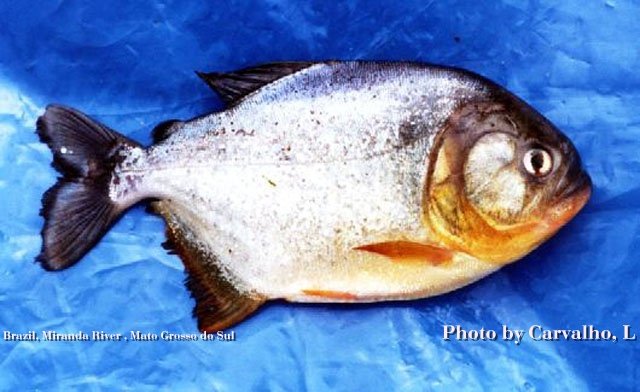
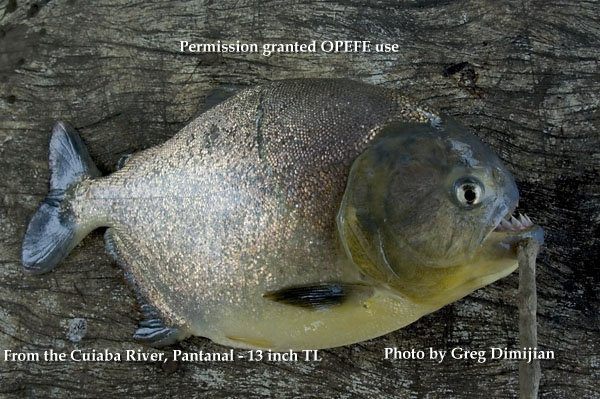
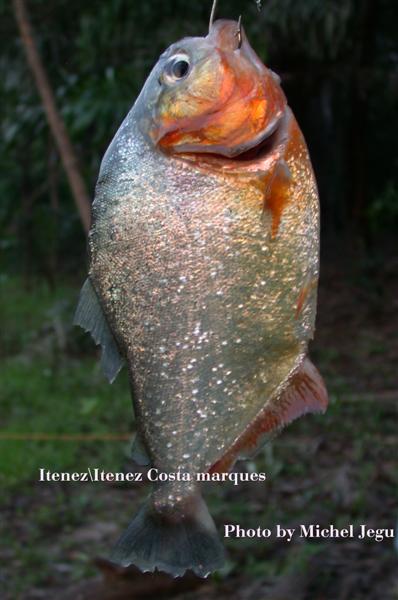
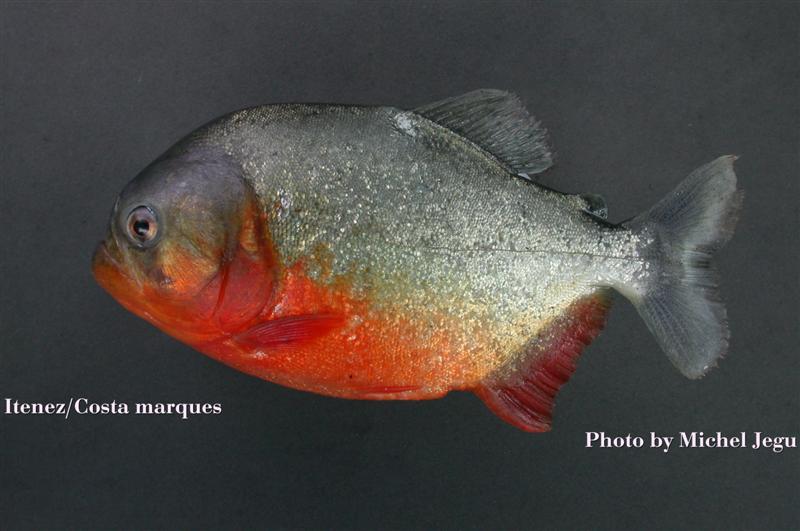
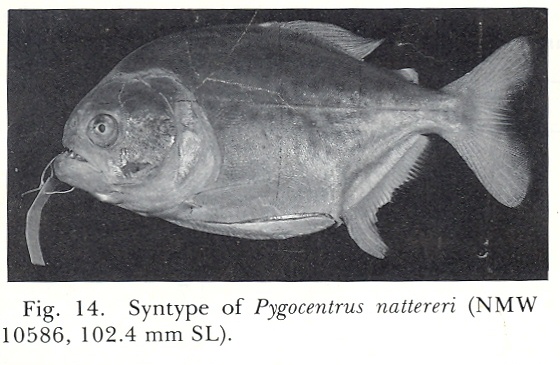
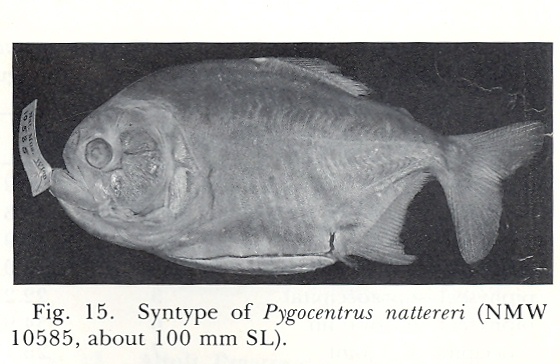
 Pygocentrus nattereri was described
from specimens collected in Mato Grosso region where the Rio Amazonas and the
Rio Paraguay are barely separated geographically. There was few if any variation
found in this population from the others in the basins. None of the characters
used could consistently place specimens in relation to their geography. Southern
populations clearly range within the variation of the Amazonian and coastal
populations, although southern specimens available do not encompass the
total size range of Amazonian specimens. It is not possible from data
accompanying the types to determine the place of origin for any particular
specimen. Syntypes are shown above in figures 14 and 15. Extensive analysis of
nearly 100 specimens from the Amazon, Paraguay, and associated
basins found no differences that exceeded the extensive individual/population
variations within the basins. Fink found no shape, color pattern, or meristic
differences among them that could be used to consistently to place specimens in
relation to their geography.
Pygocentrus nattereri was described
from specimens collected in Mato Grosso region where the Rio Amazonas and the
Rio Paraguay are barely separated geographically. There was few if any variation
found in this population from the others in the basins. None of the characters
used could consistently place specimens in relation to their geography. Southern
populations clearly range within the variation of the Amazonian and coastal
populations, although southern specimens available do not encompass the
total size range of Amazonian specimens. It is not possible from data
accompanying the types to determine the place of origin for any particular
specimen. Syntypes are shown above in figures 14 and 15. Extensive analysis of
nearly 100 specimens from the Amazon, Paraguay, and associated
basins found no differences that exceeded the extensive individual/population
variations within the basins. Fink found no shape, color pattern, or meristic
differences among them that could be used to consistently to place specimens in
relation to their geography.
 Rio Araguaia - Because of the vast
number of tributaries, it is not easy to unambiguously define its source.
Important tributaries originate in the Araras mountain range in Mato Grosso as
well in the Divisões mountain range situated in Goiás (according to other
sources however, the Araguaía comes from the Caiapó Range, at the Goiás-Mato
Grosso border). From there it flows northeast to a junction with the Tocantins
near the town of São João. Along its course, the river forms the border
between the Brazilian federal states of Goiás, Mato Grosso, Tocantins and Pará.
Roughly in the middle of its course, the Araguaia splits into two forks (with
the western one retaining the name Araguaia and the eastern one being called Rio
Javaés). These later reunite, forming the Ilha do Bananal, the world's
largest river island.
Rio Araguaia - Because of the vast
number of tributaries, it is not easy to unambiguously define its source.
Important tributaries originate in the Araras mountain range in Mato Grosso as
well in the Divisões mountain range situated in Goiás (according to other
sources however, the Araguaía comes from the Caiapó Range, at the Goiás-Mato
Grosso border). From there it flows northeast to a junction with the Tocantins
near the town of São João. Along its course, the river forms the border
between the Brazilian federal states of Goiás, Mato Grosso, Tocantins and Pará.
Roughly in the middle of its course, the Araguaia splits into two forks (with
the western one retaining the name Araguaia and the eastern one being called Rio
Javaés). These later reunite, forming the Ilha do Bananal, the world's
largest river island.
|
|
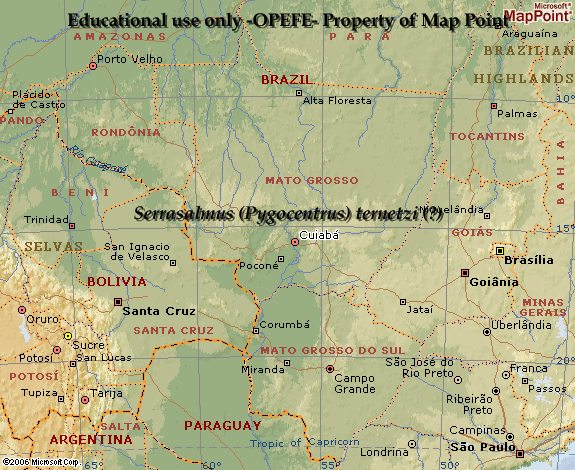
Mato Grosso do Sul - inland estado ("state") of Brazil, situated in the Grande Regiao Centro-Oeste (Grand Central-West Region). It is bounded on the north by the state of Mato Grosso, on the northeast by the state of Goias, on the east by Minas Gerais and Sao Paulo, on the southeast by Parana, and on the west and south by Bolivia and Paraguay. A portion of the Pantanal is found here, it is located in central South America and covers areas in Brazil, Bolivia, and Paraguay.
Cuiaba River - river, central Mato Grosso state, Brazil, rising northeast of Rosario Oeste, between the basins of the Amazon and Paraguay rivers, and flowing for 300 miles (480 km) south-southwest to join the Sao Lourenco River. These two rivers' combined courses, sometimes called the Cuiaba, continue across the Paraguay floodplain in a braided fashion to enter the Paraguay River, north of Corumba.
Mato Grosso - inland estado ("state") of Brazil, situated in the Grande Regiao Centro-Oeste (Grand Central-West Region). It is bounded on the northwest by the states of Rondonia and Amazonas, on the northeast by Para, on the east by Tocantins and Goias, on the south by Mato Grosso do Sul, and on the southwest and west by Bolivia. A portion of the Pantanal is found here as well.
|
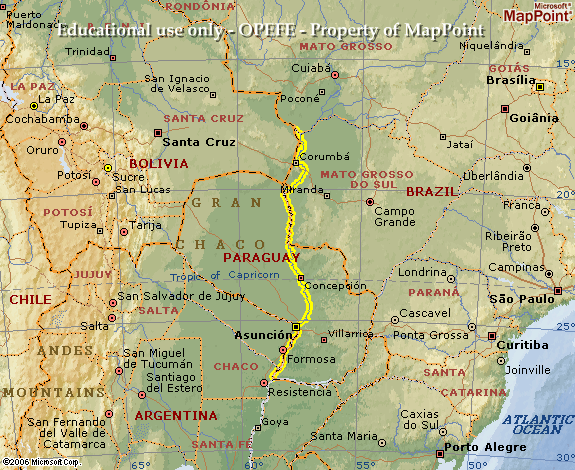
PARAGUAY - (Itenez/rio Guapore Paraguay) |
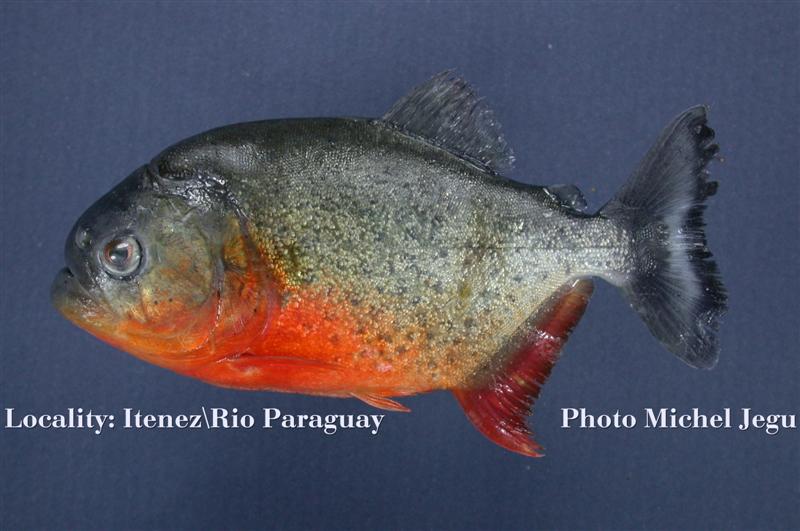
 Pygocentrus ternetzi, was
described by Steindachner (1908) from a single specimen found in the Rio
Paraquay and was compared with P. piraya. Steindachner clearly wanted to
differentiate the southern populations of Pygocentrus which were not
P. piraya (restricted to the Rio São Francisco). However Steindachner
did not compare nor mention P. nattereri in this comparison. The
unique type specimen of S. ternetzi, now lost, apparently had a damaged
anal fin, because it was supposed to have but 12 rays and have its origin on a
vertical midway between the dorsal and adipose fins; neither attributes have
been found in any other specimens of serrasalmin, and Eigenmann's supposition,
supported by Norman, that the specimen was damaged, was reasonable. In his key,
Norman differentiated S. ternetzi from P. nattereri using three
specimens (220-250 mm SL) and 40 specimens (75-270 mm SL), respectively based on
the the anterior profile (strongly arched vs moderately arched) and a few other
features. With the exception of two specimens from "Rio Plata," the
specimens Norman called S. nattereri were from the Amazon or Guyana. In
testing slopes and intercepts of regressions of these features against SL, no
significant differences between southern and Amazonian populations in these
features (as measured herein) were detected.
Pygocentrus ternetzi, was
described by Steindachner (1908) from a single specimen found in the Rio
Paraquay and was compared with P. piraya. Steindachner clearly wanted to
differentiate the southern populations of Pygocentrus which were not
P. piraya (restricted to the Rio São Francisco). However Steindachner
did not compare nor mention P. nattereri in this comparison. The
unique type specimen of S. ternetzi, now lost, apparently had a damaged
anal fin, because it was supposed to have but 12 rays and have its origin on a
vertical midway between the dorsal and adipose fins; neither attributes have
been found in any other specimens of serrasalmin, and Eigenmann's supposition,
supported by Norman, that the specimen was damaged, was reasonable. In his key,
Norman differentiated S. ternetzi from P. nattereri using three
specimens (220-250 mm SL) and 40 specimens (75-270 mm SL), respectively based on
the the anterior profile (strongly arched vs moderately arched) and a few other
features. With the exception of two specimens from "Rio Plata," the
specimens Norman called S. nattereri were from the Amazon or Guyana. In
testing slopes and intercepts of regressions of these features against SL, no
significant differences between southern and Amazonian populations in these
features (as measured herein) were detected.
Géry et al. (1987) listed several characteristics that they took to indicate that southern and Amazonian populations represent different species, suggesting that the southern species retain the name P. nattereri and placing S. ternetzi as a junior synonym of the former. Paraguay specimens were thought to be different from Amazonian specimens in several features, including red pigment absent from the belly (based on their examination of about 100 specimens from Paraguay), greater convexity of the head, shorter and larger snout, distance between the nares larger eye diameter, and "probably" with a larger number of serrae and more scales (13 specimens were used for counts and measurements). Fink (1993) investigated photographs taken in Paraguay and Brazil. These photographs confirm that individuals in these populations do have reduced pigmentation on the belly, relative to most Amazonian fishes; however the amount of pigment, usually orange or yellow-orange, falls within the variation found in Amazon area populations. Also, Fink was unable to confirm any of the suppositions pertaining to body shape and meristics. He wrote that those authors probably did not take into account individual and population differences with their small analyzed samples. The convexity of the head shape of these southern populations is difficult to quantify. Fink found no difference in head shapes from the southern populations and Amazonian populations. Visual comparisons also did not confirm differences in head convexity. Snout length did appear to be short in large individuals from the southern populations, but it was not significantly different from the Amazonian population.
Fink, in order to determine if there were any potential discriminators, measured snout length using a sub-sample of both populations of over 60 specimens of equal size and he found no statistical differences in slopes or intercepts of regression of snout length on SL. Distance between the nares being less than or larger than the eye, used by Géry et al. (1987). Géry used a comparison that conflates head width and eye size, one showing positive allometry and one negative allometry (interorbital width). Fink found no differences between southern and Amazonian populations in interorbital width or eye size in the specimens Fink used (determined by slopes and intercepts of each measured in a linear regression on SL). The prepelvic counts were also compared and the numbers garnered from that do not support a hypothesis for independent evolution in those groups. Géry suggested that the name S. altus (Gill 1871) be applied to Amazonian species while S. ternetzi (Steindachner 1908) be used for Paraguayan populations to differentiate them. The problem is, both these names are younger than P. nattereri. Both S. altus and S. ternetzi remain available for upper Amazon and Paraguay populations, respectively should they be found diagnosable (see next paragraph).
Fink and Zelditch (1997) reviewed the description and all available citations pertaining to S. ternetzi. They could not find reliable characters to distinguish between the two, and consider S. ternetzi as a nonlinear cline (varying body shape) of P. nattereri.
Paraguay River - the fifth largest river in South America and the principal tributary of the Parana River (q.v.). Rising in the Mato Grosso region of Brazil at 980 feet (300 m) above sea level, it crosses Paraguay to its confluence with the Parana near the Argentine border.
Parana River - river of South America, the second longest after the Amazon, rising on the plateau of southeast-central Brazil and flowing generally south to the point where, after a course of 3,032 miles (4,880 km), it joins the Uruguay River to form the extensive Rio de la Plata estuary of the Atlantic Ocean.
THERE IS QUITE A BIT OF SIZE VARIATION FROM PLACE TO PLACE AS REPORTED BELOW
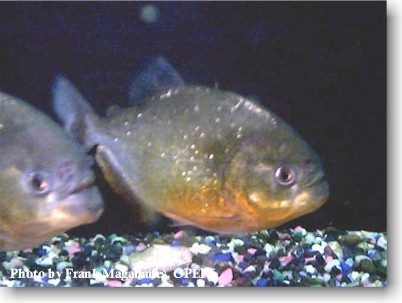 It is
extremely variable in pigmentation and spotting. Pigmentation even within
populations can range from yellow through orange to red, with coverage ranging
from only a small area in the belly to most of the belly and head. Dark spots
can be found on rather large specimens in some populations, but are lacking in
others (Fink, 1993). Tank Bred (Note the variance of jaw size, probably a
middle Amazon fish). Photo by Frank Magallanes, OPEFE.
It is
extremely variable in pigmentation and spotting. Pigmentation even within
populations can range from yellow through orange to red, with coverage ranging
from only a small area in the belly to most of the belly and head. Dark spots
can be found on rather large specimens in some populations, but are lacking in
others (Fink, 1993). Tank Bred (Note the variance of jaw size, probably a
middle Amazon fish). Photo by Frank Magallanes, OPEFE.
Hobbyists should always be cautious on attaching a common name based on locality.
RECORDED SIZES OF CAPTURED Pygocentrus nattereri.
-
Paulo Próximo a Manaus, o maior exemplar que capturei foi uma fêmea do Lago Catalão, com 211 mm (SL) de comprimento padrão, em novembro de 1994.
-
Contudo, a literatura registra a ocorrência de exemplares de Pygocentrus nattereri de um porte maior: 250 mm (TL) de comprimento total.
-
(Azuma, 1975) - aquário do laboratório em Tóquio 26 cm de coprimento padrão (Lauzanne & Loubens, 1985) - rio Mamoré 26.9 cm (SL) (macho) e 30.4 cm (SL) (fêmea) de comprimento padrão.
-
(Loubens & Aquim, 1986) - rio Mamoré 25 cm (SL) de comprimento padrão (Santos et al., 1984) - baixo rio Tocantins.
RECORDED SIZES
211 mm SL = 8.307 inches
250 mm TL = 9.843 inches
26.9 cm (male) SL and 30.4 cm (Female) SL = 11.69 inches and 11.97 inches
25cm SL = 9.843 inches.
PIRANHA (Pygocentrus) REFERENCES FOR SIZE INFORMATION:
-
Azuma, H. (1975). Spawning the red-bellied piranha, Serrasalmus nattereri. Tropical Fish Hobbyist 23(11): 4-15, 96-97.
-
Lauzanne, L. & Loubens, G. (1985). Peces del rio Mamoré. ORSTOM-CORDEBENI-UTB. Collection Travaux et Documents, n? 192. Paris: ORSTOM.
-
Loubens, G. & Aquim, J. L. (1986). Sexualidad y Reproducción de los Principales Peces de la Cuenca del Río Mamoré, Beni-Bolívia. Informe Científico nº 5. Convenio ORSTOM-U.T.B.-CORDEBENI. 45 p. (manuscrito).
-
Santos, G. M.; Jegu, M. & Merona , B. (1984). Catálogo de peixes comerciais do baixo rio Tocantins. ELETRONORTE/CNPq/INPA, Manaus. 83 p.
DISTRIBUTION
They are found in the rivers of central and southern South America east of the Andes and including the coastal rivers of the Guiana's and Brazil. In the northeast region of Brazil, there have been introductions into the small human-made lakes common there. Although ecological details are often lacking from collections, it appears that the species is extremely rare in black water rivers (FINK, 1993).
Contributors and Advisors:
-
Zelditch, Miriam
-
Fink, William L
-
Bolin, Jason
REFERENCES
Fink, W. L., 1993 Revision of Piranha Genus Pygocentrus (Teleostei, Characiformes), Copeia, 1993(3),pp.665-687.
Magallanes, Frank - (2000) Feeding seeds to genus Pygocentrus nattereri. Available at this web site.
Machado-Allison, Antonio and Fink, William. - (1996) Los Peces Caribes de Venezuela, Diagnosis, Claves, Aspectos Ecologicos Y Evolutivos.
Fink, WL; Zelditch, ML (1995): Phylogenetic analysis of ontogenetic shape transformations: a reassessment of the piranha genus Pygocentrus (Teleostei). Syst. Biol. 44 (3), 343-360.
Fink, WL; Zelditch, ML (1996): Historical patterns of developmental integration in piranhas. Amer. Zool. 36, 61-69.
Fink, WL; Zelditch, ML (1997): Shape analysis and taxonomic status of Pygocentrus piranhas (Ostariophysi, Characiformes) from the Paraguay and Paraná river basins of South
America. Copeia 1997 (1), 179-182.
Zelditch, ML; Fink, WL (1995): Allometry and developmental integration of body growth in a piranha, Pygocentrus nattereri (Teleostei: Ostariophysi). J. Morph. 223 (3), 341-355.
Fuller, P. L., L. G. Nico and J. D. Williams. 1999. Nonindigenous Fishes Introduced into Inland Waters of the United States. American Fisheries Society, Bethesda, Maryland.
Saint-Paul, Ulrich, Jansen Zuanon, Marle A. Correa, Marcelo Garcia, Nidia Fabre, etc. March 2000. Fish Communities in Central Amazonian White- and Blackwater floodplains. Environmental Biology of Fishes 57:235-250.
Sazima, Ivan and Francisco Machado. 1990. Underwater Observations of Piranhas in Western Brazil. Environmental Biology of Fishes 28:17-31.
Tobias Wang and Augusto Abe. Uetanabaro, Massao, . 1993 Breeding Behaviour of the Red-Bellied Piranha, Pygocentrus nattereri, in nature. Environmental Biology of Fishes 38 :369-371.
Putz, B. 2002. "Pygocentrus nattereri" (On-line), Animal Diversity Web. Accessed September 23, 2006 at http://animaldiversity.ummz.umich.edu/site/accounts/information/Pygocentrus_nattereri.html.
Galvis,G., Mojica, J.I., Rodriguez, F. 1989. Estudio Ecologico de una Laguna de Desborde del Rio Metica. Universidad Nacional de Colombia. Fondo FEN Columbia. pp.60-62.
Kelso-Winemiller,L.C., Winemiller, K.O. 1993. Fin-nipping Piranhas. National Geographic Research & Exploration. 9(3), pp.344-357
Kner, R. 1858, Zur Familie der Characinen. Sitzungsber. Akad. Wiss. Wien 163-168.
Kner, R. 1860, Abstract of Kner 1860.
Mato Grosso, 2006. In Encyclopædia Britannica. 2006, from Britannica Concise Encyclopedia: http://concise.britannica.com/ebc/article-9371543/Mato-Grosso
Diaz-Sarmiento, Jaime Alberto, Alvarez-León Chapter 7. Migratory Fishes of the Colombian Amazon (on line).
CLICK HERE TO RETURN PYGOCENTRUS LIST OR USE YOUR BACKSPACE
USE THIS LINK TO RETURN TO RESEARCH PAGE
TO RETURN HOME CLICK HERE.
The OPEFE web site and its contents; is disclaimed for purposes of Zoological Nomenclature in accordance with the International Code of Zoological Nomenclature, Fourth Edition, Article 8.3 and 8.4. No new names or nomenclature changes are available from statements at this web site.
Copyright© 1994-2012 Oregon Piranha Exotic Fish Exhibit (The OPEFE fish exhibit is permanently CLOSED as of 2000) Sutherlin, Oregon. Information posted on this web site is archival data on fish scientific classifications and other information. DISCLAIMER: The copyrighted material may not be used for any purpose other than private study, scholarship or research. Cited information requires credit and this link www.opefe.com. All rights reserved. All images shown (unless otherwise noted) is property of OPEFE.
UPDATED: 11/15/2014