FROM FRANK MAGALLANES - ACKNOWLEDGEMENT
 This page is dedicated to my
friends; Dr. Paulo Petry, Bio-Amazonia Conservation and Dr. Michel Jégu of
Antenne IRD, Laboratoire d'Ichtyologie, Muséum national d'Historie naturelle,
Paris, France. Both these gentlemen sent their works and photographs to make
this web pages possible for students wishing to learn more about Phytophagous
Serrasalmidae and other interesting topics about their alimentary diet not known
before. I also want to thank the men and women who dedicate their lives (often
times, in dangerous situations) to collect and catalog species. We all owe a
debt of gratitude to them for their work and dedication.
This page is dedicated to my
friends; Dr. Paulo Petry, Bio-Amazonia Conservation and Dr. Michel Jégu of
Antenne IRD, Laboratoire d'Ichtyologie, Muséum national d'Historie naturelle,
Paris, France. Both these gentlemen sent their works and photographs to make
this web pages possible for students wishing to learn more about Phytophagous
Serrasalmidae and other interesting topics about their alimentary diet not known
before. I also want to thank the men and women who dedicate their lives (often
times, in dangerous situations) to collect and catalog species. We all owe a
debt of gratitude to them for their work and dedication.
It has been many years since I originally created this web page. Since then many more new species have been discovered and added to the list. Material subject to change without notice. The information relating to systematic information and locality data will be updated frequently. It is not to be considered scientifically valid, unless otherwise indicated.
THE HISTORICAL PROBLEMS AND ASSERTIONS BY THE PET INDUSTRY
 Both
pacus and silver dollars are not exclusive, yet are not totally inclusive if one
simply lumps these vulgar names as common names of a particular group. The group
which forms the silver dollars and pacus (for example, Mylossoma, and Myleus)
is very complicated genera due to the number of synonyms and poor historical
taxonomic measurement of species. The problem also seems centered around the pet
industry which has lumped the genera into common names for the pet industry
benefit to separate from the carnivorous Serrasalminae. The term silver dollars
is an artificial group defined by the body color, not by synapomorphies. The
group is not evolutionarily correct and all silvers dollars are pacus, with the
noted exception of Metynnis (see below; Patterns of Nucleotide Changes
in Mitochondrial Ribosomal RNA Genes and Phylogeny of Piranhas 42: 169-182,
Orti, et al. 1996). Most look similar to each other during ontogeny,
but those within the same species might even look like an entirely different
species as they mature. Some of the larger pacus (genus Piaractus and Colossoma
also called tambaqui) are imported for the aquarium trade as vegetarian
piranha which is a gross mistake not only in classification, but misleads
the public into thinking they are piranhas. Unfortunately,
these beast grow huge, some exceeding 600 mm SL. The unknowing aquarists finds
that his small home aquarium can no longer house a fish that not only eats a
lot, but grows rapidly. Their pretty little, red-bellied piranha-like fish grows
over a foot long in a short period of time. The aquarium might as well be a
swimming pool since this fish will keep growing and growing. They are also the
species most often released in non-native waters which create the piranha
scare in the media as these fish are usually misidentified by fish
and game experts.
Both
pacus and silver dollars are not exclusive, yet are not totally inclusive if one
simply lumps these vulgar names as common names of a particular group. The group
which forms the silver dollars and pacus (for example, Mylossoma, and Myleus)
is very complicated genera due to the number of synonyms and poor historical
taxonomic measurement of species. The problem also seems centered around the pet
industry which has lumped the genera into common names for the pet industry
benefit to separate from the carnivorous Serrasalminae. The term silver dollars
is an artificial group defined by the body color, not by synapomorphies. The
group is not evolutionarily correct and all silvers dollars are pacus, with the
noted exception of Metynnis (see below; Patterns of Nucleotide Changes
in Mitochondrial Ribosomal RNA Genes and Phylogeny of Piranhas 42: 169-182,
Orti, et al. 1996). Most look similar to each other during ontogeny,
but those within the same species might even look like an entirely different
species as they mature. Some of the larger pacus (genus Piaractus and Colossoma
also called tambaqui) are imported for the aquarium trade as vegetarian
piranha which is a gross mistake not only in classification, but misleads
the public into thinking they are piranhas. Unfortunately,
these beast grow huge, some exceeding 600 mm SL. The unknowing aquarists finds
that his small home aquarium can no longer house a fish that not only eats a
lot, but grows rapidly. Their pretty little, red-bellied piranha-like fish grows
over a foot long in a short period of time. The aquarium might as well be a
swimming pool since this fish will keep growing and growing. They are also the
species most often released in non-native waters which create the piranha
scare in the media as these fish are usually misidentified by fish
and game experts.
Prior to OPEFE closing (2000), it had the unfortunate history of being home to over 168 donated red-bellied pacus in the last 6 years. The silver dollars are considered harmless species due to their herbivorous diet. The larger pacus are important in not only providing sustenance for the Indians, but the fishes method of defecating undigested seeds which replenish the rainforest. As a whole they are opportunistic feeders and will eat small fish on occasion. Their close appearance to their relative, the piranha, has caused some concerns in the past. G. S. Myers (A monograph of the Piranha (1949) say in part; "some of the fishes described and figured in the aquarium literature as piranhas, are not piranhas at all, and the dictionary definition of piranha is misleading in that it includes many fishes which have never been and could not be called piranhas, simply because their diet is mostly vegetarian." If your pacu gets to large for your home aquarium, humanely euthanize the fish or if it has not been treated with any toxic medications, hook it and eat it. They are quite delicious and make a good barbeque surprise for friends or neighbors. The majority of Public Aquariums do not accept these fish because of the problems of housing them. Think carefully before purchasing such a potentially large sized fish, but under no circumstances release unwanted pet fish!
CARL EIGENMANN (1915) ET AL.,
The group was historically placed separate from the current subfamily (Serrasalminae); as subfamily Mylinae (Eigenmann, 1915). Eigenmann used dental characters to erect the subfamily Serrasalminae, comprising six genera with a single row of teeth on each jaw, and the subfamily Mylinae (9 genera) with two rows of teeth on pre-maxillary which also included the Lepidophagous monotypic genus Catoprion. Norman (1929), Gosline (1951), and Géry (1977) grouped them together in subfamily Serrasalminae based on the teeth structure (dental morphology).
If one follows the taxon writings of Géry, the genus Metynnis is lumped together into quite a few synonyms (J. Géry, Characoids of the World, 1977) . Géry disassociates himself by the number synonyms listed on page 270, Characoids of the World, TFH (1977). Pacus on the other hand (Eigenmann, 1915 - Mylinae) form a monophyletic group which includes all the genera mentioned previously. The epithet "pacus" is not a formal nomenclature entity, nevertheless it reflects an evolutionary line, if Metynnis is excluded (as stated above). In Brazil, the species of Mylossoma are called pacu, Piaractus mesopotamicus is called Pacu Caranha, Myleus, Mylesinus, etc., and Metynnis are also called pacus. It is a general term applied to these deep bodied fishes that resemble piranha.
Three groups are considered structurally different from the rest of the clade; Piaractus, Colossoma and Mylossoma, because of the absence of the predorsal spine.
PROBLEMS WITH THIS ANALOGY COMMENCES HERE
Piaractus, Colossoma and Mylossoma were considered the most primitive genera by Dr. Jacques Géry (1977), linking them with some other characins such as Tetragonopterinae (because of the absence of the pre-dorsal spine). According to Systematists today, the absence of the spine does distinguish the 3 genera from the rest, but IT IS NOT THE SILVER BULLET THAT DEFINES IT AS THE MOST PRIMITIVE GROUP WITHIN THE SUBFAMILY. Nor does it point to the inference that this clade is the most primitive in the subfamily. Some very recent research suggests that there might be a connection (Patterns of Nucleotide Changes in Mitochondrial Ribosomal RNA Genes and Phylogeny of Piranhas 42: 169-182, Orti, et al. 1996) with this topology. Accordingly, Antonio Machado-Allison (1982) was the first to apply cladistic methods to serrasalmin systematic. He defined the subfamily as a monophyletic unit based on 27 morphological synapomorphies, and subdivided it into two clade.
In his thesis, he places these 3 genera on the top of the cladogram and considers them the most advanced because they lost this spine. To understand the reasoning for the assertion of the hypothesis that Machado-Allison suggested one must read the entire citation. His "lineage A" contained all the pacus (most of the Mylinae of Eigenmann) and "lineage B" contained all piranhas (Serrasalminae of Eigenmann) plus the genera Catoprion and Metynnis. He further emphasized the need to further explore genetic limits within "lineage A." He considered Acnodon to be the most primitive pacu, and used a series of 19 characters to define the position of Colossoma/Mylossoma/Piaractus clade in relation to Acnodon. Machado-Allison based this on an assumption in order for the "character reversal" to work . In this sense, the absence of the spine is considered to be such a reversal. The problem is far more complex than simply the presence or absence of a structure.
QUANTITATIVE SHAPE ANALYSIS OF SERRASALMINAE OTOLITH
Paulo Petry
Elliptic Fourier Analysis was used to quantify lapillus shape differences in four species of serrasalmin fishes, Colossoma macropomum, Mylossoma aureum, Mylossoma duriventre and Piaractus brachypomus. Normalized harmonic coefficients were used as input vectors on a multivariate analysis to compare shape differences among and within taxa. The results indicate that M. aureum has much higher otolith shape variability than any of the other species. The within taxa shape differences for this species suggests two distinct otolith shapes groups. Shape classification using a discriminate function analysis revealed that the two shape groups within M. aureum are more distinct among themselves than either group is to the remaining species analyzed. A hypothesis of environmental factors influencing otolith shape will be discussed. (IX Meeting of the Neotropical Ichthyological Association).
MACHADO-ALLISON, 1982 VS MOLECULAR DATA
Division of the subfamily Serrasalminae into two groups based on the previous hypothesis by Machado-Allison is not supported based on the 12S and 16S molecular data set analyzed. Instead three major groups are defined. The earliest divergence within the serrasalmin gave rise to plant (leaves, fruits, and seeds)-eating fishes which lacked the pre-dorsal spine (see above). This condition is known as pleiseomorphic. Another character associated with similar distribution is an opening in the anterolateral musculature of the body wall, forming a "humeral hiatus." This hiatus is present in all serrasalmin except Piaractus, Colossoma, and Mylossoma.
Until the sister group to Serrasalminae is found, the question will continue without a definitive answer. Pacus form a monophyletic clade and piranhas do too. Common names (vulgar) are used for each group of fishes below to help the aquarist delineate each group. Common names have no scientific value, but is only helpful to those that need to know it.
HYBRID SPECIES
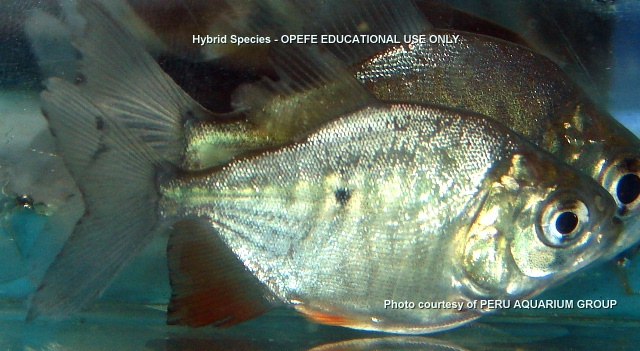
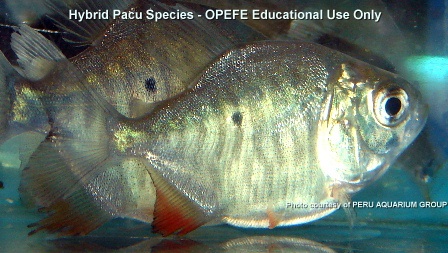
A new hybrid species produced in Peru call Pacotana that is a mixed of female Pacu (Piaractus brachypomus) and male Gamitana (Colossoma macropomum).
|
|
|
|
CLICK TO ENTER COMPLETE VALID SPECIES LIST ABOUT GENUS Metynnis. This species herein is not placed with the pacus as it is more closely aligned with the piranhas. To access that species, CLICK HERE. |
PHOTO REFERENCES
-
Jeff Dubosc: www.allfishes.net
-
Fish base: www.fishbase.org
-
Paulo Petry Bio-Amazonia.
-
All other photos marked with ownership.