 WELCOME TO OPEFE ARCHIVES
Parasites and Diseases of Piranhas and associated forms (Pirambebas)
by Frank Magallanes, OPEFE
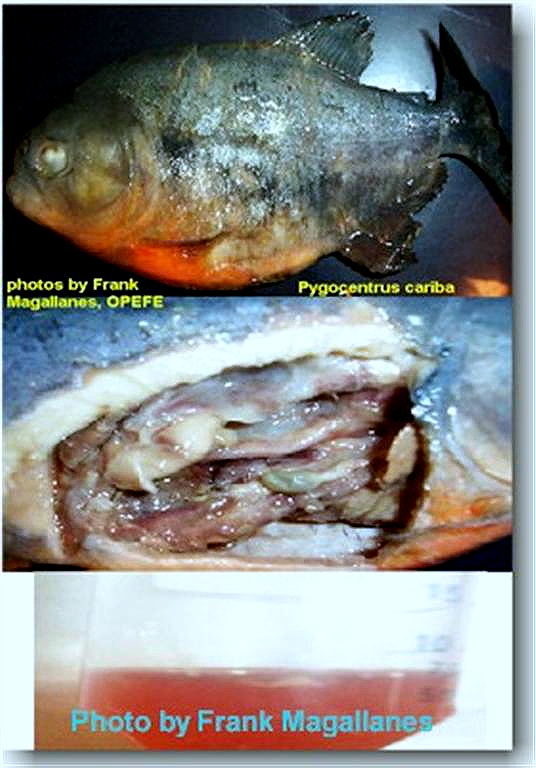
Photo of piranha dissected within hours of death.
INTRODUCTION
Generally as a rule, I don't recommend people to treat their fishes with medications. Reason being, the average person doesn't know what actual problem the fish is suffering. Many hosts and diseases take on a multitude of similar appearances. The only way to determine what your fish is actually suffering with is through a professional, specialized laboratory techniques, such as through a veterinary clinic. Fortunately, few diseases transfect the majority of piranha species. Most can be easily handled with medications. The best prevention against problems we are about to discuss is learn as much about your piranha as possible before you buy them. Knowing your fish before buying them helps in determining the healthiest ones to pick for your home aquarium. If you intend to put your new purchase with an already established group, then you should quarantine your new arrival for a period of approximately 2 to 3 weeks. This will give the fish time to calm down and you can then observe any potential problems or physical defects. You also want to practice good care (husbandry) while this fish is in isolation by providing good water quality. Poor water quality can give false readings that the fish might be suffering a disease or parasite problem. I have personally encountered this in my own home aquariums. The fish would get some slimy growth on the fins and appear listless. Once the water was changed and good maintenance, the fish normally would recover and look fit.
The other thing to consider is, piranhas (Serrasalminae in general) and small scaled fishes are sensitive to chemicals such as medications. Aquarists should carefully read the label of any medication they may want to use for warnings. Some chemicals like Dylox are considered harmful to piranhas. In the early stages of my hobby in keeping piranhas I lost many due to the use of Malachite green. This formulation should be used in low doses or half the recommended dose. Anytime you see one fish in your piranha group look sick, its a sure bet the majority will also come down with the problem especially if it is contagious agent. In this case, treatment should begin immediately. Otherwise, separate the infected fish and treat it appropriately in a hospital tank. The hospital tank should be bare with just an object placed inside to allow the fish to hide behind or in. Low light should be used (keep it off is suggested). Filtration can either be a sponge filter or outside filter. Do not use carbon or any water conditioner during the medical treatment. Carbon will remove the medication from the water. Once you are satisfied the fish has recovered sufficiently, then you can add carbon to remove remaining medicine.
If your piranha is wounded from a bite or from running into objects, they have amazing regenerative powers. Oftentimes, its best not to treat, however, because they are piranhas, you may want to separate the mutiliated fish, especially if it is a flesh wound. If blood and juices are in the water, very likely this injured fish will be eaten by the majority. According to biologist David M. Schleser, he recommends treatment with a broad spectrum antibiotic for infection prevention. According to Dave, a commercially available product containing nitrofurans can be safely used, but follow the manufacturers directions. Some products having a mix of nitrofurazone and furazolidone are particularly effective. The medicines are non-toxic to piranhas and the biggest plus of all it doesn't effect your biologic filtration.
Over
the years (and most recently), I've read topics of how fat-looking
certain caribe or piranha look. The aquarist often remarks how often the fish is
attacked in the belly region by other piranhas. Often exposing eggs, sometimes
not. This has led some people to believe a nice fat piranha is probably a
pregnant piranha (piranhas are egg-layers and do not get pregnant!). The
photos above demonstrate a fat piranha. The hobbyist believed it was probably
female. The photo is a plump male cariba.
In the photos, is a diseased cariba, probably infected with Edwardsiella
sp. or a related organism that is found on catfishes and in particular gold
fishes. If you feed gold fishes (Carassius sp.) you will likely encounter
problems like this which are transfected to your pet fishes. Overcrowding
fishes and poor water quality will also cause the invader to spread. These are
gram-negative problems best treated orally. With a piranha that is not a safe
thing to do. I'm hoping the hobbyist, will take to heart my warnings about
feeding live fishes to your piranha, in particular gold fishes, minnows or any
such critter to your piranhas. Internal lesions can be seen on the organs as
well.
For diseases and parasites that are general in nature for the home aquarium visit this page.
Edwardsiella
is not only common but is being recognized as more widespread that originally thought. Particularly in farm-raised fishes. Also the disease can be human transfected.
Septicemia
A condition where bacteria gains entry into the fish's body through wounds or the stomach. The bacteria can cause failure of the internal organs, damage to body tissue, blood vessels, and result in recognizable symptoms. This often results in internal bleeding, due to the fluids filling the fish's abdomen. Dropsy may occur as a result. The problem with this type of situation is that the bacteria is present inside the fish and safe from the antibiotics you would place in the water. It could be the result of another infection or caused from dirty water. Symptoms: Clamped fins, bulging eyes, red bellies, eroding, reddened fins, lack of appetite, and fish showing signs of being sluggish or exhibiting sluggish behavior. Treatment: It is best to feed the fish antibiotics rather than using the kinds you place directly into the water. Placing the ill fish in a hospital tank is advised while administering treatment. Check your local pet store for some good medicated food or check for antibiotics if necessary. Septicemia is fatal if not treated immediately!
Aeromonas hydrophila
is a motile, Gram-negative bacillus. This bacterium is free living and is always present in the water. As an opportunist, this bacterium may infect many species of freshwater and brackish water fishes. Synonyms for A. hydrophila infection include "motile aeromonas septicemia," "infectious abdominal dropsy," and "bacterial hemorrhagic septicemia." Infection with this organism is thought to be at least partially associated with overcrowding and high levels of stress in the fish population. This bacterium is associated with hemorrhagic septicemia (blood-borne bacteria). The clinical and histological signs of disease are similar to those associated with A. salmonicida.
Edwardsiella sp.
are motile, Gram-negative, gas-producing bacilli. There are two main bacterial species, designated Edwardsiella tarda and Edwardsiella ictaluri. The former species causes "putrefactive disease of catfish" (EPDC) or "fish gangrene," while the latter species is associated with "enteric septicemia" of catfish. These bacteria primarily affect channel catfish, but bacterial infection also may be observed in gold fish, golden shiners, and large mouth bass. Edwardsiella sp. also presents a serious threat to eel culture in Asia. The lesions produced by Edwardsiella tarda include small cutaneous ulcers and hemorrhages in the skin and muscles. In advanced disease, large abscesses with malodorous, gas-filled cavities may be observed in muscles. Edwardsiella ictaluri may be associated with petechial (pinpoint) hemorrhages in the skin. Other lesions caused by these organisms may appear similar to those caused by Aeromonas sp.
Hobbyists are cautioned to always wash your hands before and after handling your fishes or its water. Transfection to humans can be a factor when handling parasites or diseased fishes. Here is a list compiled at medications that are commonly used for a wide spectrum of treatments. I have modified the list to allow only products safe for piranha.
AS A
RULE, ALWAYS READ THE LABEL BEFORE BUYING OR APPLYING MEDICATIONS TO YOUR
AQUARIUM:
DO NOT USE PRODUCTS CONTAINING MALACHITE GREEN, there are sufficient
warnings about this ingredient killing tetras and scaleless fish that I would
caution anyone using it.
Aquarium Salt
Salt can be used for numerous purposes: General tonic and stress reducer:
Used to improve the efficiency of medications and reduce the harmful effects of nitrite.
Salt is useful in treating ich and fungus, or preventing it.
CopperSafe-
Chelated copper treatment recommended for the treatment of ick, flukes, anchor worms, velvet, protozoan diseases and other external parasites.
Maracide
Maracide is a highly effective treatment for ick Trichodina and related parasitic infestations.
Ick (small white spots may cover entire body.
protozoan/velvet (tiny yellowish-white spots, loss of color, rubbing or scratching against bottom)
parasites (extra mucus, visible spots or worms, rapid breathing, flashing and scratching or rubbing on rocks).
MelaFix
Melafix is a patented 1% mixture of CAS Melaleuca (Tea Tree Oil) which is used to enhance healing in fish.
This product is used for a wide range of external reasons...
Antibacterial Remedy.
Rapidly Repairs Damaged Fins.
Heals Open Wounds and Ulcer.s
Stops Mouth Fungus.
Treats Fin and Tail Rot.
Will not harm biological media in your filters nor will it effect your Ph..
PimaFix
An all natural botanical antibacterial remedy made from Pimenta racemosa (West Indian Bay) oil.
Treats fungal infections.
Treats both internal and external bacterial infections.
Works in combination with MelaFix to enhance effectiveness for extreme conditions.
Eliminates the possibility of the development of resistant strains of disease-causing organisms.
Remedy for both freshwater and marine fish.
Has no effect on pH.
Harmless to aquatic plants.
Does not discolor water.
Potassium Permanganate
Potassium permanganate, KMnO 4 , is a chemical oxidizing agent that will react with any organic matter in aquariums. Treats common fish pathogens such as gill parasites and external bacterial and fungal infections.
PraziPro
Oxybispropanol (as an inert solubilizing agent) and <5% Praziquantel by weight.
Controls unwanted parasites in freshwater or marine aquariums
Treats flukes, tapeworms, flatworms and turbellarians
Can be used as a preventative
Safe and effective; will not negatively impact biological filtration
Non-toxic to commonly kept aquarium animals and plants
Tetracycline
A broad-spectrum antibiotic used in the treatment of gram-positive and some gram-negative bacterial infections.
For infections of fin and tail rot, frayed fins,
popeye
inflamed gills,
mouth and body open sores/ulcers
livebearer disease
dropsy,
Columnaris, and secondary infections such as fungal.Useful for the control of some common bacterial diseases, including Aeromonias and Pseudomonas Genera and the Mysobacterial group.
DO NOT USE PRODUCTS CONTAINING MALACHITE GREEN, there are sufficient warnings about this ingredient killing tetras and scaleless fish that I would caution anyone using it.
REFERENCES
Dr. William M. Stoke, B.Sc., M.R.C.V.S., Danger Signs With Your Fishes - http://www.aquarticles.com
The Edwardsiella ictaluri genome sequencing project is being conducted by Mark Lawrence, D.V.M., Ph.D., of the Mississippi State University College of Veterinary Medicine; David Dyer, Ph.D., and Allison Gillaspy, Ph.D., of the Laboratory for Genomics and Bioinformatics; and Ronald Thune, Ph.D., of the Louisiana State University School of Veterinary Medicine. These studies are supported by USDA/CSREES grant #2004-35600-14180, Laboratory for Genomics & Bioinformatics, University of Oklahoma Health Sciences Center,975 NE 10th Rm 372, Oklahoma City, OK 73104
Schleser,
David M. 1997 Piranhas, A Complete Pet Owner's Manual, Barron's Educational
Series, Inc. pg. 48-50.
USE YOUR BACKSPACE TO RETURN OR CLICK HERE TO RETURN RESEARCH PAGE
TO RETURN HOME CLICK HERE.
The OPEFE web site and its contents; is disclaimed for purposes of Zoological Nomenclature in accordance with the International Code of Zoological Nomenclature, Fourth Edition, Article 8.3 and 8.4. No new names or nomenclature changes are available from statements at this web site.
Copyright© 1994-212 Oregon Piranha Exotic Fish Exhibit (The OPEFE fish exhibit is permanently CLOSED as of 2000) Sutherlin, Oregon. Information posted on this web site is archival data on fish scientific classifications and other information. DISCLAIMER: The copyrighted material may not be used for any purpose other than private study, scholarship or research. Cited information requires credit and this link www.opefe.com. All rights reserved. All images shown (unless otherwise noted) is property of OPEFE.