WELCOME TO OPEFE ARCHIVES
Tometes trilobatus
No
Photo
Valenciennes
1850
Systematics and
phylogenetic analyses of these fish and their comparison with old specimens kept
in collections resulted in the identification and description of Tometes
lebaili and T. makue. Differentiation between each other and the
type-species of the genus (T. trilobatus) is manifest notably by the
position of the mouth and the number of teeth.
These species are
attached strictly to environments where podostemaceans grow : the adults feed
exclusively on leaves whereas the young shelter deeper among the plant masses,
eating invertebrates which develop there. These fish, which can weigh over 5 kg
and measure over 50 cm long, count among the 15 or so most imposing species les
plus described in South America for 50 years.
Michel
Jégu, Geraldo Mendes Dos Santos, Philippe Keith, and Pierre-Yves Le Bail
Summary.
- Tometes trilobatus is a species different of Myleus setiger. Tometes
is a kind close to Mylesinus, Ossubtus and sub-genus Myleus (Myleus)
with which it shares several single characters at Serrasalminae. The bones of
the jaws are laminar and the series of teeth of the prémaxillaire are narrowly
coupled the ones with the others. The mésethmoïde is broad, not very thick and
the side wings are very reduced. The olfactive window is broad. In front of the
pelvic fins, the serrae, very few and reduced to spines, do not draw an
abdominal hull. Mylesinus, Ossubtus and Tometes have geared teeth
incisiformes bi- and tricuspides. Tometes differs from these two kinds by
the teeth of the jaws which are thicker and shorter. The two last teeth of the
prémaxillaire of Tometes are different from the first, short and with
sigmoid crown. At Mylesinus and Ossubtus, all the teeth of the
labial series of the prémaxillaire are high, plane with a rectilinear crown.
Abstract. - Supplementary description and rehabilitation of Tometes
trilobatus Valenciennes, 1850, type-species of Tometes Valencian
(Characidae: Serrasalminae).
Tometes trilobatus, type-species of Tometes, was placed in
synonymy with Myleus setiger since its description in 1850. Tometes
was thus considered by authors have synonym of Myleus. Recently, we could
show that Myleus setiger, type-species of Myleus, was different
from Tometes trilobatus. The examination of the specimens collected in
French Guiana and in the State of Amapa in Brazil, associated with has standard
studies of the of Tometes enables custom to show that different Tometes
is from Myleus and shares several characters with Mylesinus and Ossubtus.
After has shorts historical background of various works referring to Tometes
trilobatus, we give A detailed re-description of the morpho-anatomical and
meristical characteristics of the species, and we rehabilitate the Tometes
genus.
Different Tometes trilobatus is from Myleus setiger and T.
unilobatus is synonym of T. trilobatus. Tometes has genus
closed to Mylesinus, Ossubtus and Myleus (Myleus) sub-genus
with which it shares several single characters in the Serrasalminae. The bones
of the jaws are laminar and the series of teeth of the premaxillary are placed
side by side. The mesethmoïde is broad, not very thick and the supraethmoïdal
wings are very reduced. Olfactive The foramen is broad. The prepelvic serrae are
few and reduced to spines, and C not Draw abdominal year keel. Mylesinus,
Ossubtus and Tometes cuts geared bi- and tricuspid incisiform teeth. Tometes
differs from this two genus by thicker and lower teeth. Labial The posteriormost
premaxillary teeth of Tometes different are of the anterior ones, shorts
and with has sigmoid crown. Labial All the premaxillary teeth of Mylesinus
and Ossubtus are planes with has right crown.
Tometes trilobatus seems to be associated with the Podostemaceae, the
rupestral seedlings characteristic of the rapids of the studied area. Internal
By taking the of some specimens for the parasitic studies of the, we observed
Podostemaceae in abundance in the stomachs. Tometes, Mylesinus and Ossubtus
present has diet closely related to Podostemaceae, associated with has parasitic
hyperinfestation, while Myleus (Myleus), Myleus (Myloplus),
Myleus (Paramyloplus) and Myleus (Prosomyleus)
present A diet less specialized and composed of exogenic sheets, fruits gold
seeds and invertebrates.
The typology of the localities of collection of T. trilobatus confirms
that it has rheophilic species. In the three basins considered (Oyapock, Flexal
and Araguari), the captures always took place in the high races and more
particularly in the zones of rapids.
|
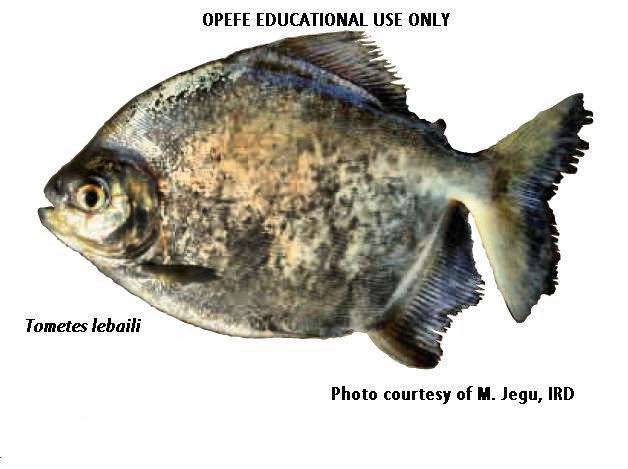
Tometes lebaili
Michel Jégu, P. Keith, E. Belmont-Jégu (2002) |
Summary.
- Tometes makue is a new species of Tometes of the Guianese
shield. This species differs from T. trilobatus and T. lebaili by
a smaller number of serrae prépelviennes and a greater number of teeth to the
dental one. At T. makue and T. trilobatus, the mouth is horizontal,
whereas it is oblique and round upwards at T. lebaili. T. makue is also
an endemic species rhéophile basins of Orénoque, in Venezuela, and of Rio
Negro, in Brazil.
Abstract. - Tometes makue (Characidae: Serrasalminae), has new species
from Guiana shield, described from the Rio Negro Basin (Brazil) and Orinoco
Basin (Venezuela).
Tometes makue has new species of Tometes Valenciennes, 1850 from
Guiana shield. Previously identified have has Mylesinus species by Kner
(1860), Sepulveda (1984) and Jégu and Al (1989), T. makue present
the hand characteristics of T. trilobatus Valenciennes, 1850, standard
species of Tometes, and T. lebaili Jégu and Al, 2002. T.
makue differs from Mylesinus by stronger and shorter tri and bicuspid
teeth, two last sigmoid premaxillary teeth, has shorter side premaxillary
lingual process and the two median teeth bracked together. T. makue
differs from T. trilobatus and T. lebaili by has smaller number of
prepelvic serrae, which are often absent in the larger specimens (0-9 in adults vs.
11-24 in T. trilobatus and 19-26 in T. lebaili). T. makue
differs from T. trilobatus by has greater number of dentary teeth one the
labial series (6-11 vs. 5-6 in T. trilobatus). T. makue and
T. trilobatus present horizontal year and final mouth, whereas it is
oblique and upturned in T. lebaili. Youthful of T. makue present 6
to 10 vertical black stripes one the sides and has humeral black spot between 40
and 85 mm SL. Larger specimens are uniformly grey. Content observations one
stomach indicate that T. makue feed mainly one Podostemaceae. T. makue,
which edge reach 379 mm SL, is year endemic rheophilic species from Orinoco
basin, in Venezuela, and Rio Negro basin, in Brazil. T. makue, T. trilobatus,
T. lebaili and Mylesinus paraschomburgkii form has group of broad
phytophagous serrasalmins endemic of the Podostemaceae meadows of Guiana shield,
from Caroni to rivet in Venezuela to Maroni to rivet in French Guiana.
The
herbivorous serrasalminids, dependent on the Podostemaceae beds growing in the
Guianan plateau rapids, have the special feature of belonging at once to the
natural and to the cultural heritage of the Amerindians. The discovery of T.
lebaili and T. makue shows that the distribution area of the large herbivorous
serrasalminids is not limited to the wide deep rivers of the Amazonian plain but
extend to the rapids of the Guianan plateau. Investigations are continuing in
order to improve knowledge about these fish and their habitat.
REFERENCES
-
JÉGU
M., G.M. dos SANTOS, P. KEITH & P.-Y. LE BAIL, 2002. Description
complémentaire et réhabilitation de Tometes trilobatus Valenciennes,
1850, espèce-type de Tometes Valenciennes (Teleostei: Characidae:
Serrasalminae). Cybium, 26(2): 99-122.
-
JÉGU
M., G.M. dos SANTOS & E. BELMONT-JÉGU, soumis décembre 2001. Tometes
mahkue (Teleostei: Characidae: Serrasalmiane), une nouvelle espèce de
bouclier guyanais décrite des bassins du rio Negro (Brésil) et de
l'Orénoque (Vénézuéla ). Cybium, 26(3).
-
JEGU
M., KEITH P., BELMONT-JEGU E., 2002.- Une nouvelle espèce de Tometes (Teleostei
: Characidae : Serrasalminae) du bouclier guyanais, Tometes lebaili n. sp.
Bull. Fr. Pêche Piscic., 364: 23-48.
-
H.
Pagezy, M. Jégu - Valeur patrimoniale de Serrasalminae herbivores du Haut
Maroni (Guyane française) : approches biologique et socioculturelle en pays
Wayana, Bull. Fr. Pêche Piscic., 364 : 49 - 69, 2002.
USE YOUR BACKSPACE TO RETURN OR CLICK HERE TO RETURN
VALID PHYTOPHAGOUS SPECIES PAGE
RETURN RESEARCH PAGE
TO
RETURN HOME CLICK HERE.
The
OPEFE web site and its contents; is disclaimed for purposes of Zoological
Nomenclature in accordance with the International Code of Zoological
Nomenclature, Fourth Edition, Article 8.3 and 8.4. No new names or nomenclature
changes are available from statements at this web site
.
Copyright©
1994-2012 Oregon Piranha Exotic Fish Exhibit (The OPEFE fish exhibit is
permanently CLOSED as of 2000) Sutherlin, Oregon. Information posted on this web
site is archival data on fish scientific classifications and other information. DISCLAIMER:
The copyrighted material may not be used for any purpose other than private
study, scholarship or research. Cited information requires credit and this link
www.opefe.com. All rights reserved. All images shown (unless otherwise
noted) is property of OPEFE.

UPDATED:
12/27/2011