|
Kner 1858 Jégu, Michel., Dos Santos, Geraldo Mendes., Cybium 2001, 25(2): 119-143. Mise Au Point À Propos de Serrasalmus spilopleura Kner, 1858 et Réhabilitation de S. maculatus Kner, 1858 (Characidae: Serrasalminae). Etymology: maculatus: Refers to large spot(s) on the side
From Frank Magallanes
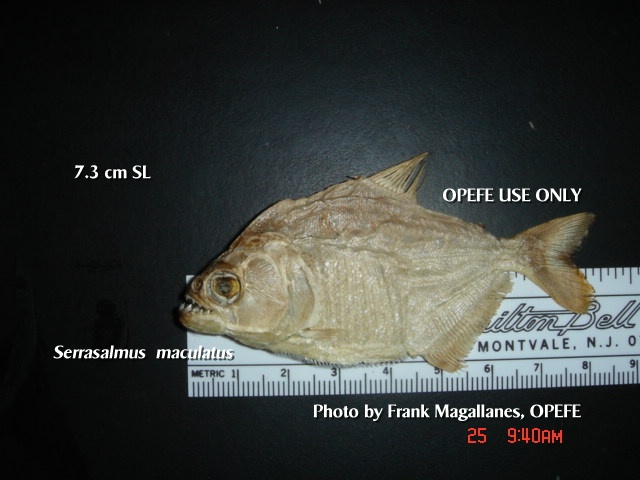
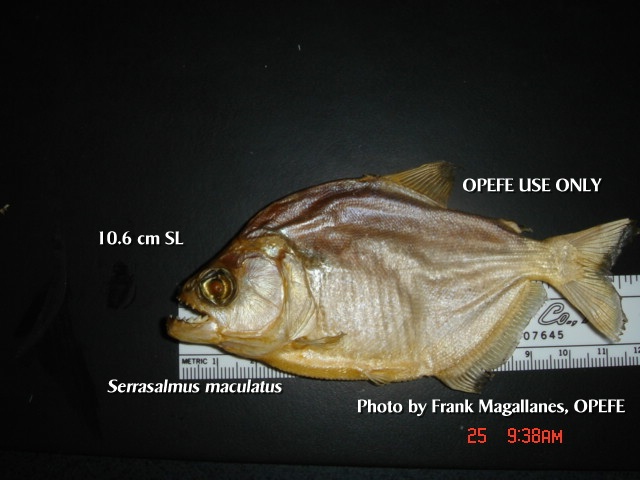
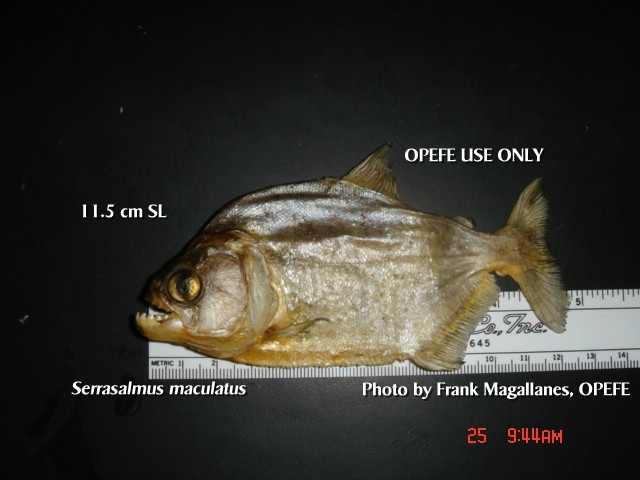
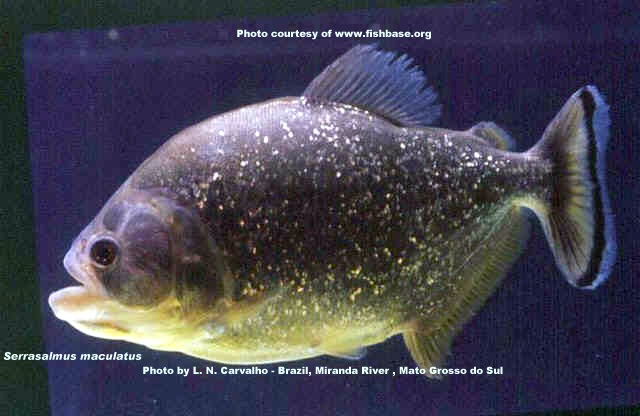
This species description is confusing to me. A few years ago, this species would have simply been known as S. spilopleura based on the midline tail band ALONE. Now the species has been rehabilitated and it appears it is not S. spilopleura at all but S. maculatus and is the species commonly seen and kept in hobbyist aquariums. The species is considered more widespread than the true S. spilopleura. The real S. spilopleura is limited to the Rio Guapore river basin, Bolivia. S. maculatus is more widespread and likely the species most often encountered in the hobby trade. Including bred in captivity. The midline band is visible on very young species but as maturity sets it this midline band become terminal or one can observe a very thin hyaline edge on the caudal fin. On the other hand, S. spilopleura maintains its midline band throughout its life. The best that I can interpret from this complex description is the real S. spilopleura exhibits a reddish-orange eye, bright red belly. While S. maculatus is found as a golden-yellow belly throughout its range.
Both authors, Jégu and Fink have opposing revisions of this particular species. The problem seems centered on the placement of the Amazonian species described as S. nigricans. This species is a younger name to S. maculatus. In terms of nomenclatural speaking S. nigricans should have been a synonym to S. maculatus and would appear overlooked by Jégu. All things being equal, S. nigricans should be relegated as a junior synonym to S. maculatus. S. maculatus is a younger name to S. spilopleura. S. spilopleura is the oldest name to others. However, this is my opinion and perhaps should be looked into further detail by a competent authority in the future.
According to current revisions, Serrasalmo aesopus (Cope 1872), Pygocentrus melanurus Kner (ex Heckel) 1860, is a synonym of S. maculatus and S. spilopleura. S. nigricans (Spix 1829) was overlooked by the author and placed as valid with a distribution range of the Amazon river basin, Brazil. Hobbyist who collect this species will be left with confusion on what to call their species, either; S. nigricans, S. maculatus or S. spilopleura. I hope readers now understand a bit more about the systemic problems with these species.
Some photos are online now: Serrasalmus maculatus geographical species page. More information pertaining to S. maculatus: Serrasalmus maculatus, Argentina.
INTRODUCTION - Regarding Science
Norman (1929) was not able to identify S. maculatus (Kner 1868) from the Rio Guapore specimen. But believes it to be S. spilopleura. Norman maintained that the broad dark (brown or black) margin midway on the caudal fin became broader with age and less intense. In several specimens Norman examined from the Amazon, the band is much more broader extends out almost to of the caudal fin. Where the hinder part of the had been worn away, the fish appears to have a marginal rather submarginal dark band.Occurs in ponds, generally in small groups of up to 20 individuals which appear to have a definite range within a pond or a creek. This does not mean the fish stay together for life, individuals leave and rejoin other groups that closely match their individualistic traits. This prevents the group from practicing natural selection and removing an undesirable member of their group. So caution is also suggested for the home aquarium if you keep several of these together.
S. spilopleura (= S. maculatus) have been observed to be active mainly during the day. Larger fish extend their foraging until about 9 at night. At night, it stays in the shallows near the bottom, sheltered among vegetation (Sazima, I. and F. A. Machado, 1990). Some aquarists are attempting to duplicate conditions of keeping more than one (1) of these species together with little success. The few that report success at keeping them as a group often show fishes with bit fins and body parts regenerating. Mortality is often the end result. Juveniles and adults feed mostly on fins and muscle portions of fishes (Sazima, I. and J.P. Pombal, Jr., 1988). There are reported cases of this species biting humans; Attacks on humans with bite outbreaks may occur in dammed portions of rivers during the breeding season, related to brood protection by the spawning adults (Haddad-Jr., V. and I. Sazima, 2003). While this is one of the small pirambebas, aquarists are cautioned against handling the species with bare hands. Serious bites can occur.
ENGLISH TRANSLATION - Not to be considered accurate translation; (OPEFE readers may access the actual .pdf by following this link.)
Serrasalmus spilopleura KNER, 1858 and S. maculatus KNER, 1858 are described from Guaporé Basin. Most authors have always considered S. maculatus as a synonym of S. spilopleura, a well-known species from Paraná-Paraquay and Amazon basins. The examination of the type-series in Vienna shows that S. maculatus and S. spilopleura are in fact two different species. In S. spilopleura the infraorbital series bones are narrower and the naked cheek zone is broader than in S. maculatus. Two thirds at the base of caudal fin are dark and the last third hyaline in S. spilopleura whereas S. maculatus shows a final or sub terminal black bar in the caudal fin, depending on the size of the specimens and the sampling area.
Serrasalmus maculatus and S. spilopleura were described from the rio Guaporé by Kner (1858:166), followed up by Natterer, then presented with more details in the work of Kner (1860) on the Characidae. Kner (1858) indicates that the edge of the anal and tail fin of S. maculatus is black and that the flanks carry spots while S. spilopleura the edge of the tail is clear and the flanks carry a humeral black spot. Kner (1860) indicates that according to Natterer, who collected these fishes, the vulgar names are << Piranha pequena >> for S maculatus and << Piranha doce >> For S. spilopleura that Heckel (in Kner, 1860) names Piranha dulcis.
Kner, 1858 does not give any value for the meristic and morphometric measurements of Serrasalmus spilopleura, to the opposite of S. maculatus. The author describes that none of the examined S. spilopleura presents a series of complete ectopterygoid teeth, while it observes 5 to 6 teeth to the palate with S. maculatus, in alcohol and at least 3 on the dry spécimens. Kner (1858) indicates also as the infraorbital series is notoriously narrower with S. spilopleura than with S. maculatus, the naked zone surrounding the infraorbital is 3 being wider with S. spilopleura. The size of the black pupil which is banded are well visible on the representation of S. maculatus (Kner, 1960) : pl. 4, fig. 10), but only a darker humeral spot is visible on the flanks of S. spilopleura (Kner, 1960: pl. 5, fig. 11). For both of these two species, it is not known the number of specimens examined, but the author indicates that the specimens of S. spilopleura originates from Bogota, Rio Guaporé in the Mato Grosse.
For S. maculatus, that also originates from Guaporé, Kner (1858) examined dry specimens from Caicara. Gunther (1864: 370) quotes S. spilopleura of the river Capim of Brazil and reviews the description of Kner (1858) for S. maculatus. Eigenmann (1915; 249) distinguishes S. spilopleura, by having a tail with a black band submarginal and has the distal edge hyaline, while S. maculatus presents a tail with a marginal black band. Eigenmann (1915: 253) cites that S. spilopleura is known from Amazon and Laguna's in Paraguay or pools and is cited for the first time by Boulenger (1896), while S. maculatus would be limited in distribution in Bolivia and in the Amazon river. Norman (1929: fig. 13) describes S. spilopleura with a well defined submarginal tail band and confirms the fishes presence in the Laguna's of the Paraguay and of the Amazon; ill. (p. 799) suggested that S. maculatus be considered synonym of S. spilopleura. The last review of S. maculatus was presented by La Monte (1935) from the Rio Jurua. Followed up by Fowler (1950: 384) and Géry (1976) both considered S. maculatus as synonym of S. spilopleura. Géry (1964) observed that it is often difficult to determine the sub terminal black band of the tail in S. spilopleura found in Iquitos region of Peru. According to this author (1978: 286), S. spilopleura is characterized by the presence of teeth on the palate and of a hyaline distal band on the tail. Nevertheless, it illustrates the uniform color of these two specimens (p. 292).
Santos and et al. (1984: 35), then Jégu and Santos (1988: pl. 11), S. spilopleura of the Tocantins are represented with the characteristic black subterminal band on the tail, black edges on the fin tips on the flanks of the young ones and a humeral spot with the adults. The latter authors indicates (p. 256) that the exposed zone of the cheek seems wider and the eyes smaller on the representation of S. spilopleura of Kner (1860), but they follow Norman (1929) and place S. maculatus, Tocantins cited by Ulrey (1895), as synonym of S. spilopleura. Lauzanne in Loubens (1985: 53, fig. 48) distinguishes S. spilopleura from the Mamoré basin and the Itenez (Bolivia) using the same color characteristics. Géry et al. (1987: fig. 58, 59) reviewed the related bibliography and places S. spilopleura in the Paraña-Paraguay with S. spilopleura of the Paraguay represented with having a subterminal black band on the tail and tips of the fins black, on the flanks of a juvenile of 77 mm SL. Santos (1990: 176, fig. 178) describes S. spilopleura from the Guaporé as having body markings distinctly defined, without the tail edge being hyaline but with ectopterygoid teeth. The author (p. 175-177) cites the presence of two other species without ectopterygoid teeth from Rondonia. The one species (Serrasalmus sp. 1, fig. 186), described from the Guaporé and effluent of Jamari, a tributary branch from the Madeira, the edge of the tail is black and with the other (S. aureus, fig. 183), described from the Jamari, the edge of the tail is hyaline.
Castro (1994: 64), from the Putumayo (Colombia), and Ferreira et al. (1998: 82), from THE AMAZON and the region of Santarem (Brazil), describes S. spilopleura with a black subterminal band on the tail. Fernandez-Yepez (1969), and Mago Leccia (1970) cites S. spilopleura from Venezuela, but Machado-Allison and Fink (1996) do not keep this species in their manuscript of the piranhas from Venezuela. Finally, Jegu and Keith (1999A) cite the presence of S. spilopleura in the marshes near the shore of the Oyapock where the adult forms uniformly turn purple and dark, the characters of the color of the tail is not more visible. These authors agree therefore on the presence, with the young S. spilopleura of the basins of the Amazon and Paraguay, of a black subterminal band on the tail, black spots on the flank and a clear bottom. The coloration of the adults would be more subdued and brilliant violet and the coloring of the tail more difficult to observe (Jégu and Santos, 1988; Azuma, 1990).
Jégu and Keith (1999B) place S. spilopleura in the subfamily of the Serrasalminae from the Varzea in the the basin of the Amazonia, towards the east and extension to the South even in the high Tocantins and to the North in the marshes of the Amapá (Brazil) and from the Oyapock. Two specimens of the Guaporé, collected by Natterer and preserved in alcohol (NMW 17995, 162 mm LS and NMW 17996, 122 mm LS) are identified as syntypes of S. maculatus. A third spécimen (NMW 57058, 109 mm LS), collected by Natterer from Barra do Rio Negro, was recently (Feb. 10, 1978) designated syntype in the collection. The locality << Barra do Rio Negro >> Is from the mouth of the Rio Negro, in downhill of Manaus. It is without a doubt one of the specimens of the type series for Kner (1860) and clearly indicates that the specimens shown fit the description of S. maculatus originating from the Rio Guaporé.
In his work, (KNER 1858: 164) describes Myletes maculatus of the Guaporé of which it resembles also the description in 1860 (p. 26) and presents an image (pl. 2, fig. 5). A specimen of Myletes maculatus is stored in the London Museum and integrated to the collection under the number BMNH 1928.1.24:10. Eschmeyer (1998:994) lists this specimen by error as syntype of Serrasalmus maculatus, stating that it is very likely a syntype of M. maculatus, placed today in the genus Metynnis. The three individuals have homogenous morphometric characters. The general from of the body is very close to that of S. spilopleura, but these specimens are different by several characters. he body is a little higher (54,2-57,2% SL vs 49,3-53,6 for S. spilopleura) while the posterior length is less (distance postdorsale-postanale 28,6-29,5% SL vs 31,2-33,6 for S. spilopleura). The muzzle is short and obtuse, the head and and profile are wide.
S. maculatus (KNER 1858) showing a variation of color from Lago do Rei, Ilha doCareiro, Rio Amazonas. A - juvenile; B - Adult; C - Adult in breeding condition(?). Photos courtesy of Dr. Michel Jégu.
IN THE AQUARIUM
Cautionary statement; some aquarists report keeping this fish as a group, however long term results are sketchy. Much of it based on new hobbyists that have little to no experience in the piranhas natural behavior. Much of it is based on cramped situations where the fish are herded in small aquariums and expected not to be stressed from such a situation. My personal experiences suggest it should not be kept as a group except for breeding purposes. They will damage each other, mostly through fin biting, ultimately death. Mortalities do occur if something is not to their liking, as piranhas and pirambebas are unpredictable. Recommend keeping as solitary species in home aquarium. As stated above, they do not form life long groups. Individuals leave and join other groups.
Readers may access test mixing of this species with genus Pygocentrus and S. sanchezi to see what results might take place should you try and attempt this.
BREEDING
S. spilopleura (= S. maculatus) is not migratory, present parental care and utilize the "aguape" (Eichhornia sp.) and other macrophytes for laying eggs (Castro and Arcifa 1987, Thomaz and Bini 1999).
This species has been bred in captivity numerous times according to some published reports. See AZUMA, H. 1990.- Breeding the gold piranha Serrasalmus gibbus, Trop. Fish Hobbyist, 38(10) :64-69. Photo upper left is a breeding male S. maculatus. Photo by Frank Magallanes.
The fish have been observed in the wild to occupy a specific range. Often may travel in small groups of 20 or more. The species is active during the day and larger adults forage until dusk. Adults stay hidden among the vegetation and shallow bottom of the pond or creek. Larvae and juveniles hide and feed within the root tangle of water hyacinths, which also act as a dispersal during the rainy, flood season. Larvae feed on microscopic crustaceans and small aquatic insects; very small size juveniles (about 1.2 cm) already clip fins of other fishes.
DISTRIBUTION
Amazon and Paraguay-Paraná R. basin: Argentina, Bolivia, Brazil, Colombia, Paraguay, Peru and Uruguay.
MAXIMUM SIZE
20.2 cm SL
CONTRIBUTORS/ADVISORS
REFERENCES
USE YOUR BACKSPACE TO RETURN OR CLICK HERE TO RETURN SERRASALMUS LIST
USE THIS LINK TO RETURN TO RESEARCH PAGE.
TO RETURN HOME CLICK HERE.
The OPEFE web site and its contents; is disclaimed for purposes of Zoological Nomenclature in accordance with the International Code of Zoological Nomenclature, Fourth Edition, Article 8.3 and 8.4. No new names or nomenclature changes are available from statements at this web site.
Copyright© 1994-2009 Oregon Piranha Exotic Fish Exhibit (The OPEFE fish exhibit is permanently CLOSED as of 2000) Sutherlin, Oregon. Information posted on this web site is archival data on fish scientific classifications and other information. DISCLAIMER: The copyrighted material may not be used for any purpose other than private study, scholarship or research. Cited information requires credit and this link www.opefe.com. All rights reserved. All images shown (unless otherwise noted) is property of OPEFE. UPDATED: 07/09/2009 |