 WELCOME TO OPEFE ARCHIVES
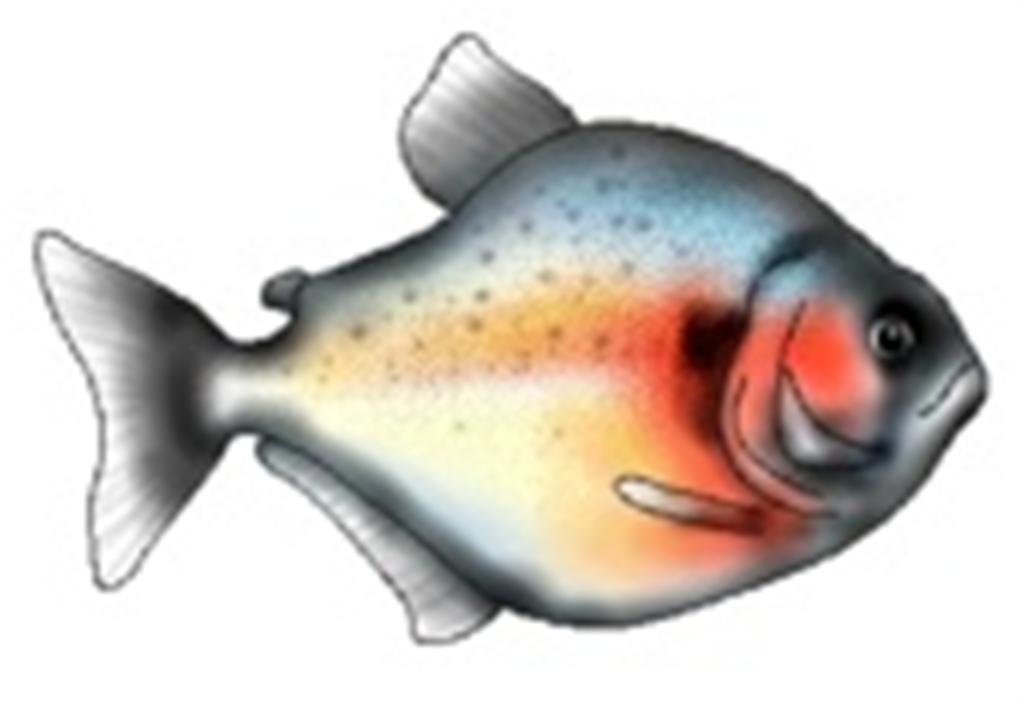
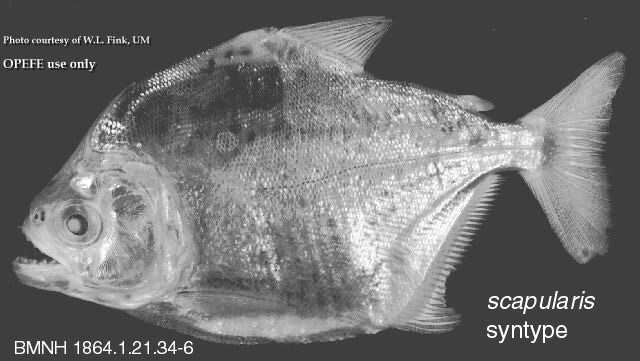
Serrasalmus scapularis
Günther 1864
This species is assigned as a synonym of Pristobrycon striolatus.
Perhaps should be considered as valid as Pristobrycon scapularis (Günther 1864).
FROM FRANK MAGALLANES
Very little is known on the care of this species. It is not imported for the aquarium trade, often it is confused for one of the other Pristobrycon and Serrasalmus species. Recommend keeping as solitary species in home aquarium. No live examples are available and is considered a synonym of the more recognized Pristobrycon striolatus.
|
Serrasalmo scapularis |
This species is based on a single example described by Günther (1864) described from Essequibo river, Guyana.
Norman (1929) followed Carl Eigenmann regarding Fowler's S. coccogenys as being identical with S. scapularis, but according Norman (1929), the Orinoco species (S. coccogenys) may eventually prove to be distinct. An indistinct dark blotch on the shoulder; base of caudal fin somewhat darker." Eigenmann (1915) places this fish as a Pristobrycon and says "it is very similar to Serrasalmus aureus, but not so deep, and to calmoni, which has a black bordered caudal. Caudal pale-edged; upper parts of sides with small spots."
The problem with this fish is there are several piranhas that fit the general description of Serrasalmo scapularis to include S. serrulatus (Valenciennes 1849). Eigenmann (1915) thought it possible that Serrasalmo punctatus (Schomburgk, 1841 - See Pygopristis denticulata) drawing represented Pristobrycon scapularis instead of S. punctatus.
The humeral blotch is present on S. eigenmanni at different ages and sizes. Norman (1929) mentions... Upper part of body with round dark spots; an indistinct diffuse mark on the shoulder; basal part of caudal dark. The fish taxon known as S. scapularis is not unique or distinctive as a species. Géry placed this species as a subspecies of P. striolatus, but there are mitigating factors to disregard this placement. Synonym of Pristobrycon striolatus (Steindachner 1908) -- (Jégu in Reis et al. 2003:188). According to Eschmeyer, the species should be considered valid as Pristobrycon scapularis (Günther 1864). However, Fink (1993) placed this species as synonym of Pristobrycon striolatus. S. coccogenys and Pristobrycon scapularis are now placed as a synonym of Pristobrycon striolatus (Machado-Allison and Fink 1996).
C. H. Eigenmann
Serrasalmo scapularis Gonther, Cat. Fishes Brit. Mus., Vol. V, 1864, p. 368 (British Guiana); Pellbgrin, Bull. Mus. d'Hist. Nat., 1899, p. 157 (Apur£). Pygocentrus scapularis Eigenmann & Eigenmann, Proc. U. S. Nat. Mus., Vol. XIV. 1891, p. 69; Ulrey, Ann. N. Y. Acad. Sci., Vol. VII. 1895, p. 297 (Marajo); Eigenmann & Ogle, Proc. U. S. Nat. Mus., Vol. XXXIII, 1907, p. 35 (South America). Serrasalmo coccogenis Fowler, Proc. Acad. Nat. Sci. Phila., 1911, p. 428, fig. 4 (La Pedrita, on the Cano Uracoa, Venezuela).
Habitat.—British Guiana, Orinoco, Amazon to Para. 5799 a-b. C. M. 140-197 mm. Manaos, Dec. 9, 1910. Haseman.
Very similar to Serrasalmo aureus, but not so deep, and to calmoni, which has a black bordered caudal.
Head 3.4-3.66 to end of lateral line; depth 1.7-1.8; D. 16 or 17; A. 32 or 33; serrae 26 + I and 28 + 1; interorbital 2.25-2.5 in the length of the head. Distance from dorsal to caudal fulcra equals length of head, much greater than base of dorsal; origin of dorsal about equal to distance from tip of snout to end of lateral line; base of anal a little longer than head; suture between first and second suborbitals vertical; second suborbital leaving a naked area nearly half as wide as bone in the larger and but little narrower than the bone in the smaller specimen; palatines roughened more or less and with a tooth-like tubercle. Caudal pale-edged; upper parts of sides with small spots. In the suture between the first and second suborbitals these specimens differ from the specimens from Guiana in which it extends downward and forward.
HISTORICAL NAMES
?Serrasalmo aureus (Agassiz, in Spix, 1929; Cuvier & Valenciennes (1850)
Serrasalmo scapularis (part.) Günther (1864)
Serrasalmus coccogenys Fowler (1911)
Pygocentrus scapularis Eigenmann (1912)
DISTRIBUTION
Unknown other than the original single collection; Essequibo river, Guyana.
REFERENCES
Günther, A. 1864 (10 Dec.) Catalogue of the fishes in the British Museum. Catalogue of the Physostomi, containing the families Siluridae, Characinidae, Haplochitonidae, Sternoptychidae, Scopelidae, Stomiatidae in the collection of the British Museum. Cat. Fishes v. 5: i-xxii + 1-455.
Eigenmann, Carl H. The Serrasalminae and Mylinae, Annals of th e Carnegie Museum, Vol. IX, Nos. 3-5, 1915.
Norman, J.R., 1928 The South American Characid Fishes of the Subfamily Serrasalmoninœ, with a Revision of the Genus Serrasalmus Lacepéde.
Géry, J. 1972 (19 Dec.) Poissons characoïdes des Guyanes. I. Généralités. II. Famille des Serrasalmidae. Zool. Verh. (Leiden) No. 122: 1-250, Pls. 1-16.
Machado-Allison, Antonio and Fink, William L., Los Peces Caribes de Venezuela, Diagnosis, Claves, Aspectos Ecologicos Y Evolutivos, pg. 83, 1996
Reis, R. E. , S. O. Kullander, and C. J. Ferraris, Jr. 2003 Check list of the freshwater fishes of South and Central America. CLOFFSCA. Check list of the freshwater fishes of South and Central America. CLOFFSCA. 2003: i-xi + 1-729. Synonym [of the younger] Pristobrycon striolatus (Steindachner 1908).
.USE YOUR BACKSPACE TO RETURN OR CLICK HERE TO RETURN SERRASALMUS LIST
TO RETURN HOME CLICK HERE.
The OPEFE web site and its contents; is disclaimed for purposes of Zoological Nomenclature in accordance with the International Code of Zoological Nomenclature, Fourth Edition, Article 8.3 and 8.4. No new names or nomenclature changes are available from statements at this web site.
Copyright© 1994-2012 Oregon Piranha Exotic Fish Exhibit (The OPEFE fish exhibit is permanently CLOSED as of 2000) Sutherlin, Oregon. Information posted on this web site is archival data on fish scientific classifications and other information. DISCLAIMER: The copyrighted material may not be used for any purpose other than private study, scholarship or research. Cited information requires credit and this link www.opefe.com. All rights reserved. All images shown (unless otherwise noted) is property of OPEFE.
UPDATED: 12/27/2011