FROM FRANK MAGALLANES
This species is not seen often in the aquarium trade. With problems of exportation in Venezuela, this species from that region will be more difficult to obtain until further notice. Brazilian species are more reddish, but other waters may produce a golden-yellow form. At one time in science, this species was considered a Serrasalmus species. Sufficient examples seen and examined places this species as a Pristobrycon.
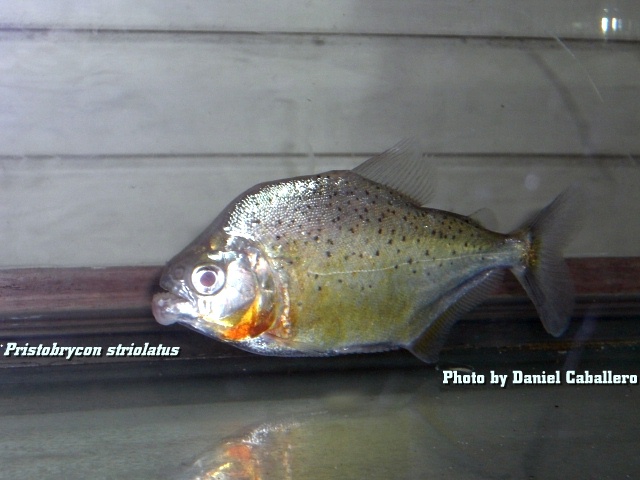
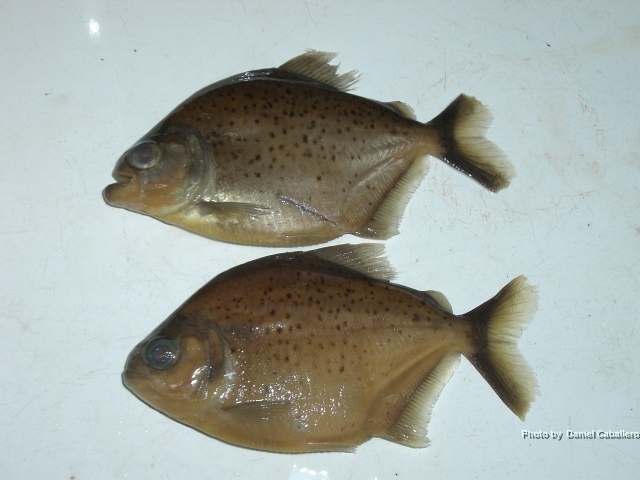
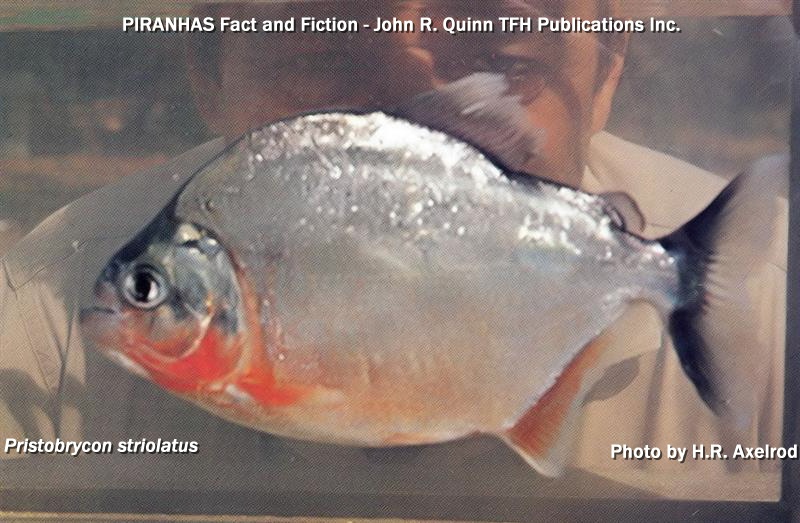
The species is a fin biter and performs this function quite well. Certainly not fit to be kept as a group. Young ones are sometimes kept together, as they mature their natural behavior develops rapidly. Recommend keeping as solitary species in home aquarium. Pristobrycon striolatus, which has previously been regarded as quite distinct from its congeners (Machado-Allison et al., 1989), forms a well-supported group with Catoprion and Pygopristis. This is consistent with the results of Ortí et al. The fish has the distinct dark "V" at the caudal fin with the edging having a black band. Heavily spotted (small) with a humeral blemish on the cheek. The eye is hyaline with a dark band transecting it, the base of the adipose fin is very dark and the body very silvery with the lower jaw red. The body has tints of orange and the coloration is more intense during breeding condition. The adult species feed on fish during the dry season, then switch to fruits when the rain forest is flooded. the diet can also consist of fins, terrestrial insects, crustaceans and of course scales. Grows to about 20 cm (David Schleser, 1977). Often called (erroneously Serrasalmus scapularis). The synonym name P. scapularis is herein revised as a synonym [Synonym of Pristobrycon striolatus (Steindachner 1908) -- (Jégu in Reis et al. 2003:188) ].
 |
|
|
SCIENCE HISTORY
VALID NAME: Pristobrycon striolatus Steindachner, 1908
SYNONYMS
-
Pygopristis antoni Fernández-Yepez, 1965.
-
Serrasalmo scapularis, Günther 1864:368 (Synonym of Pristobrycon striolatus (Steindachner 1908) -- (Jégu in Reis et al. 2003:188.Perhaps should be considered as valid as Pristobrycon scapularis (Günther 1864).
OTHER HISTORICAL NAMES APPLIED
-
Serrasalmus (Pygocentrus) striolatus Steindachner, 1908.
-
Pygocentrus striolatus Fernandez-Yepez, 1969, Evencias, 23:2.
DIET
Crushed seeds and fish parts.
DISTRIBUTION
Brazil, French Guiana, Guyana, Suriname and Venezuela.
LOCALITY
-
Modulo Unellez, Mantcal, AP
-
Rio Emoni, A.
-
Rio Guariquio, Laguna La Yuca, GU
-
Rio Chimire, Gu
-
Cano Babilla, afl. Rio Casiquiare, A.
-
Cano Amazonas, Rio Negro, A.
-
Rio Caura con Rio Orinoco, BO
-
Rio Aquaro, GU
-
Morichal Largo, MO
-
Morichal El Toro,GU
-
Rio Atabapo, A.
-
Rio Mavaca, A.
OTHER LOCALITY DATA
-
Brazil; Curua-Una, Trombetas, Cumina, Uatuma, Pitinga, Mapuera, Jatapu, Puduari, Capucapu, Negro, Cachorro.
-
Guyana; Dawa pumping station on Lake Topakuma shore side; Topakuma River drainage. No others collected.
-
Venezuela; Apure, Orinoco, Morichal Largo-Orinoco, Capanaparo, Alto Orinoco, Mavaca, Cinaruco, Llanos E.
MAXIMUM SIZE
15.0 cm TL
REFERENCES
-
Steindachner, F. 1908 Über sechs neue Serrasalmo- und Myletes-Arten aus Südamerika. Anz. Akad. Wiss. Wien v. 45 (no. 18): 359-367.
-
Eigenmann, C. H. 1915 (Mar.) The Serrasalminae and Mylinae. Ann. Carnegie Mus. v. 9 (nos. 3-4): 226-272, Pls. 44-58.
-
Fink, W. L. 1993 (18 Aug.) Revision of the piranha genus Pygocentrus (Teleostei, Characiformes). Copeia 1993 (no. 3): 665-687.
-
Taphorn, D. C. 1992 The characiform fishes of the Apure River drainage, Venezuela. Biollania Edición Especial - No. 4. Monografias Cientificas del Museo de Ciencias Naturales, UNELLEZ -- Guanara, estado Portuguesa, Venezuela. 1-537.
-
Géry, J. 1972 (19 Dec.) Poissons characoďdes des Guyanes. I. Généralités. II. Famille des Serrasalmidae. Zool. Verh. (Leiden) No. 122: 1-250, Pls. 1-16.
-
Planquette, P., P. Keith and P.-Y. Le Bail 1996 Atlas des poissons d'eau douce de Guyane (Tome 1). Muséum National d'Historie Naturelle, Ministčre de l'Environnement. Atlas Poissons Guyane: 1-431.
-
Machado-Allison, Antonio., Fink, William., 1996 Los Peces Caribes de Venezuela, Diagnosis, Claves, Aspectos Ecologicos Y Evolutivos.
-
Goulding, Michael, 1980 The Fishes and The Forest, Explorations in the Amazonian Natural History. University of California Press Berkely, Los Angeles London.
USE YOUR BACKSPACE TO RETURN OR CLICK HERE TO RETURN GENUS PRISTOBRYCON
TO RETURN HOME CLICK HERE.
The OPEFE web site and its contents; is disclaimed for purposes of Zoological Nomenclature in accordance with the International Code of Zoological Nomenclature, Fourth Edition, Article 8.3 and 8.4. No new names or nomenclature changes are available from statements at this web site.
Copyright© 1994-2009 Oregon Piranha Exotic Fish Exhibit (The OPEFE fish exhibit is permanently CLOSED as of 2000) Sutherlin, Oregon. Information posted on this web site is archival data on fish scientific classifications and other information. DISCLAIMER: The copyrighted material may not be used for any purpose other than private study, scholarship or research. Cited information requires credit and this link www.opefe.com. All rights reserved. All images shown (unless otherwise noted) is property of OPEFE.
UPDATED: 12/27/2011