From Frank Magallanes
According to California Academy of Sciences (CAS) the species valid name is Pygocentrus cariba effective March 1, 2012.
The problems with the species designation was because of a revision done by Leo Nico (Nico, L. G. 2001), who wrote; "the species name is more likely a species of Serrasalmus than a Pygocentrus."
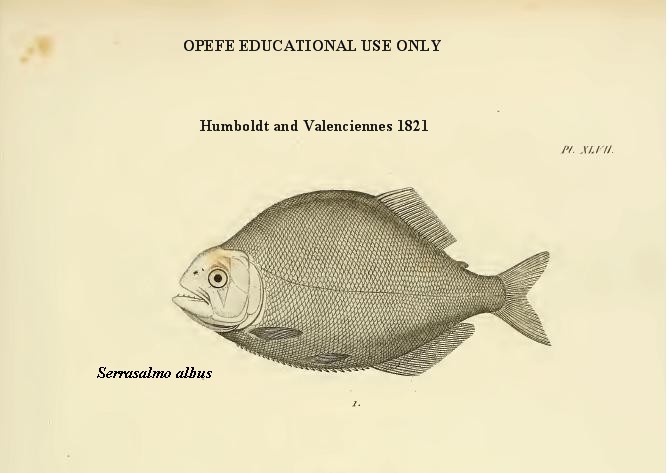
Serrasalmo albus Humboldt [F. H. A. von] in Humboldt & Valenciennes 1821:173, Pl. 47 (fig. 1) [Voyage de Humboldt et Bonpland, Deuxième partie. v. 2 (Title page 1833); Not regarded as a species; should have been "Serrasalmo Cariba, albus..." according to Fink 1993:669. Invalid name (as Serrasalmus albus) (Machado-Allison et al. 1991:125). •In the synonymy of Pygocentrus cariba (Humboldt 1821) -- (Fink 1993:669, Nico 2001:139 with comments, Machado-Allison 2002:58, Jégu in Reis et al. 2003:189). •In the synonymy of Serrasalmus cariba (Humboldt 1821). CURRENT STATUS: Serrasalmus cariba synonym of Pygocentrus cariba.
I offer my support to Dr. Fink and his assessment of this species as a Pygocentrus. Nico states; "I question the conclusion that Humboldt's fish is a Pygocentrus. Based on the overall profile and appearance, the piranha illustrated in Humboldt's plate 47 clearly resembles one of the sharp-snouted piranhas (e.g., Serrasalmus rhombeus or S. medinai, among others) as opposed to Pygocentrus" (Nico 2001:139).
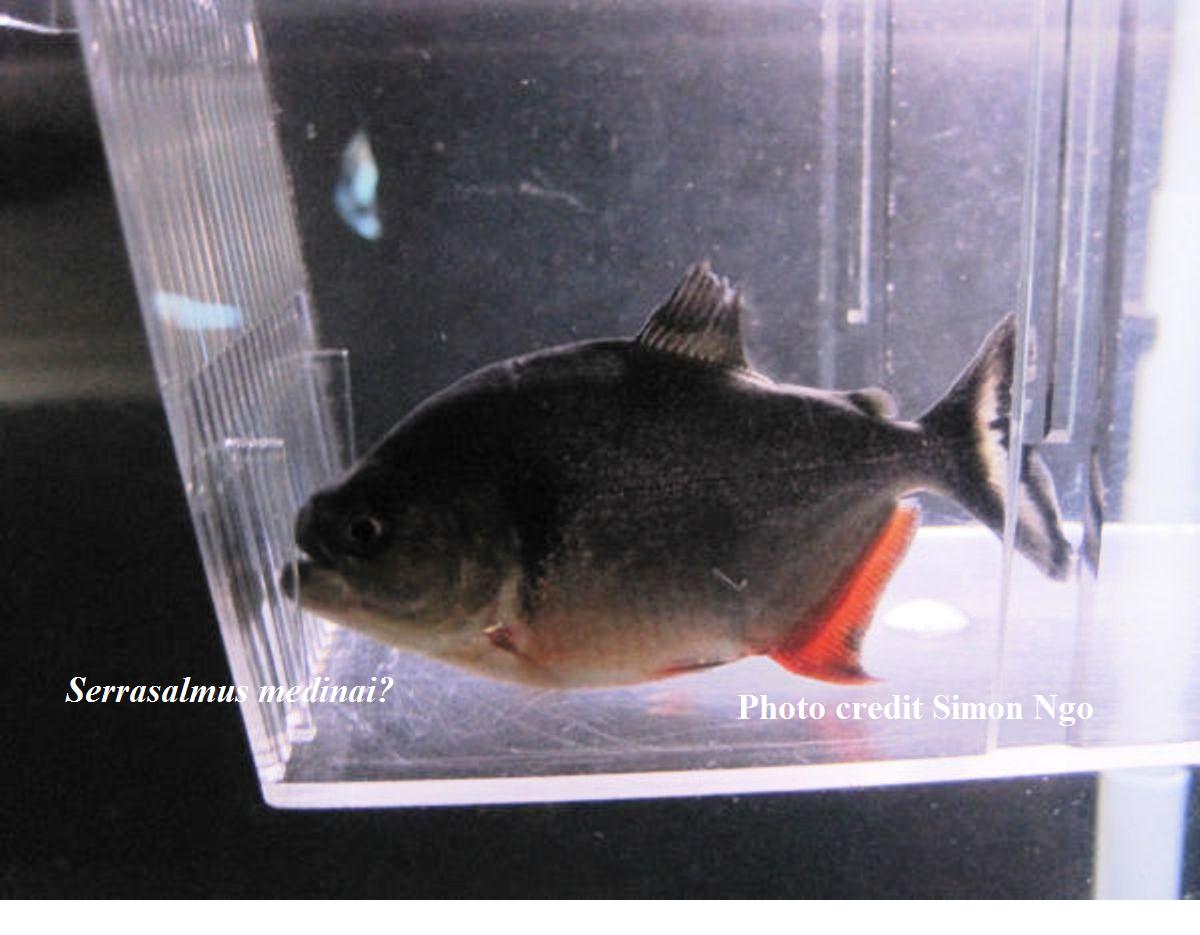
Here is an example of P. cariba (misidentified as S. medinai?) and a Venezuela S. rhombeus having such a profile like a Serrasalmus discussed in more detail below:
|
Note closely how this fish resembles S. albus. The photo has a information being Serrasalmus medinai ? This was written by me when the fish photo was sent. It is indeed P. cariba. Some P. cariba lack the humeral spot. That alone doesn't make it a "different" species. This particular colored cariba is found in near blackwater. |
Serrasalmus medinai Eye position is higher than S. albus drawing. The gill plate looks somewhat similar to S. albus. Of the three specimens here, S. medinai is the closest appearing to P. cariba. |
Serrasalmus rhombeus - Venezuela
While there is normally a concavity on the profile above the eyes, note the size of the lower jaw. One can agree that Nico might be right in terms on this one looking like S. albus. The latin name albus which means white, also hints at this species. |
Serrasalmo albus Humboldt [F. H. A. von] in Humboldt & Valenciennes 1821:173, Pl. 47 (fig. 1).
Note the head shape, jaw and position of eye. Striking similarities with the specimen on the far left. |
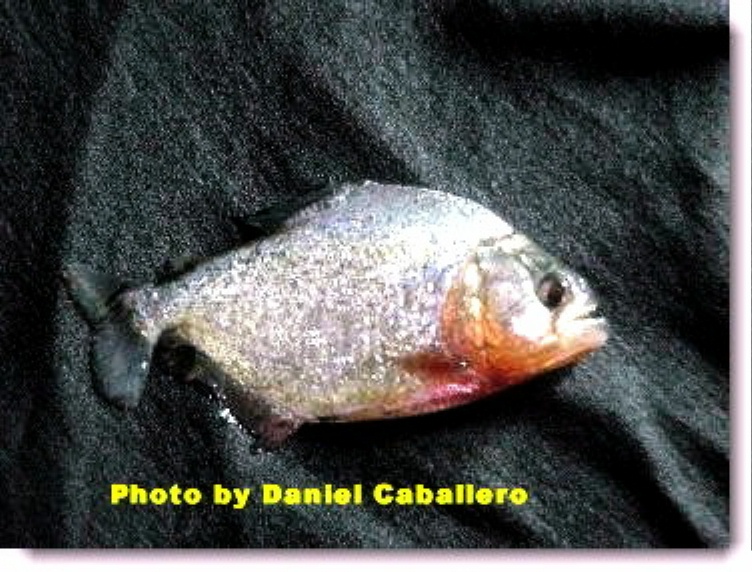
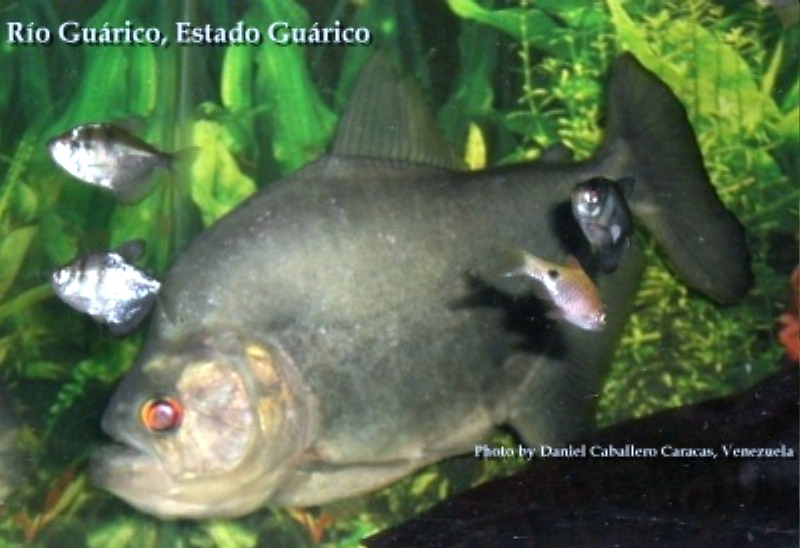
This species have always fascinated me and their natural beauty is one today, that still holds my attention. My first view of the species was a TFH Publications booklet by Harald Schultz on Piranhas (1964). There inside the pages, was a photograph of this species under the erroneous scientific name caption of Serrasalmus nattereri.
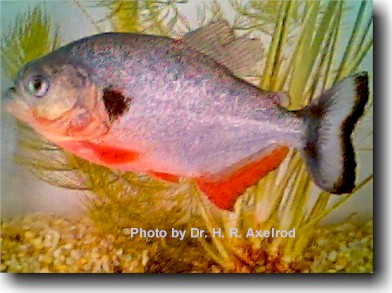
Pygocentrus cariba is characterized by four *supraneurals and a prominent black humeral spot on the flank (FINK, 1993). Supraneurals are small bones that are between the neural spines of the vertebrae, anterior of the dorsal fin. They may vary in number, depending on the position of the dorsal fin (Weitzman, 1962).
The state of the systemic of Pygocentrus is typical of many Neotropical groups. Only three of the nominal species were described in this century (20th), and in some cases the type specimens have been lost (FINK, 1993). There was speculation that Pygocentrus nattereri could be a sister to P. species. In most of the features that allow differentiation among the species, P. nattereri is the most similar to P. cariba (FINK, 1993). Current data today has shown that P. nattereri is indeed distinctive from P. cariba. Pygocentrus cariba forms a unique clade in having a prominent humeral spot behind the gill cover on the flank. The dark humeral spot may be absent on some specimens and can cause confusion among hobbyist who wonder if they might have a different species of piranha. However some captive specimens may lose this blemish for a number of reason's including poor diet and water conditions. Age seems to be the biggest factor in loss. This species is likely the one with the worst publicity of the species placed in genus Pygocentrus. Evidence for this observation is discussed. When in breeding condition body, fins, turn totally black. P. cariba (NICO and TAPHORN, 1986) also called caribe capa burro (donkey castrator) is found often near bird roosts. Large birds feed their young fish. The remains of these fish sometimes fall into the water becoming a meal for the capa burro waiting below. The small birds learning to move around the nest and branches sometimes fall into the water too. This availability of food has conditioned the piranhas to attack anything that falls into the waters from these trees. This makes the water very dangerous for any animal entering it, especially during the dry season when food is scarce. Piranhas during the dry season are trapped into small pockets of water and become very hungry. However, reports from researchers in the field who have entered these waters report no active aggressive behavior. Still, caution is required of any animal that has been conditioned to a ready food source and there are indeed reports of the fish biting humans in certain fishing areas. Again, this is the result of conditioned feeding of entrails tossed into the waters.
There are some species of P. nattereri from the Rio Araguaia that have bright red bellies and clear eyes, but these are different species from P. cariba and lack the supraneurals that P. cariba possesses. P. cariba form the second largest sized Pygocentrus next to P. piraya. I also consider them one of the prettiest to keep in the home aquarium and most colorful.
According to Dr. William L. Fink (1993), Pygocentrus cariba either under the name albus or caribe, has been long considered a synonym of Serrasalmus rhombeus (see Eigenmann, 1915) but was originally described as having a dark eye, rather than red as in S. rhombeus. Most of the written description does not seem to apply to rhombeus nor does the figure resemble that species. However, even though no type specimen of cariba exists, the plate and description in Humboldt and Valenciennes include sufficient detail to suggest that cariba, is a Pygocentrus. Most of the original description of cariba is a mélange of piranha lore which includes information on several species. But it is clear from the main theme of that the description from the author was attempting to describe a common, aggressive piranha of the Rio Orinoco (see NICO, 2001).
Pygocentrus certainly fits that characterization, and there is reasonable justification for use of cariba for the Venezuelan Pygocentrus.
Another species that is often confused for Pygocentrus species is Serrasalmus medinai. This species when juvenile are so closely resembled that it is often hard to tell the difference between them. However, S. medinai eye orbit is yellow, while P. species remains silver throughout its life. I have one example of such a juvenile. But readers are cautioned that even though this specimen has all the features of S. medinai, it is no way for certain unless the palatine teeth (ectopterygoid) are present.
 This
specimen came in a shipment of Pygocentrus species. My first impressions
was the fish might be deformed. However largely in part to a further examination
via photos, S. medinai, a rare species of caribe that is usually found
with Pygocentrus cariba. While no physical exam has been made to check
for ectopterygoid teeth, the coloration of the eye is yellowish-amber not silver
as found in P. cariba. But, and there is a but, some juvenile P.
cariba show this coloration on the orbit). The odd shape and coloration also
seems to indicate S. medinai. This specimen was a mystery. According to a
Venezuela field expert, the black coloration is very common in black water.
Silvery coloration is common to whitewater. Also noted these darker fish are
found in pH values of 5.5 - 6.5. So this may solve the mystery of the dark
color, but not the odd shape. In summation, I believe this is nothing more than
linear cline of P. cariba.
This
specimen came in a shipment of Pygocentrus species. My first impressions
was the fish might be deformed. However largely in part to a further examination
via photos, S. medinai, a rare species of caribe that is usually found
with Pygocentrus cariba. While no physical exam has been made to check
for ectopterygoid teeth, the coloration of the eye is yellowish-amber not silver
as found in P. cariba. But, and there is a but, some juvenile P.
cariba show this coloration on the orbit). The odd shape and coloration also
seems to indicate S. medinai. This specimen was a mystery. According to a
Venezuela field expert, the black coloration is very common in black water.
Silvery coloration is common to whitewater. Also noted these darker fish are
found in pH values of 5.5 - 6.5. So this may solve the mystery of the dark
color, but not the odd shape. In summation, I believe this is nothing more than
linear cline of P. cariba.
IN THE AQUARIUM
Potentially Dangerous to Humans - May be kept as a group, some moralities reported so caution should be exercised when putting several individuals together in the home aquarium. Most of the injuries, according to reports, occur when the fish is juvenile or at sub-adult size. The problem of keeping the species together seems to center on the size differences and the size of the aquarium being used. Also inexperience in keeping the species in a suitable environment is a monumental problem. Hobbyist generally put large fish into aquariums they can afford, which are usually small sized aquariums (55 gallons). Another problem is their perception of the animal based on myth and legend of the species. So overfeeding and poor conditions are the norm for those that actually know little about the species requirements. They believe the animal must be fed live food and that is not necessary, contrary to published reports, in the home aquarium.
Often seen in National Geographic Society television specials feeding on young birds that fall in the water! Strongly disliked by ranchers because of the fish reputation of mutilating cattle's underside (bellies) while crossing rivers or lips while drinking water. Majority of stories surrounding this species are suspect based on actual contrary evidence. But they can be dangerous to handle if you are fishing for them and get careless. So caution is required when moving the fish with a net from the aquarium. They can easily bite through it, so use a bucket under the net should the fish fall through. A flopping on the floor caribe is a dangerous fish to hands or feet! The aquarium size that is recommended for a single P. species is 50 U.S. gallons, for additional specimens larger aquariums are recommended. Water temperature should be maintained at approximately 78-82F and live plants should be used. P. species are known to eat them, so a good supply of hardy plants is also recommended.
COLOR OF LIFE
Juveniles and adults collected in Rio Apuré of Venezuela (UMMZ 214742), dorsal and lateral parts of body from black humeral spot to anal-fin origin silvery gray. Abdomen from lateral spot to anal-fin origin red to reddish-orange. Most of head gray, suffused with orange or red, especially posterior and ventrally. Eye silvery, with black pigments above and below iris. Lower jaw dark anterior, posterior the same red or orange as the abdomen, pectoral and pelvic fins, red through orange. Dorsal fin dark grayish-black. Adipose fin black proximally, often some hyaline area distally. Caudal fin dark grayish-black, with a pale subterminal band or posterior border. Anal fin is black, proximally in the area of small scales on the fin and with black pigment scattered along distal margin; otherwise, fin red or red-orange.
Large juveniles to adults: Based on specimens between about 80-120 mm SL (UMMZ 211299 from the lower Orinoco) much of the color pattern remains similar to that of juveniles. The distinctive changes noted is the loss of the caudal spot, a pale belly compared with the dorsum in larger specimens, and the presence of a humeral blotch just posterior to the opercle. The black blotch on the shoulder reaches dorsally nearly to the dorsal border of the opercular opening and ventrally nearly to the pectoral fin in some specimens. The anterior border of the blotch is the cleithrum (Fink 1993). Specimens at around 80 mm are still densely spotted. In larger specimens, body spotting is no longer present. Very large adults are darker, to the point that the shoulder blotch is not visible.
Breeding adults give the appearance of a black piranha in coloration. The extent and hue of the belly coloration is somewhat variable individually, geographically, and depending on color of the water in which the fish lives (FINK, 1993). Pygocentrus species is widely distributed in the Rio Orinoco basin lowlands, in Columbia and Venezuela. It is listed among record species, with a 1-pound 4-ounce fish being the largest caught (source: Field and Stream 2002).
TEETH
The teeth of Pygocentrus species are broad, serrated, tricuspid and razor sharp. These teeth are used for slicing chunks of fish. These teeth are backup by strong musculature that have enough force with combination of the teeth to clip off a finger or toe! A medium sized P. species (8 inch specimen) can have teeth as long as 7 mm TL or larger depending on the overall size of the animal.
Photographs of species VIEW
BREEDING
Reproductive biology of freshwater fishes from the Venezuelan floodplains.
Guerrero HY, Cardillo E, Poleo G, Marcano D.
Source
Laboratorio de Neuroendocrinología Comparada, Instituto de Medicina Experimental, and Escuela de Medicina JM Vargas, Universidad Central de Venezuela, Apartado, Caracas, Venezuela. guerreroh@med.ucv.ve
Abstract -
This review describes the endocrine changes that occur during the annual reproductive cycle of Pygocentrus cariba, Pimelodus blochii, and Oxydoras sifontesi and their relationships with the environmental characteristics of Venezuelan floodplains. Most reproductive studies of teleosts have focused on changes that occur during annual cycles in temperate species but, in tropical fish, this has been examined less frequently. P. cariba, P. blochii, and O. sifontesi are seasonal breeders widely distributed along the Orinoco River. Under natural conditions they have an annual gonadal cycle closely related to changes in the annual hydrology cycle of the Orinoco River which defines two seasons on the floodplain: inundation and isolation. The reproductive cycle of these species seems to be controlled by cues from the external environment. Relevant data about gonadal maturation, for example gonadosomatic index and sexual hormones secretion, are contrasted. The role of catecholamines in neuroendocrine control of the reproductive axis is also considered in this work.
Fish Physiol Biochem (2009) 35:189–196
Pygocentrus cariba (formerly Pygocentrus notatus), a characid species known in the region as‘‘Caribe’’ or ‘‘Piranha’’ and two catfishes Oxydoras sifontesi and Pimelodus blochii known as ‘‘SierraNegra’’ and ‘‘Chorrosco’’ respectively. Early studies of the reproductive biology of fishes from the Orinoco floodplains were performed on P. cariba (Gonza´lez 1980). In this species, the first neuroendocrine study described the variations in brain distribution and plasma concentration of gonadotropin (GTH) hormone releasing hormone (GnRH) during the annual reproductive cycle (Gentile et al. 1986;Marcano et al. 1989). Later, the catecholamine content in the brain (Guerrero et al. 1990) and changes in plasma sexual hormones (Guerrero et al. 1995) associated with the reproductive cycle of P. cariba were described. Therefore, the ‘‘piranha’’, besides being a commercial subject for fiction films on TV and cinema, has become our first model of the reproductive physiology of fish. Studies of the physiology of freshwater catfish from the region have begun more recently. Catecholamine content and metabolism in the hypothalamus and pituitary of P. blochii during the reproductive gonadal cycle have been investigated (Rodrıguez et al. 2000; Marcano et al. 2002). In O. sifontesi, a relationship between gonadal maturation and secretion of sexual hormones has been described (Marcano et al. 2007). Nevertheless, knowledge of the reproductive physiology of tropical freshwater is still limited, generally speaking.
The spawning season is inferred from the relative frequencies of gonad maturity stages throughout the study period. In P. cariba, the percentage of immature males and females is highest in January, February, and March (near 100%). The percentage of mature males and females increases from April to June; in July, generally, all captured males and females are spent/spawned. Peaks in GSI, along with changes in percentage frequency of mature and spent/ spawned individuals, indicate that P. cariba spawns in July–August and has a reproductive peak in May– June. The pattern of spawning observed in this species seems to be typical for species inhabiting tropical waters, in particular for those species from Venezuela floodplain ecosystems.
The gonadosomatic index (GSI)
The GSI has been a useful index for monitoring the progression of gametogenesis in teleost fish. As in other teleosts, the GSI of P. cariba, P. blochii, and O. sifontesi rapidly increases during the months of the dry season, to reach the greatest values before the rain, when spawning occurs. Higher GSI values occurred during the prespawning period and declined sharply thereafter, indicating that oocytes were released. The GSI values of male and female P. cariba, recorded during four years are shown in The female GSI increases rapidly from January to April, and remains relatively high during May and June. By July, all fish captured had spawned. GSI of females range between 0.26% and 8.26%, and varied between months. The GSI of males was usually lower than that of females, ranging from 0.07% to 0.71%. The indices increased from March to reach very high levels in April/May and gradually decrease in June and July. Lower values occur in July–August.
Aquarium breeding of Pygocentrus cariba by John Smith, formerly of Lurkin' In The Weeds pet store, Michigan. Click to read article.
HISTORICAL SCIENTIFIC NAMES:
- Serrasalmo cariba (Humboldt & Valenciennes, 1821)
- Serrasalmus caribe (Valenciennes, 1850)
- Serrasalmus (Pygocentrus) notatus (Lütken, 1875)
- Pygocentrus stigmaterythraeus (Fowler, 1911)
MAXIMUM SIZE
P. cariba can range up to 38 cm (15 inches) TL, but usually range up to 30 cm (12 inches) and weigh up to 1 kg (Taphorn 1992). They have very high foreheads and a bulldog-like face, which makes them look considerably large.
DISTRIBUTION
Orinoco Basin, widely distributed in the Orinoco River basin lowlands and tributaries into Columbia.
Drainage: Llanos, Orinoco, Cinaruco- Orinoco, Apure/Orinoco, Cano Igues Portuguesa, Portuguesa-Apure, Orinoco Delta, Guariquito, Uracoa, Medio Rio Orinoco, Caura, Capanaparo, Ventuari, Alto Orinoco, Ocamo, Cojedes, Rio Payara.
REFERENCES
-
Fink, W. L., 1993 Revision of Piranha Genus Pygocentrus (Teleostei, Characiformes), Copeia, 1993(3), pp.665-687.
-
Humboldt, F. H. A. von and A. Valenciennes 1821 Recherches sur les poissons fluviatiles de l'Amérique Équinoxiale. In: Voyage de Humboldt et Bonpland, Deuxième partie. Observations de Zoologie et d'Anatomie comparée. Paris. Humboldt & Bonpland's voyage v. 2 (Title page 1833): 145-216, Pls. 45-52. [For dates of publication see Sherborn 1899, Ann. Mag. Nat. Hist. (Ser. 7) v. 3: 428; see also Lazara 1993 [ref. 21300] for authorships.]
-
Nico, L. G. 2001 Alexander von Humboldt (1769-1859): contributions to knowledge of new world fishes. BioLlania Ed. Esp. no. 7: 127-165.
-
Machado-Allison, A., R. Royero and C. Silvera Humboldt y su contribucion as conocimiento de los peces de agua dulce de Venezuela. Bol. Acad. C. Fís. Mat. y Nat V. 60 (nos 3-4): 63-72.
-
Fuller, P. L., L. G. Nico and J. D. Williams 1999 Nonindigenous fishes introduced into inland waterways of the United States. Am. Fish. Soc. Spec. Publ. 27: i-x, 1-613, 7 figs.
-
Machado-Allison, A. and W. L. Fink 1991 (Nov.) Notas sobre la sistemática del género Serrasalmus y géneros relacionados. Parte II: el género Pygocentrus en Venezuela. Acta Biol. Venez. v. 13 (no. 1-2): 109-135. [In Spanish, English summ.]
-
Lütken, C. F. 1875 Ichthyographiske bidrage. III. Nogle nye eller mindre fuldstaendigt kjendte, mellem- eller sydamerikanske Karpelax (Characiner). Vidensk. Medd. Naturh. Foren. Köbenhavn for 1874: 220-240. [Also part of a separate, pp. 31-51 (with dual pagination). Summary in French.]
-
Nielsen, J. G. 1974 Fish types in the Zoological Museum of Copenhagen. Fish Types: 1-115.
-
Fowler, H. W. 1911 (27 July-15 Aug.) Some fishes from Venezuela. Proc. Acad. Nat. Sci. Phila. v. 63: 419-437. [Mailing date on volume is 27 July for pp. 419-424, and 15 Aug. for pp. 425-437.]
-
Böhlke, E. B. 1984 Catalog of type specimens in the ichthyological collection of the Academy of Natural Sciences of Philadelphia. Acad. Nat. Sci. Philad. Spec. Publ. 14: i-viii + 1-246.
-
Machado-Allison, A. and W. L. Fink, 1996 - Los Peces Caribes de Venezuela, Diagnosis, Claves, Aspectos Ecologicos Y Evolutivos, pg.38-42.
-
Guerrero HY, Caceres-Dittmar G, Marcano D. Seasonal changes in plasma levels of sexual hormones in the tropical freshwater teleost, Pygocentrus cariba (formerly P. notatus, Teleostei; Characidae). In: Proceedings of the Fifth International Symposium on the Reproductive Physiology of Fish; 1995; Austin, TX. p. 239.
Click here to return toTrue Pygocentrus list
USE THIS LINK TO RETURN TO RESEARCH PAGE
The OPEFE web site and its contents; is disclaimed for purposes of Zoological Nomenclature in accordance with the International Code of Zoological Nomenclature, Fourth Edition, Article 8.3 and 8.4. No new names or nomenclature changes are available from statements at this web site.
Copyright© 1994-2012 Oregon Piranha Exotic Fish Exhibit (The OPEFE fish exhibit is permanently CLOSED as of 2000) Sutherlin, Oregon. Information posted on this web site is archival data on fish scientific classifications and other information. DISCLAIMER: The copyrighted material may not be used for any purpose other than private study, scholarship or research. Cited information requires credit and this link www.opefe.com. All rights reserved. All images shown (unless otherwise noted) is property of OPEFE.
Created: April 10, 1994
UPDATED: 12/05/2015