 WELCOME TO OPEFE ARCHIVES
TRUE PIRANHA
Valid as; Pygocentrus piraya
(Cuvier, 1819)
FROM FRANK MAGALLANES
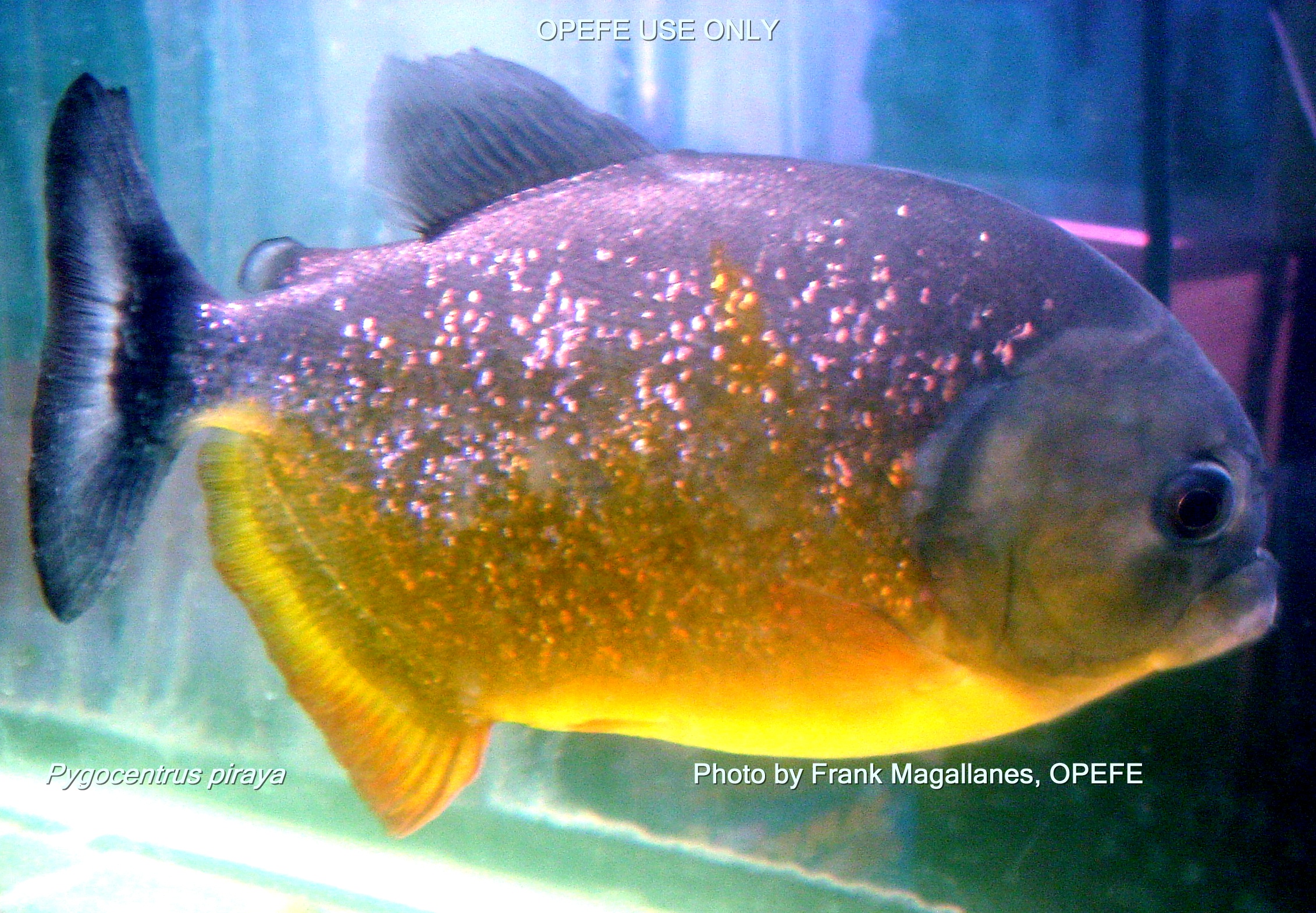
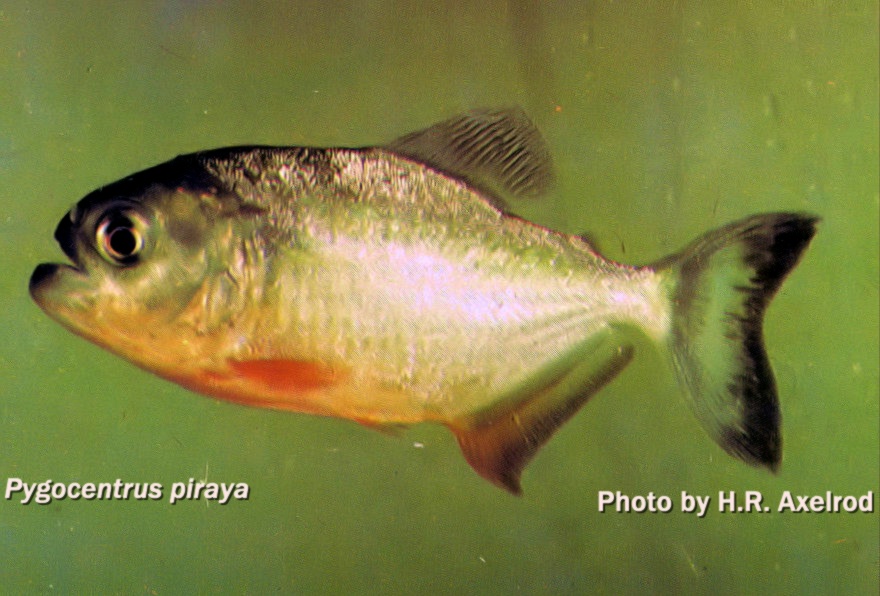
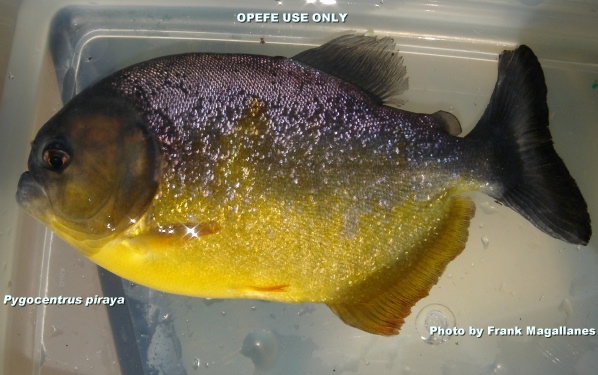
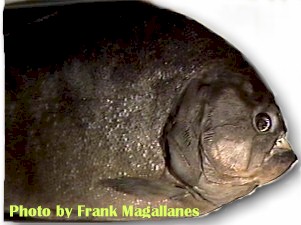
Pygocentrus piraya is the largest of the 3 species of true piranha often reaching the impressive size of 20 U.S. inches, though smaller one’s are imported for aquarium use. Having kept my first P. piraya in 1976, few were imported during that time. Most were not distinguished from P. nattereri by dealers, though the body color flames were a clear indication of the species true identity. The hobby of piranha keeping itself for the home aquarist did not really begin until the early 1960's. Prior to that, few people even knew what a piranha was, much less the number of species available. Today, it is not uncommon to find them in pet stores that specialize in oddball fishes. The other two species of true piranha (P. species and P. nattereri) are much smaller in size. P. piraya has the least dark body pigment in the genus, because spotting is reduced and then lost relatively early in ontogeny. The small sample available for color pattern descriptions indicates that the bright yellow-orange pigment of living specimens covers more of the body than similar pigmentation in other species. However, as in the other species in the genus, one might expect ontogenetic stage and environmental variables such as water color to effect pigmentation.
|
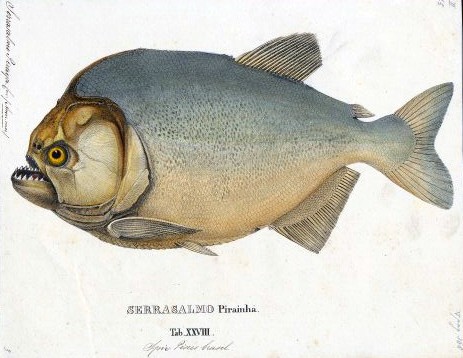
Plate image photo shopped to enhance colors |
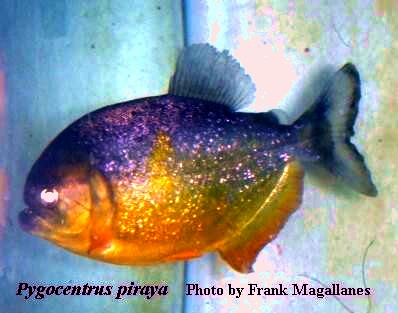
Pygocentrus piraya, aquarium specimen - Frank Magallanes |
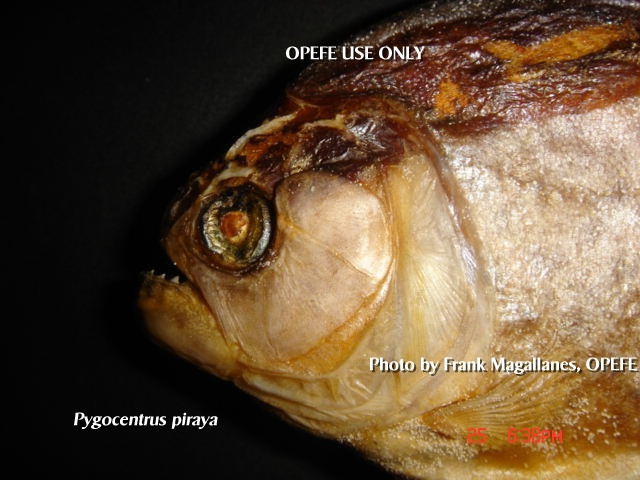
Head image |
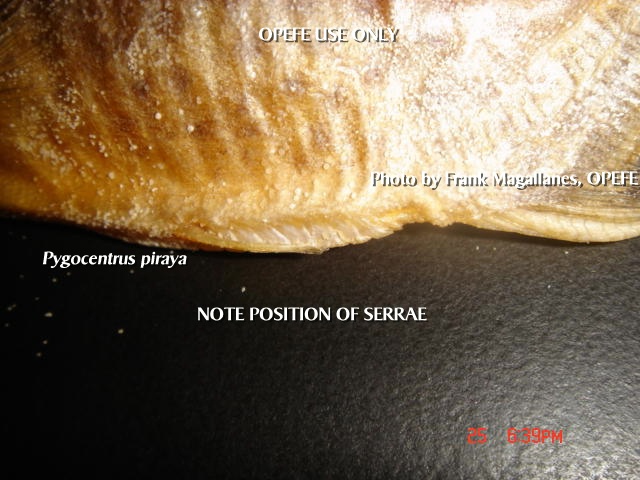
Belly serrae |
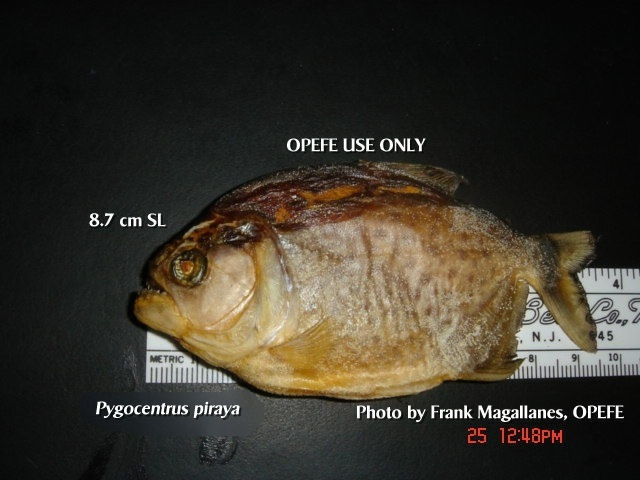
Body measurement |
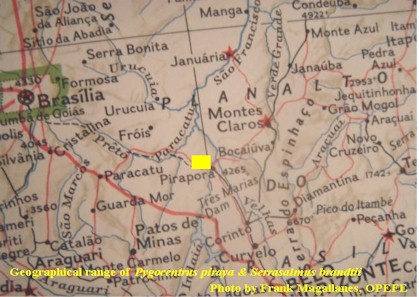
Locality |
 The
classification of this species has been covered under genus Pygocentrus (here). The species closely resembles
Pygocentrus nattereri. The only external differences between the two
species is piraya size, flank flames and the growth of a rayed adipose
fin that seem to develop after the species attains approximately 9 inches total
length or larger (*sub-adult). Few people are able to keep this species in
captivity because of the large size it attains. Some hobbyists, who are keeping piraya
as a pet, remark how much more the head of piraya differs from other
piranhas in genus Pygocentrus. However, only slight differences
actually exist between the 3 species of Pygocentrus. (Click here) for a web page that discusses
piranha head shapes. * Sub-adult -- A developmental life stage when fish exhibit
most but not all traits of an adult fish.
The
classification of this species has been covered under genus Pygocentrus (here). The species closely resembles
Pygocentrus nattereri. The only external differences between the two
species is piraya size, flank flames and the growth of a rayed adipose
fin that seem to develop after the species attains approximately 9 inches total
length or larger (*sub-adult). Few people are able to keep this species in
captivity because of the large size it attains. Some hobbyists, who are keeping piraya
as a pet, remark how much more the head of piraya differs from other
piranhas in genus Pygocentrus. However, only slight differences
actually exist between the 3 species of Pygocentrus. (Click here) for a web page that discusses
piranha head shapes. * Sub-adult -- A developmental life stage when fish exhibit
most but not all traits of an adult fish.
IN THE AQUARIUM
Potentially Dangerous To Humans - Cautionary statement for hobbyists: Some aquarists report keeping this fish as a group, however long term results are sketchy (infighting) often resulting in death. Recommend keeping as a solitary species when juvenile to sub-adult or when they are very large adults. Less infighting is reported as adults, but I wouldn't trust that opinion too far! Large water changes are recommended for any species of piranha kept as a group. Water changes keep the aggression levels low. OPEFE has several articles regarding this and the fright response (here). Mixing this species with other members of Pygocentrus (species and nattereri) is also reported. While this type of aquarium is somewhat successful and probably esthetically pleasing to the eye, it is also unnatural. Unnatural because these 3 species are not found together in the wild. Again, I prefer to err in caution and suggest hobbyists not mix the 3 species, you still run the risk of something going wrong, thereby losing your fish or fishes through predation. While some may argue their experience has shown them these fish can be kept together, it does not over rule the naturalness of these beasts....Cannibalism!
In keeping unpredictable species like Pygocentrus its better to err for life than death! Some hobbyists also place non-piranha fish with their P. piraya. While this practice is not recommended for the average aquarists, advanced aquarists have had minor success in keeping bottom dwellers and small characins that are below this piranha’s notice. But don’t trust that logic too far. The suggested aquarium size for a single P. piraya (12 inches total length or smaller) is 125 gallons minimum. Anything smaller for this species is not recommended. For multiple P. piraya larger aquariums are strongly suggested.
BREEDING IN THE HOME AQUARIUM
 Hobbyists as of
this writing have not accomplished breeding P. piraya. However, there are
some hobbyists trying and the purpose of my writing information here is to help
provide data that may be of some help. P. piraya as described above, is
the largest species in genus Pygocentrus. While their breeding habits are
similar to P. nattereri, there are some things that need to be done in
order to have the best suitable breeding environment. Sexually mature fishes are
those that are (female) approximately 28 cm SL (= 11.02 inches SL) and male,
18.0 cm SL (=7.087 inches SL). Be sure to add 1.5 inches to achieve TL (= Total
Length) to those previous numbers. Breeding sizes in aquariums may be smaller.
P-FURY members have an active program to breed this species, with one member
reporting eggs being released, but unfertilized. Because they are a large
species and prone to excessive aggressive behavior, it is my recommendation that
an aquarium of at least 500 U.S. gallons be used to facilitate breeding. While
it may be possible to accomplish this in much smaller aquariums, I believe the
greater accomplishment would be with the larger tank as this would give P.
piraya a much better chance to feel at home. Smaller aquariums
could cause aggressive behavior problems and territorial disputes. Though this
could also play out in larger aquariums, but less likely. Cannibalism is a norm
for Pygocentrus species and this species is no different. So be watchful
for any problems that might occur. Body damage from bites could lead the group
to attack and eat the injured fish. Like other species of piranha and pirambeba,
the fish darken during breeding condition. Tail slapping and also nest building
has been observed (see Hartt, 1870 notes below). This behavior is also common
amongst all the species. In the wild, the water fluctuates (covered below) and
this causes the fat storage in the dorsum area to be used as needed depending on
the season. This then triggers egg production. As I stated with P. species,
the spawning will occur if the fish is ready and the conditions are right. Water
changes alone will not accomplish this nor will re-creating a wet season or dry
season. The main thing with water fluctuation is the abundance or lack of food.
Knowing how much is a problem as each fish is different as are the needs.
Hobbyists as of
this writing have not accomplished breeding P. piraya. However, there are
some hobbyists trying and the purpose of my writing information here is to help
provide data that may be of some help. P. piraya as described above, is
the largest species in genus Pygocentrus. While their breeding habits are
similar to P. nattereri, there are some things that need to be done in
order to have the best suitable breeding environment. Sexually mature fishes are
those that are (female) approximately 28 cm SL (= 11.02 inches SL) and male,
18.0 cm SL (=7.087 inches SL). Be sure to add 1.5 inches to achieve TL (= Total
Length) to those previous numbers. Breeding sizes in aquariums may be smaller.
P-FURY members have an active program to breed this species, with one member
reporting eggs being released, but unfertilized. Because they are a large
species and prone to excessive aggressive behavior, it is my recommendation that
an aquarium of at least 500 U.S. gallons be used to facilitate breeding. While
it may be possible to accomplish this in much smaller aquariums, I believe the
greater accomplishment would be with the larger tank as this would give P.
piraya a much better chance to feel at home. Smaller aquariums
could cause aggressive behavior problems and territorial disputes. Though this
could also play out in larger aquariums, but less likely. Cannibalism is a norm
for Pygocentrus species and this species is no different. So be watchful
for any problems that might occur. Body damage from bites could lead the group
to attack and eat the injured fish. Like other species of piranha and pirambeba,
the fish darken during breeding condition. Tail slapping and also nest building
has been observed (see Hartt, 1870 notes below). This behavior is also common
amongst all the species. In the wild, the water fluctuates (covered below) and
this causes the fat storage in the dorsum area to be used as needed depending on
the season. This then triggers egg production. As I stated with P. species,
the spawning will occur if the fish is ready and the conditions are right. Water
changes alone will not accomplish this nor will re-creating a wet season or dry
season. The main thing with water fluctuation is the abundance or lack of food.
Knowing how much is a problem as each fish is different as are the needs.
BREEDING IN THE WILD
Tropical Wild Life In British
Guiana: Zoological Contributions From The Tropical Research Station Of The New
York Zoological Society: William Beebe. George Inness Hartley. Paul Griswold
Howes. New York Zoological Society. Tropical Research Station, 1917
Rio Sao Francisco:
The fishermen said that the
Piranha also leaves the river and chooses a shallow spot with a sandy bottom to
deposite its eggs. Stooping down, the fisherman with whom I was conversing one
morning took up a Piranha lying before him, and showed me just how the eggs were
laid. The fish having chosen the proper spot, sweeps away the sand with its tail
and anal fin, so as to make a little saucer shaped depression four or five
inches wide. The eggs, of about the size of mustard-seed, are then laid in the
nest in a ball, two or three inches in diameter. This accomplished, the mother
fish takes up her position near the nest, and keeps watch over the eggs until
the young are hatched, for the Piranha has enemies in the hungry little Piabas,
which swarm about in countless numbers, and from which she must defend her eggs.
Looking over a large lot of Piabas in a canoe, I found it difficult to obtain a
perfect specimen, on account of the mutilation of the tail and fins. "This
is the Piranha's work," said the fisherman, " and the marks of the
terrible teeth of the monster." The larger fish of the river also bear
similar scars.
The laying, according to the fisherman, takes place principally in October, or
soon after the freshets set in. During this time the Piranhas are especially
fierce.
One fisherman described in a vivid manner his finding a Piranha watching its
nest in a shallow place by the riverside. "I thought to catch it,"
said he, " and waded softly into the water to put a basket over it, but I
was not quick enough. The fish darted at me and took a piece out of my leg. Look
there!" and rolling up his pants he showed a pair of crescent-shaped scars
left by the fish's jaws. The fishermen are often bitten, and almost every man
present had scars to show, either on the arms or legs.
The fishermen united in saying that just as this fish is about to spawn the
color of the belly changes from yellow or orange to the same color as the back,
but that soon after the eggs are laid the original color returns.
The Piranha frequents rather the deeper parts of the river, and abounds in the
eddies among the rocks, but I have seen it caught, as at Penedo, close in shore,
where the water-was. not very deep and the bottom was sandy.
During my stay at Penedo a poor little idiot sitting on the pier, having been
frightened by a cannon, fell over into the river. The next morning the Piranhas
caught in the vicinity were found to contain portions of his body. There are
numerous well-authenticated cases where persons have been attacked by the fish
while bathing and devoured. Only a short time before my visit to Penedo a young
lady was thus attacked and eaten. A horse fording the river slips and wounds
himself on a stone; the Piranhas, attracted by the blood, crowd about in great
numbers, each cutting out mouthful after mouthful of flesh, until, in many
instances, the voracious creatures have been known to devour the entire animal
in a few hours. They sometimes throng about their prey in such numbers that they
may be seen leaping one on top of the other out of water, in their eagerness to
get at it.*
* Bates speaking of the great swarms
of Piranhas in the Amazonas. Humboldt (Travels, Vol. II. p. 1G7) says of the
Piranhas of the Orinoco: "The Indians dread extremely these caribes; and
several of them 6howed us the scars of deep wounds in the calf of the leg and in
the thigh made by these little animals. They swim at the bottom of the rivers;
but if a few drops of blood be shed on the water they rise by thousands to the
surface, so that if a person be only slightly bitten it is difficult for him to
get out of the water without receiving a severer wound." dangerous only
during the spawning season. During my voyage on the Sao Francisco I saw
everywhere bare-legged women standing in the water on the banks washing, and
that not only in sandy and quiet localities, but among the rocks, as at Propria,
while I repeatedly saw men wading in the water and boys bathing in the river.
PUBLIC AQUARIUM BREEDING
No record of P. piraya spawning in public aquariums has ever been reported. It has also been discovered that the following statement (italicized) below are inaccurate regarding spawning at a public aquarium. The species being discussed was P. nattereri not P. piraya. The inaccurate remarks will be left on line so that current readers may update themselves:
Schulte (1988) reported spawning have occurred at Aquarium Zoological Gardens in Frankfurt, Germany and Zoological Gardens, Hellabrunn, Munich, Germany, however, it was not determined that P. piraya was the species bred in captivity.
WATER CHEMISTRY
 Water
chemistry (here) for
the rio Sao Francisco (and depending where you are) is: Temp; 21 - 24 C, pH; 6 -
7.8, Hardness up to 25 dGH. What I would also suggest is lowering the pH from
the higher figure to about 6.0 and doing 30% water changes every three
days, using pre-conditioned water that had been treated by adding a phosphoric
acid at the rate of 5 milliliters per gallon. The reasoning behind this is
because it is known that some hard to breed catfishes from this region were able
to be achieve breeding behavior and clutches of eggs using this method after the
5th water change. While there is no guarantee this might help P. piraya
spawn, one never knows until all venues are examined. Peat filtration should be
used in all cases. What might be of interest to readers is the natural pH value
of Rio Sao Francisco can range anywhere from 4.8 to 7.8 and the areas where some
P. piraya are caught (rio das Velhas, a tributary of the rio Sao
Francisco) pH can average 6.5 to 8.7! Many organisms cannot tolerate high levels
of acidity, and even those who can, face the problems that their food sources
(such as insects) cannot survive in highly acidic environments. As acidity in a
water system increases, the number and diversity of organisms decreases. Also,
at levels of pH 5, most fish eggs cannot hatch (see: Project Amazonas, Threats -
Pollution). Getting back to breeding this species and its requirements, a
biological filtration box (wet/dry system) should be used as majority of
successful breeding of P. nattereri has been accomplished using this
method. Add a couple air stones in each end of the tank. Lastly, go back and
read information on S. maculatus and P. nattereri as the general
rules for breeding would nearly apply here too. However, water quality and
chemistry are two very important items to consider. According to Myers, 1972 in
his account of Hartt (1870, p. 401) this scientist gave some
circumstantial information on the breeding of P. piraya. This information was
given to him by Fishermen of the Rio Sao Francisco. "The fish clean out
a shallow nest on the sandy bottom and spawn in it. The female guards the nest
and viciously attacks any animal or human who comes near. This is said to take
place principally in October soon after the rains raise the water level."
Water
chemistry (here) for
the rio Sao Francisco (and depending where you are) is: Temp; 21 - 24 C, pH; 6 -
7.8, Hardness up to 25 dGH. What I would also suggest is lowering the pH from
the higher figure to about 6.0 and doing 30% water changes every three
days, using pre-conditioned water that had been treated by adding a phosphoric
acid at the rate of 5 milliliters per gallon. The reasoning behind this is
because it is known that some hard to breed catfishes from this region were able
to be achieve breeding behavior and clutches of eggs using this method after the
5th water change. While there is no guarantee this might help P. piraya
spawn, one never knows until all venues are examined. Peat filtration should be
used in all cases. What might be of interest to readers is the natural pH value
of Rio Sao Francisco can range anywhere from 4.8 to 7.8 and the areas where some
P. piraya are caught (rio das Velhas, a tributary of the rio Sao
Francisco) pH can average 6.5 to 8.7! Many organisms cannot tolerate high levels
of acidity, and even those who can, face the problems that their food sources
(such as insects) cannot survive in highly acidic environments. As acidity in a
water system increases, the number and diversity of organisms decreases. Also,
at levels of pH 5, most fish eggs cannot hatch (see: Project Amazonas, Threats -
Pollution). Getting back to breeding this species and its requirements, a
biological filtration box (wet/dry system) should be used as majority of
successful breeding of P. nattereri has been accomplished using this
method. Add a couple air stones in each end of the tank. Lastly, go back and
read information on S. maculatus and P. nattereri as the general
rules for breeding would nearly apply here too. However, water quality and
chemistry are two very important items to consider. According to Myers, 1972 in
his account of Hartt (1870, p. 401) this scientist gave some
circumstantial information on the breeding of P. piraya. This information was
given to him by Fishermen of the Rio Sao Francisco. "The fish clean out
a shallow nest on the sandy bottom and spawn in it. The female guards the nest
and viciously attacks any animal or human who comes near. This is said to take
place principally in October soon after the rains raise the water level."
COLOR OF LIFE
|
|
|
|
Fink, W. L. 1993 (18 Aug.) Revision of the piranha genus Pygocentrus (Teleostei, Characiformes). Copeia 1993
Sub-adults and Adults (color in preservative)
Based on specimens 130.9 mm SL and 143mm SL, ground color is pale goldish-brown, darker above, becoming silvery-gold below the lateral midline. No spotting, and virtually no dark pigmentation, are present. The dorsal fin has some duskiness at fin base in some specimens; adipose fin with narrow dark border; anal fin with some dusky pigment, primarily in a narrow line along the distal border of the posterior two-thirds of the fin; fins otherwise hyaline. Dark vertical band passes through the eye, which is otherwise gold color.
Juveniles (color in preservative)
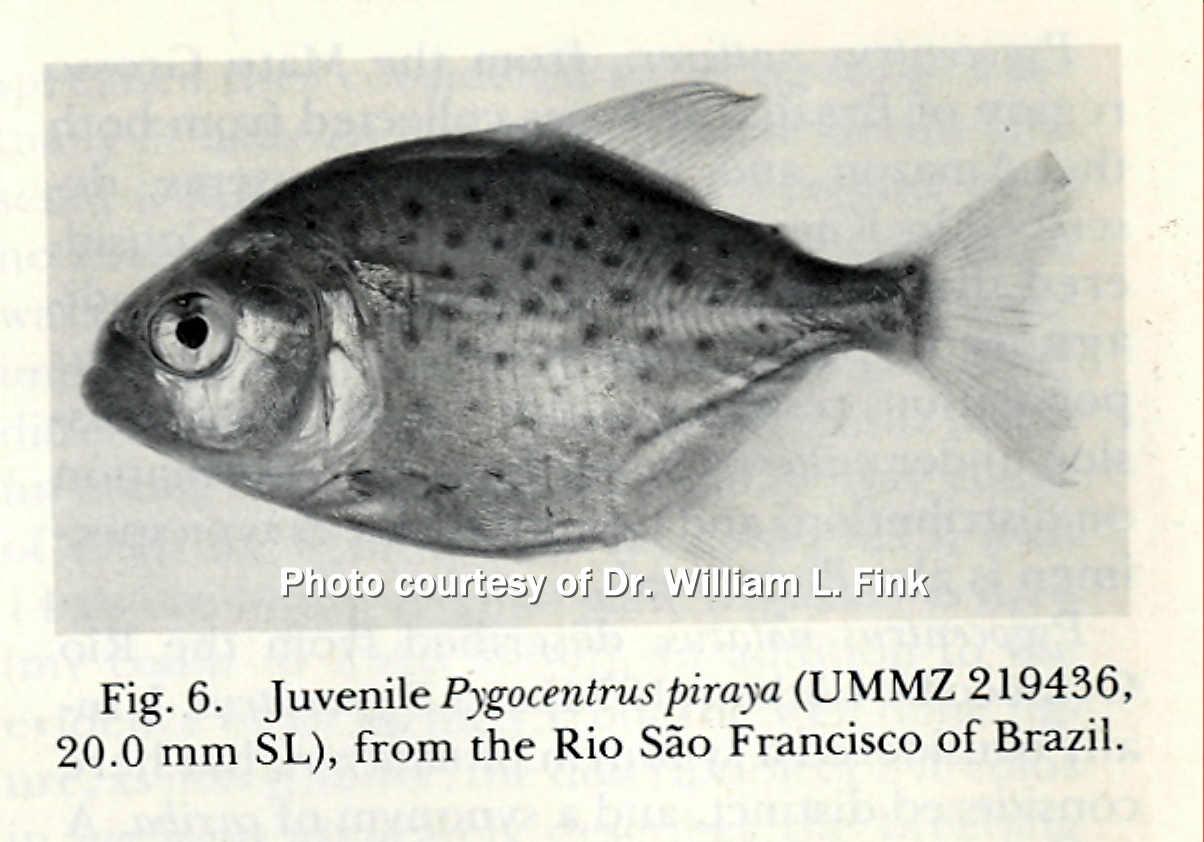
Juvenile color pattern, based on eight specimens 20-69 mm SL Bahia, Brazil (fig. 6 above), as in adults but more brownish background color. Posterior borders of the vertical fins are faintly dusky, with but a small amount of pigment. There are numerous round dark spots on the lateral body, including the belly region, but less numerous in the latter region.
This species has the least dark body pigment in the genus, because spotting is reduced and then lost relatively early in development. The small samples available for color pattern descriptions indicates that the bright yellow-orange pigment of living specimens covers more of the body than similar pigmentation in the other species. However, as in the other species in the genus, one might expect developmental stage and environmental variables such as water color to effect pigmentation. The eye color is yellowish-orange, with a dark black vertical stripe. Most of the lateral body is is bright yellow-orange, the color extends from the border of the head, up to the dorsal to the lateral line, extending to the rear of the caudal peduncle to the base of the ventral caudal-fin lobe. Pectoral, pelvic, and anal fins are bright yellow-orange. The anal fin has a narrow posterior black border. The dorsal, adipose, and caudal fins are dark as in the dorsal part of the body; there is a pale or hyaline area on the caudal fin between the proximal and distal black bands. 3 belly colors (red, orange, or yellow) are presumed to occur in P. piraya depending on locality and age.
Teeth
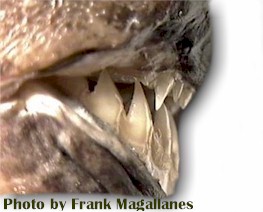
The teeth of Pygocentrus piraya are broad, serrated, tricuspid and razor sharp. These teeth are used for slicing chunks of fish. These teeth are backup by strong musculature that have enough force with combination of the teeth to clip off a finger or toe! A medium sized P. piraya (12 inch specimen) can have teeth as long as 10 mm TL or larger depending on the overall size of the animal.
Science
William L Fink - 1993
Pygocentrus piranha
Pygocentrus piraya
HISTORICAL
Pygocentrus piraya (Cuvier, 1819)
Pygocentrus bidorsalis
Pygocentrus piranha
SEXUAL DIMORPHISM
(CROSS, A.M.G.; SATO, Y.; RIZZO, E.; SAINTS, G.B.; BAZZOLI, N. sexual Maturação of piranha Pygocentrus piraya (Cuvier, 1820) (Pisces, Characidae) in the dam of Three Marias, Minas Gerais. Bios , 4 (4): 17-22, 1996).
Sexual dimorphism has been reported for the species via microscopic examination of the gonads. These fish were later raised and sexuality determined by age, sexual maturity and size.
DISTRIBUTION
The species is restricted to the Rio Sáo Francisco drainage of Brazil where the populations are being diminished because of human intervention and expansion. This species and S. brandtii are the only piranhas known to inhabit this river and its tributaries.
REFERENCES
Spix, J. B. von and L. Agassiz 1829-31 Selecta genera et species piscium quos in itinere per Brasiliam annos MDCCCXVII-MDCCCXX jussu et auspiciis Maximiliani Josephi I.... colleget et pingendso curavit Dr J. B. de Spix.... Monachii. Selecta Piscium Brasiliam: Part 1: i-xvi + i-ii + 1-82, Pls. 1-48;, Part 2: 83-138, Pls. 49-101. [Part 1 published June 1829, part 2 Jan. 1831; see Kottelat 1988, Whitehead & Myers 1971, Pethiygoda & Kottelat 1998.]
Fink, W. L. 1993 (18 Aug.) Revision of the piranha genus Pygocentrus (Teleostei, Characiformes). Copeia 1993 (no. 3): 665-687.
Kner, R. 1860 Zur Familie der Characinen. III. Folge. Der Ichthyologischen Beiträge. Denkschr. Akad. Wiss. Wien v. 18: 9-62, Pls. 1-8. [Also as a separate, pp. 1-54, with dual pagination. Some taxa appeared first in Kner 1858. Pygocentrus bidorsalis Kner (ex Heckel) 1860: 36 [28] [Denkschr. Akad. Wiss. Wien v. 18; . On p. 28 of separate. Not available, name mentioned in text under Pygocentrus piraya Müller and Troschel. Characidae: Serrasalminae. Habitat: freshwater.
Cuvier, G. 1819 Sur les poissons du sous-genre Hydrocyon, sur deux nouvelles espèces de Chalceus, sur trois nouvelles espèces du Serrasalmes, et sur l'Argentina glossodonta de Forskahl, qui est l'Albula gonorhynchus de Bloch. Mem. Mus. Natl. Hist. Nat. v. 5: 351-379, Pls. 26-28.
Bertin, L. 1948 Catalogue des types de poissons du Muséum national d'Histoire Naturelle. 3e partie. Ostariophysaires (Characiniformes, Gymnotiformes). Cat. Fish Types, Paris 3e partie: 1-49.
Britski, H. A. 2001 Sobre a obra Velhas-Flodens Fiske [Peixes do Rio das Velhas]. In: Alves and Pompeu (organizers) Peixes do Rio das Vehlas: Passado e presente. Belo Horizonte, SEGRAC. cap. 1. Peixes do Rio das Velhas: 15-22.
BLACKSMITH, R.M.A.; BAZZOLI, N.; RIZZO, E.; SATO, Y. - reproductive Aspects of piranha, Pygocentrus piraya (Teleostei, Characiformes), native species of the basin of the River Sâo Francisco. Arq. Bras. Med. Vet. Zootec. 48 (supl. 1): 71-76, 1996.
CROSS, A.M.G.; SATO, Y.; RIZZO, E.; SAINTS, G.B.; BAZZOLI, N. sexual Maturação of piranha Pygocentrus piraya (Cuvier, 1820) (Pisces, Characidae) in the dam of Three Marias, Minas Gerais. Bios , 4 (4): 17-22, 1996.
BAZZOLI, N.; RIZZO, E.; SAINTS, J. E.; SATO, Y. - Dynamic of ovogênese in forrageiros fish of the dam of Three Marias, Minas Gerais: histológico and histoquímico study. Bios, 4 (4): 5-10, 1996.
Schute, Wolfgang - Piranhas in the Aquarium TFH Publications, Inc. NJ pg. 87-88, 1988.
Hartt, Charles Frederick. 1870. "Geology and Physical Geography of Brazil." In: Thayer Expedition: Scientific Results of a Journey in Brazil, by Louis Agassiz and his travelling companions, Boston.
Myers, G. S. 1972, The Piranha Book, M-539 TFH Publications, Inc. Neptune NJ.
Plate image of Salmo piranha courtesy of http://www.archive.org
CLICK HERE TO RETURN PYGOCENTRUS LIST
USE YOUR BACKSPACE TO RETURN OR CLICK HERE TO RETURN RESEARCH PAGE
TO RETURN HOME CLICK HERE.
The OPEFE web site and its contents; is disclaimed for purposes of Zoological Nomenclature in accordance with the International Code of Zoological Nomenclature, Fourth Edition, Article 8.3 and 8.4. No new names or nomenclature changes are available from statements at this web site.
Copyright© 1994-2012 Oregon Piranha Exotic Fish Exhibit (The OPEFE fish exhibit is permanently CLOSED as of 2000) Sutherlin, Oregon. Information posted on this web site is archival data on fish scientific classifications and other information. DISCLAIMER: The copyrighted material may not be used for any purpose other than private study, scholarship or research. Cited information requires credit and this link www.opefe.com. All rights reserved. All images shown (unless otherwise noted) is property of OPEFE.
Created: April 10, 1994
UPDATED: 11/09/2014