Eschmeyer
has questions on the fishes cited range by Jégu according to the databanks.
The
systemic of piranhas is constantly changing as more current research is being
done. It further remains unknown when further systemic work will be accomplished
other than DNA and parasitological. M. Jégu is present authority on Brazilian
species and his work is not always complete or published. My correspondence with
him has not produced any fruitful information on what the future holds regarding
these species. It is indeed a messy species group.
Below
information is based on available information research and my own opinion.
Remarks by me is not to be construed as factual but based on research. S.
serrulatus is an obscure species that could fit almost any Pristobrycon-like
species.
DIET
Masticated
seeds and fish parts.
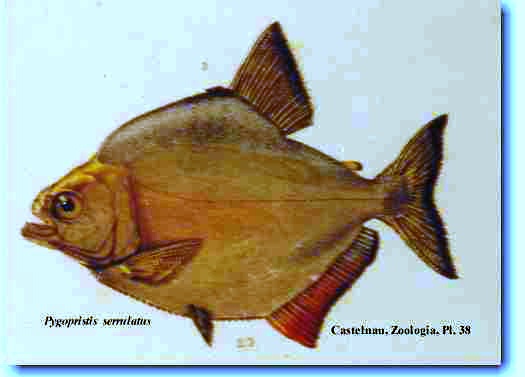
 In
the original discussion, Valenciennes (1849) does not mention a terminal band on
the caudal fin, Castelnau (1855) affirmed there is a terminal border on the
caudal fin and shows it on the plate image. However Géry (1964), based on the
holotype specimen, does not present any color that indicates a terminal band.
Due to the age and condition of the specimen, Géry cannot conclude
anything. See Jégu remarks under Historical Names.
In
the original discussion, Valenciennes (1849) does not mention a terminal band on
the caudal fin, Castelnau (1855) affirmed there is a terminal border on the
caudal fin and shows it on the plate image. However Géry (1964), based on the
holotype specimen, does not present any color that indicates a terminal band.
Due to the age and condition of the specimen, Géry cannot conclude
anything. See Jégu remarks under Historical Names.
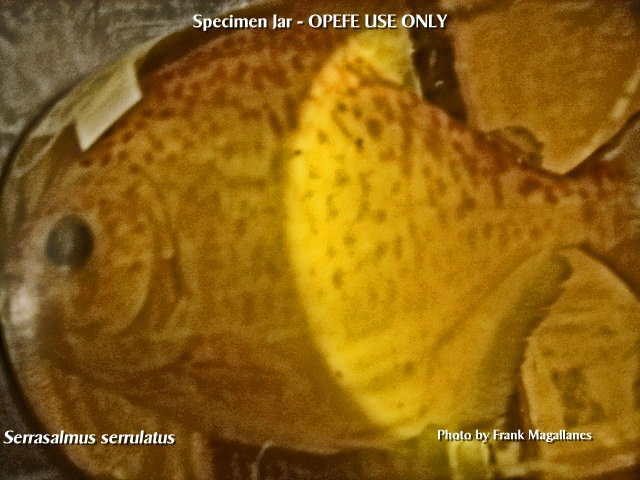
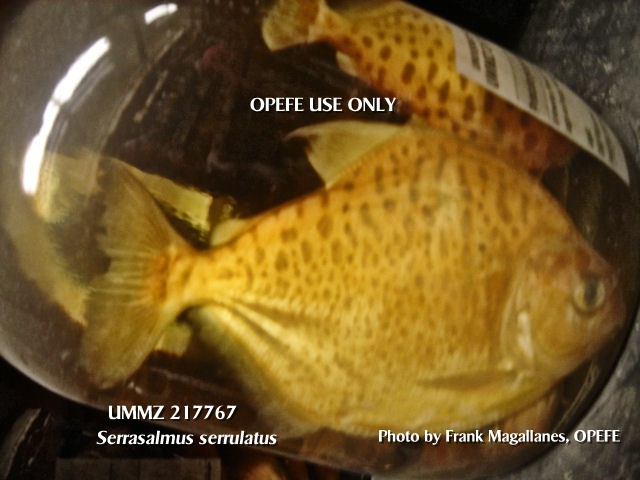
The
bottled specimen above is placed as Pristobrycon serrulatus according to
the label. The specimens shown above are in the W. L. Fink laboratory at UMMZ.
The specimen shows a faint dark "V" and does seem to present a
colored pattern at the caudal edge though very faint. The only recent review was
in 1988, Le Genre Serrasalmus dans le bas Tocantins (Brésil) et description de S.
geryi. See references below.
Morphological
and reproductive aspects of the piranha Serrasalmus serrulatus
(Valenciennes, 1849) (Ostariophysi, Serrasalmidae) in the archipelago of
Anavilhanas, lower Rio Negro, Brazil.
E. L. M.
Leão
1985 - 220 pages
The pairs of morphometric characters traditionally used in taxonomy of
Serrasalminae were considered in a study on biometrics of a sample of 253
specimens of Serrasalmus serrulatus Anavilhanas the archipelago, and its
relation expressed by linear regression.
The
existence of sexual dimorphism was tested by ANCOVA. The estimated values
for the mean lengths of sexual maturity of both sexes belong to
the range in standard length qeu found that the base of the dorsal of males
becomes greater than that of females. This allows us to assume that there was an
adaptive significance to a larger base of the dorsal fin in males, when
individuals reach adulthood.
We
observed a small decrease of 1.5 lateral line scales and a small increase of 1.0
rows of scales that cover the anal, with the growth of individuals from 100 mm
to 181 mm standard length. S. serrulatus has a maximum of six conical
teeth in each ectopterigóide. The number of teeth ectopterigoideanos decreases
as the fish grow in length. The total loss of teeth occurs between 110 mm and
166 mm standard length.
The data
in our sample are compared with those available in the literature for the
holotype of the species studied, 5 S. serrulatus Suriname and three other
species - S. scapularis, s. and S. aureus gymnogenys - qeu
have been linked to S. serrulatus a controversial problem of synonymy.
The only
differences between the holotype of S. serrulatus and S. serrulatus
Anavilhanas eye diameters were higher, the presence of peaks paired before the
anus and a greater number of rows of scales on the anal, checked in our sample.
The diameters of the eye specimens showed Anavilhanas is also higher than those
of S. scapularis and
S. gymnogenys. S. serrulatus and S. differed from S.
aureus scapularis and S. gymnogenys
because they have a higher base of the dorsal. The number of lateral line
scales revealed differences between S. serrulatus (maximum of 81 scales),
S. aureus (86), S. gymnogenys (95) and S. scapularis
(81-95). The high number of branched rays of anal S. aureus (35) this
species differed from the others, qeu showed a maximum of 33 rays.
When
related to standard length, the distance pre-dorsal projection, body height,
distance and the base of the dorsal fat fat revealed no differences between S.
serrulatus, s. scapularis, S. and S. aureus gymnogenys. The
relationship between inter-orbital distance and vertical length of the head and
base of the anal pattern and length, as well as
the number of rays of dorsal fins, pectoral and pelvic and the number of
pre-ventral serrae, also were not useful for discrimination between S.
serrulatus, s. scapularis and S. gymnogenys.
Serrasalmus
serrulatus, and S. aureus gymnogenys not differ in the relationship
between the direct measurement of length of muzzle and length of the head. We
establish the length-weight relationship for the species Anavilhanas, as well as
the perimeter-length ratio, useful as an aid to the formulation of selectivity
curves gillnets. The ontogenetic and seasonal variations of the staining pattern
of the body are illustrated photographically. Characterizer seasonal variations
are mainly due to the absence or presence of an orange color more or less
pronounced in some regions of the body, acompnhadas a smaller or larger
escuremento flank. We relate these changes to the environment in which the fish
are, during the annual cycle of ebb and flow.
The
ontogenetic variation related to the conspicuity of the humeral spot,
conspicuity and size of the spots from the flank and extension of the caudal fin
hyaline board. Data on the reproduction of the species were collected monthly
from a total of 361 specimens collected from October 1981 to October 1982. The
analysis of the proportionality between the sexes revealed a "fry-ratio
'monthly 1: a predominance of females and between 170 mm and 179 mm standard
length. Estimated at 127 mm and 137 mm respectively, the average length of
sexual maturity and average length of all males are potentially eligible for the
reproductive process.
We
estimate that females reach these stages, respectively, to 124 mm and 142 mm
standard length. The frequency distribution of oocyte diameters of 26 females in
maturation and revealed that the mature spawning species is split, with the
release of at least three batches of oocytes during the reproductive period. We
propose a scale of six stages of maturity, specific for S. serrulatus,
based on macroscopic observation of ovaries. The distribution of monthly
frequency of maturity stages of adult females, together with the variation of
their gonadosomatic index monthly average, according to a spawning period of 6
months, corresponding to the time of rise of the river, and gonadal maturation
is initiated in two th month previous to the peak of drought in Anavilhanas.
DESCRIPTION
A similar
species appears to be S. humeralis-gracilior and first mentioned by
Eigenmann (1915) and S. hollandi (Reinhardt
in Lutken, 1874). There is mention in Norman (1929) where he thought S. eigenmanni
looked more closer like S. serrulatus. Norman synonymized S. aureus
and S. gymnogenus (see also Boeseman, pdf)
with S. eigenmanni.
S. humeralis was synonymized by Norman under S. rhombeus. Interestingly,
S. humeralis was also synonymized with S. marginatus (Valenciennes, 1847). Norman says in part
about eigenmanni........
Upper
part of body with round dark spots; an indistinct diffuse mark on the shoulder;
basal part of caudal dark...further regarding S. serrulatus...
Upper part of body with round dark spots; basal part of caudal dark..
Both these species were compared with S. gymnogenus. Norman
concurred that both the two specimens above were certainly identical
with gymnogenus. The name S. humeralis-gracilior does not appear
again until Géry revised the standing in 1977. He placed this species as a
synonym of S. rhombeus.
Norman
(1929) said the humeral spot was indistinct diffused in which case the
lack of presence of these characters on these fish can be explained and probably
attributed to the ecology they are found in. Stress may also be a
factor. Norman mentions only one specimen (type of the species) in the original
description. The Norman (1929) citation have a drawing of S. serrulatus
and S. eigenmanni...as usual for drawings of that period,
they both look similar to each other except the S. eigenmanni 'V'
type caudal fin is more prominent than S. serrulatus.
Machado-Allison and Fink (1996) mentioned that S. eigenmanni has round
spots later (during ontogeny) developing a combination round spots and some
vertical long ones. Jégu in "Le genre Serrasalmus..." compared S.
eigenmanni with S. humeralis...both
species were quite close, but Jégu separated S. humeralis as a
distinct species from S. eigenmanni based on other characters not found
on S. eigenmanni.
I remain
uncertain on this species, since I have very little information on it from other
localities including lack of photographs, and of course the historical problems
with the humeralis group as a whole. Further complicated by historical
description problems that included many fish in this group on a limited range of
examination. The only present review was Fink and Machado-Allison (1996)
pertaining to the Venezuela species. But subsequent follow ups by Jégu has
left me very confused on species identification and its natural range that
is beyond my understanding at this time. For the time being, S. eigenmanni, S. hollandi, S. humeralis, S. nalseni and S.
serrulatus, may be species that will remain an enigma for me. With the
influx of specimens at the hobbyist level and lack of actual locality data, will
not make identifying this species any easier. Especially, those that might
appear to be S. serrulatus, but may be S. eigenmanni instead.
Gill
(1871) compared this species with Pygocentrus altus but did little to
justify P. altus description by stating only that it was
"Nearly related to P. scapularis (Serrasalmo scapularis)..."
the fish was mentioned probably because S. scapularis has 28 belly
serrae. Fink (1993) examined 3 syntypes of S. scapularis and found the
species serrae count are 28, 30, and 32. Géry (1972) placed P. scapularis
as a subspecies to S. striolatus. Géry recognized only 12 species of
piranha on the entire continent of South America! Nomenclature problems can be
traced to Dr. Géry when he began assigning species as subspecies. In this
situation by Dr. Géry placing S. serrulatus a poorly described species
as a subspecies to a better described taxon.
The
bionomen S. serrulatus has precedent over all the other published names
since it was first (Valenciennes 1850), thus it is likely to stay and the latter
be junior synonyms, if the fish is revisited by a competent authority.
HISTORICAL
NAMES
-
Serrasalmo
scapularis Günther 1864:368 [Cat. Fishes v. 5; ref. 1974]. Essequibo R.,
Guyana. Syntypes: BMNH 1864.1.21.34-36 (3), 1971.5.10.58 (1): Synonym of
Serrasalmus serrulatus (Valenciennes 1849), but a valid subspecies -- (Géry
1972:222: Synonym [of the younger] Pristobrycon striolatus
(Steindachner 1908) -- (Jégu in Reis et al. 2003:188: Perhaps should be
considered as valid as Pristobrycon scapularis (Günther 1864). Pristobrycon
striolatus (Steindachner 1908).
-
Pygopristis
serrulatus Valenciennes in Cuvier & Valenciennes 1850:300 [Hist. Nat.
Poiss. v. 22; ref. 1014]. Amazonas, Brazil. Holotype (unique): MNHN A-9898.
Type catalog: Bertin 1948:25-26: Valid as Serrasalmus serrulatus
(Valenciennes 1850) -- (Géry 1972:221, Ortega & Vari 1986:9, Jégu in
Reis et al. 2003:192, López et al. 2003:32, Menni 2004:78. Serrasalmus
serrulatus (Valenciennes 1850).
Géry 1972
placed S. scapularis as a synonym to S. serrulatus, but considered
it a subspecies. Jégu had some reservations about that placement.
LIST
FOR ABOVE PHOTOS
1.
Castelnau S. serrulatus plate image.
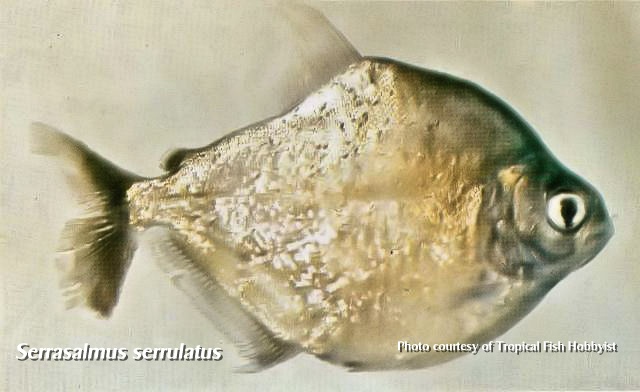
2.
Specimen unknown collection point. Listed as S. serrulatus.
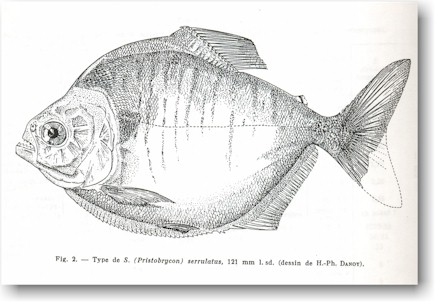
3.
Drawing of Pristobrycon serrulatus (Géry, 1963).
4.
Specimen jar holding Pristobrycon serrulatus (UMMZ) photo by Frank
Magallanes.
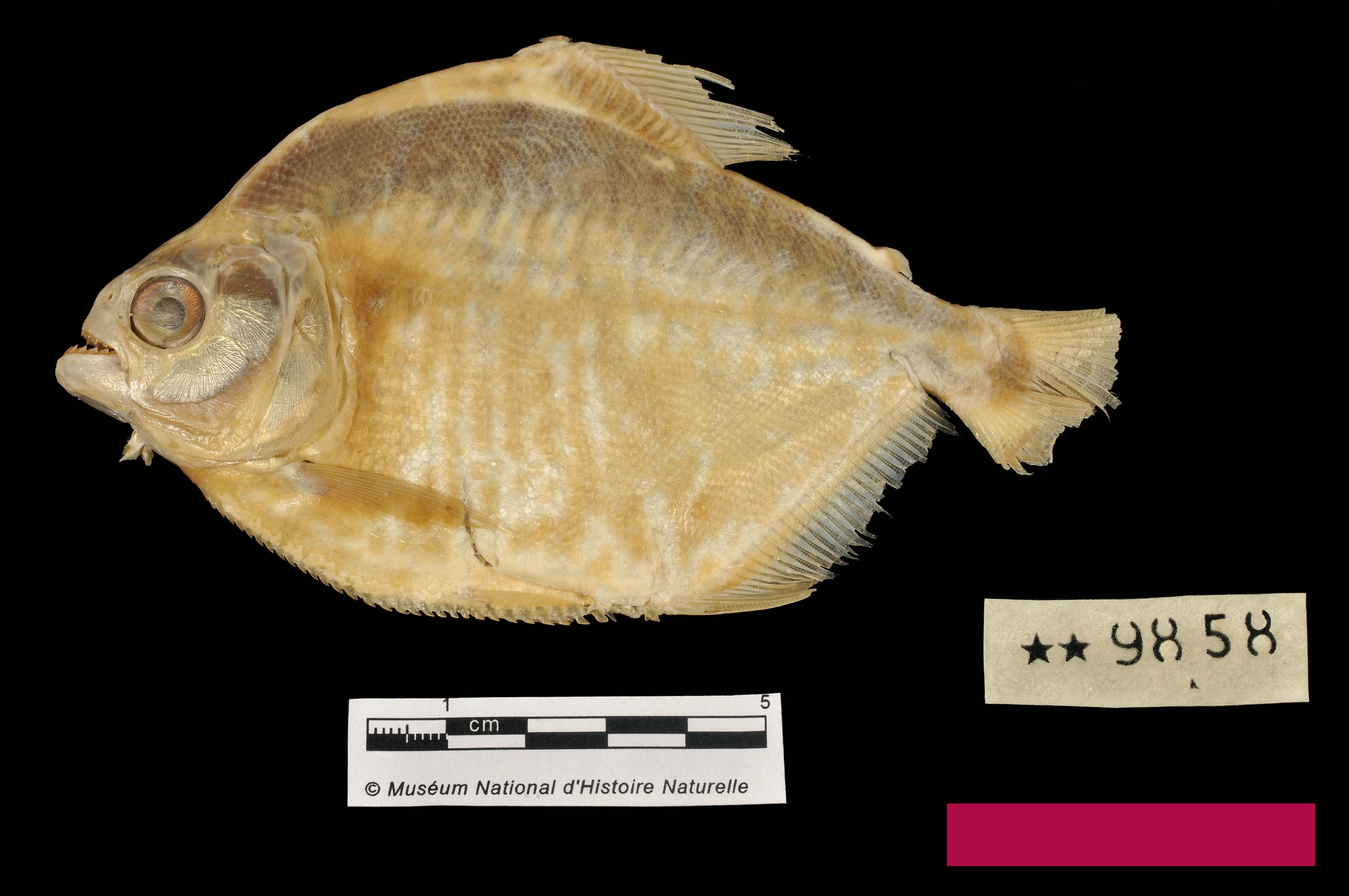
5.
Détail sur le(s) spécimen(s) : Nombre de spécimen : 1 ;LS (mm) : 117 ;LT
(mm) : 150 Conservateur : Alcool Observations : HOLOTYPE DE PYGOPRISTIS
SERRULATUS VALENCIENNES,1849 IN C.V.,H.N.P., XXII : 300 / VOIR REV. HYDROBIOL.
TROP.,21(3) : 239-274,tabl. II Détail sur l'origine : Origine : Bresil Milieu
: Continent - Coordonnées : Bassin hydrologique : Amazone - Cours d'eau :
Amazone Provenance de la collection : Détail sur le(s) collecteur(s) :
Collecteur(s) : Castelnau ; Deville Date de prélèvement : 1847
Interesting
aspect of the HOLOTYPE is the fish itself looks more like S. eigenmanni based
on the serrae. See comments above by Leão.
|
|
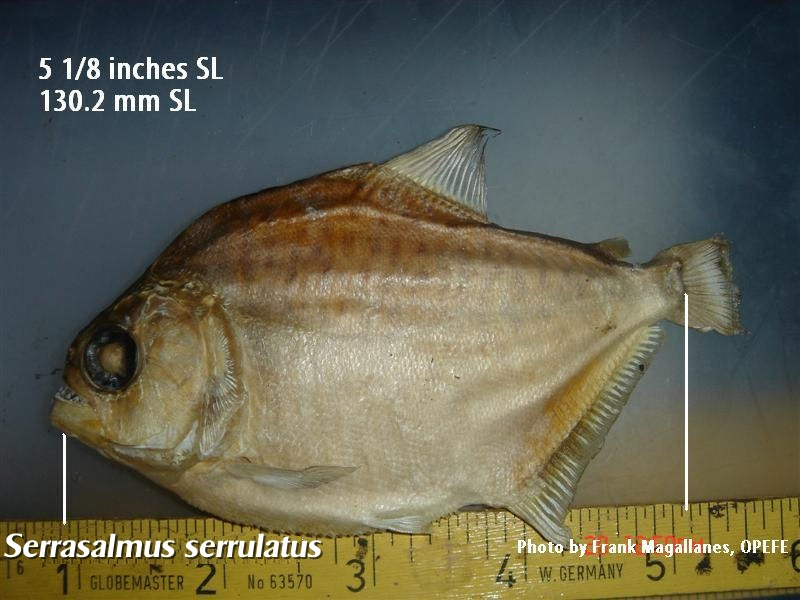
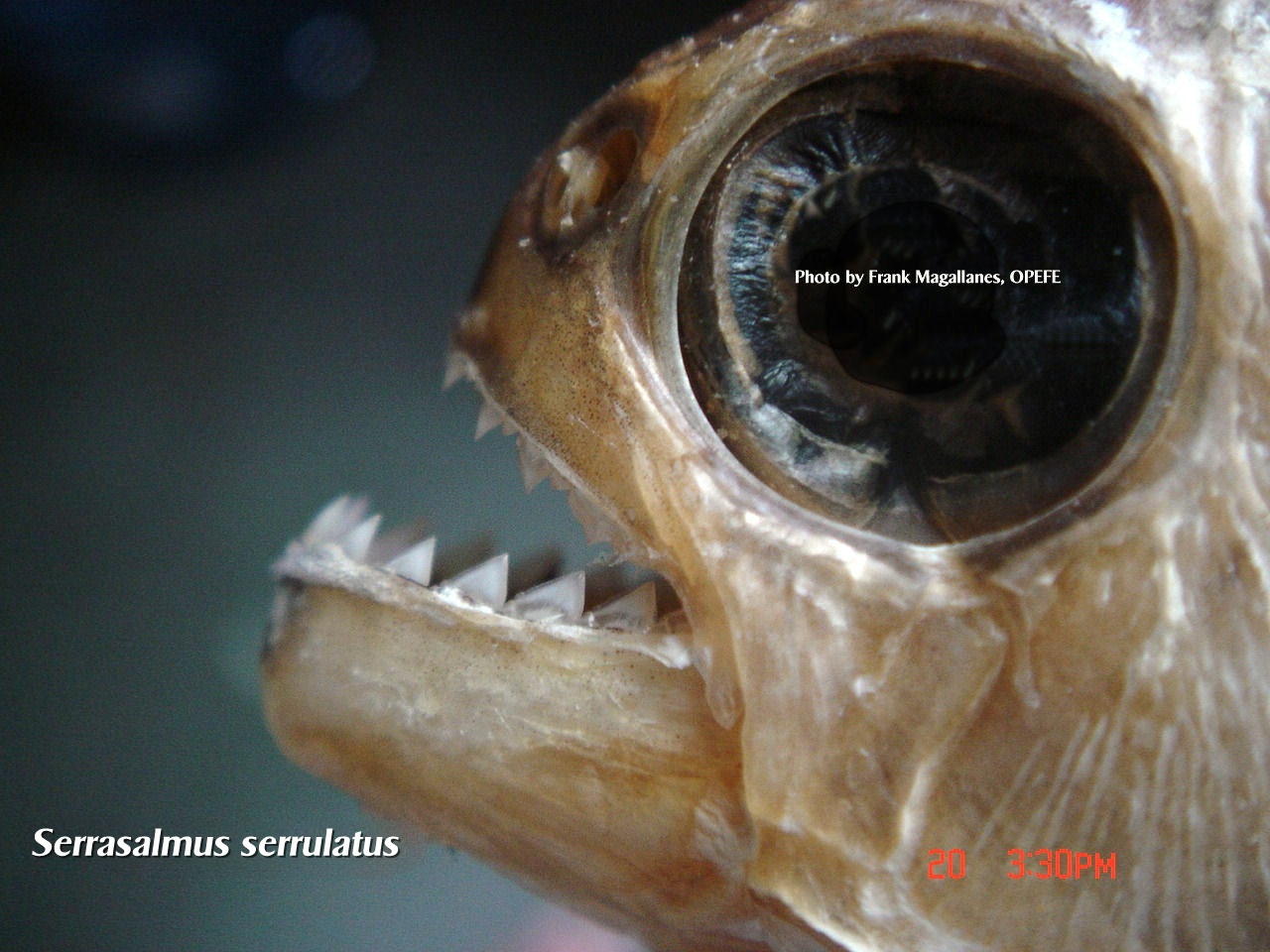
Preserved specimens of S. serrulatus |
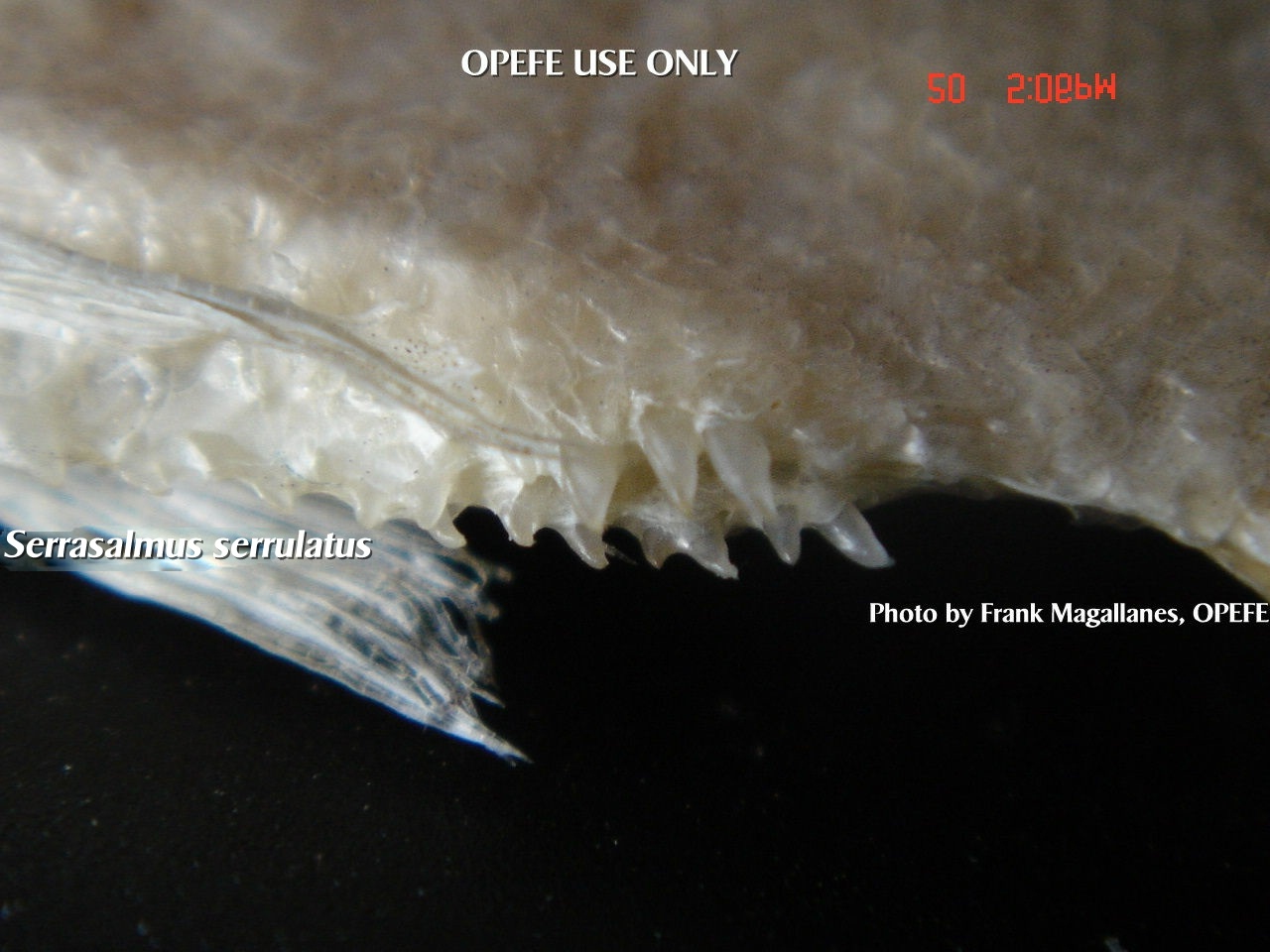
Note the form of the serra pre-anal in a pattern of duel peaks. |
|
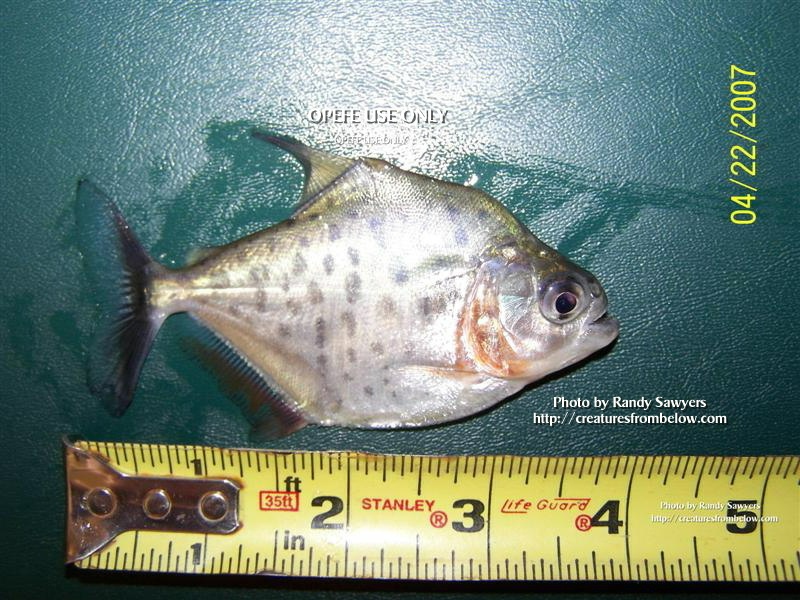
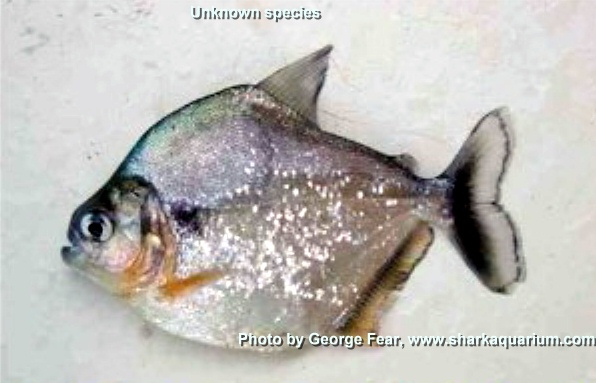
Collected by Raúl Yalán, Rio Nanay, Peru resembling S.
serrulatus.
|
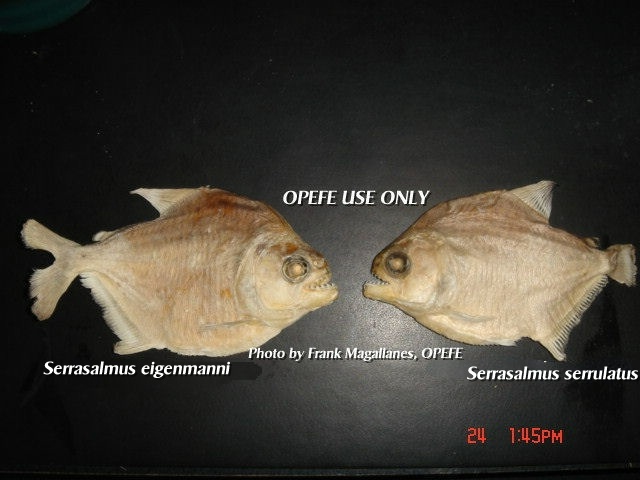
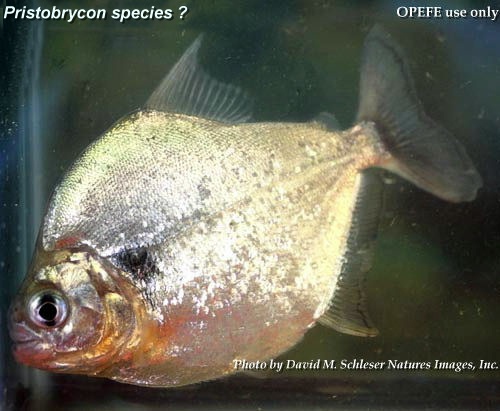
Comparison S. eigenmanni v. S. serrulatus. |
Image 1: My own research, I found little
information concerning this species, it might not even be the right species.
Closely resembles S. eigenmanni and P. striolatus. Two
(2) photos shown here may resemble S. serrulatus. As seen on the photo,
the fish has an anal fin that has a margin not touching the edges., resembling
a black line. This feature is also found on the caudle fin edge, similar to S.
spilopleura and S. maculatus. However, another species that
resembles this image and Image 2 below, is Pristobrycon calmoni. However that species is in Brazil
and Venezuela, not Peru according to current field collections.
Image 2: The
specimen possesses large ovals on the upper body in combination with vertical
elongated spots, quite similar to S. eigenmanni. Body is
very compressed laterally and discoid. Below the flank and the belly region is
heavily with small round spots and bars. Serrae are well formed and large. A
faint large humeral spot is apparent behind the gill. A black band transects
the eye. A faint caudal band seems apparent in the preserved specimen, along
with a dark "V" pattern of the basal region. Adipose fin
is large with a black margin bordering the edge. The eye (iris) is black and a
black band transects the iris and orbit with is clear. Body is high and
discoid, bright silver with a black humeral spot on the flank below the lateral
line behind the gill. Cheek yellow-gold with red tinting. Anal fin is tinted a
yellowing-orange. Pectoral fins are tinted orange. All other fins appear to be
hyaline.
LOCALITY
Amazon R.
basin and (?) Essequibo R. basin: Amazon (?), Brazil, Guyana (?) and Peru;
(not Argentina).
MAXIMUM
SIZE
19.0 cm SL
(7.4 inches SL or approximately 9 inches TL)
CONTRIBUTORS
AND ADVISERS
-
Fink,
William L.
-
Machado-Allison,
Antonio
-
Schleser,
David M.
REFERENCES
-
“Pará
is Amazonia” Project: Pará State Government Secretariats of Industry,
Commerce and Mining
(Seicom); Environment (Sectam); and the State Tourism Authority (Paratur).
-
Günther,
A.1864 (10 Dec.) Catalogue of the fishes in the British Museum. Catalogue of
the Physostomi, containing the families Siluridae, Characinidae,
Haplochitonidae, Sternoptychidae, Scopelidae, Stomiatidae in the collection of
the British Museum. Cat. Fishes v. 5: i-xxii + 1-455. Serrasalmo scapularis,
synonym of Serrasalmus serrulatus (Valenciennes 1849), but a valid
subspecies -- (Géry 1972:222).
-
Cuvier,
G. and A. Valenciennes 1850 (Jan.) Histoire naturelle des poissons. Tome
vingt-deucième. Suite du livre vingt-deuxième. Suite de la famille des
Salmonoïdes. Table générale de l'Histoire Naturelle des Poissons (pp.
1-91). Hist. Nat. Poiss. v. 22: i-xx + 1 p. + 1-532 + 1-91, Pls. 634-650.
[Valenciennes authored volume. Published as 1849. i-xvi + 1-395, index 1-81 (+
1) in Strasbourg edition.]
-
Bertin,
L.1948 Catalogue des types de poissons du Muséum national d'Histoire
Naturelle. 3e partie. Ostariophysaires (Characiniformes, Gymnotiformes). Cat.
Fish Types, Paris 3e partie: 1-49.
-
Géry,
J. 1972 (19 Dec.) Poissons characoïdes des Guyanes. I. Généralités. II.
Famille des Serrasalmidae. Zool. Verh. (Leiden) No. 122: 1-250, Pls. 1-16.
-
Ortega,
H. and R. P. Vari 1986 (10 Oct.) Annotated checklist of the freshwater fishes
of Peru. Smithson. Contrib. Zool. No. 437: iii + 25 p.
-
Menni,
R. C. 2004 (5 Mar.) Peces y ambientes en la Argentina
continental. Monografías del Museo Argentina Ciencias Natureles, Buenos Aires
No. 5: 1-316
-
López,
H. L. , A. M. Miquelarena, and R. C. Menni 2003 Lista
comentada de los peces continentales de la Argentina. ProBiotA -- Serie
Técnica y Didáctica. No. 5: 1-85.
-
Machado-Allison,
Antonio., Fink, William.,1996 Los Peces Caribes de Venezuela, Diagnosis,
Claves, Aspectos Ecologicos Y Evolutivos.
-
Jegu, M.
& dos Santos, G.M. 1988 Le genre «Serrasalmus» (Pisces,
Serrasalmidae) dans le bas Tocantins (Brésil, Pará), avec la description
d'une espèce nouvelle, «S. geryi», du bassin Araguaia-Tocantins.Rev.
Hydrobiol. Trop.. 21(3):239-274.
-
Goulding,
Michael, 1980 The Fishes and The Forest, Explorations in the Amazonian Natural
History. University of California Press Berkely, Los Angeles London.
USE YOUR BACKSPACE TO RETURN OR CLICK HERE TO RETURN
SERRASALMUS LIST
RETURN RESEARCH PAGE
The OPEFE
web site and its contents; is disclaimed for purposes of Zoological Nomenclature
in accordance with the International Code of Zoological Nomenclature, Fourth
Edition, Article 8.3 and 8.4. No new names or nomenclature changes are available
from statements at this web site.
Copyright©
1994-2012 Oregon Piranha Exotic Fish Exhibit (The OPEFE fish exhibit is
permanently CLOSED as of 2000) Sutherlin, Oregon. Information posted on this web
site is archival data on fish scientific classifications and other information. DISCLAIMER:
The copyrighted material may not be used for any purpose other than private
study, scholarship or research. Cited information requires credit and this link
www.opefe.com. All rights reserved. All images shown (unless otherwise
noted) is property of OPEFE.

UPDATED:
03/07/2015
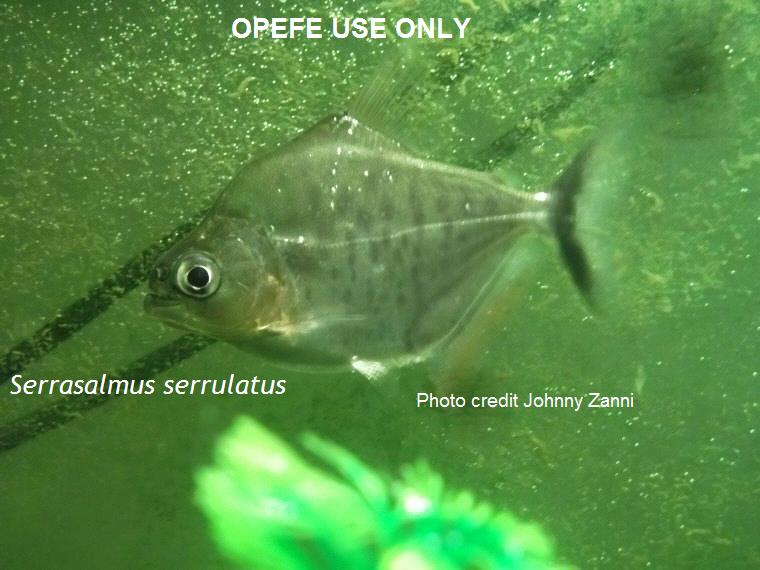
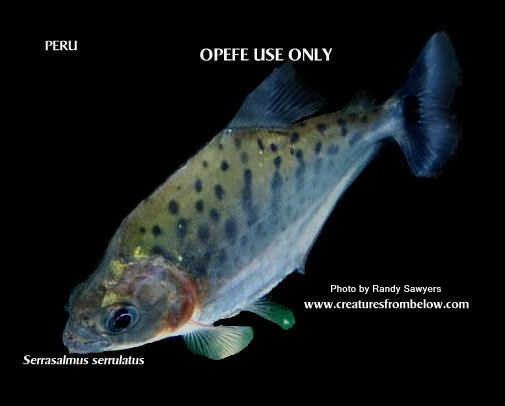 There
seems to be some problems among scientists regarding this species validity and
its placement as a Serrasalmus. Adding to this complex problem is lack of
work by authors to correct the systemic and historical problems with this
species. Even the locality is a questionable issue amounting to a huge problem
for species placement. All that I can add is that S. serrulatus is found
in Amazon river basin, Argentina, Brazil and Peru where many specimens are
imported for the aquarium trade (they are often misidentified as S. eigenmanni ).
S. eigenmanni was originally limited to Guyana and now appears more
widespread than originally believed according to French ichthyologist M.
Jégu. Whether or not the species being discussed is valid or not,
certainly those being imported for the trade resemble the group that includes S.
hollandi, S. nalseni, S. humeralis and S. eigenmanni. It could also
be possible a new species is present that has not been properly described by
previous authors. Only time will tell.
There
seems to be some problems among scientists regarding this species validity and
its placement as a Serrasalmus. Adding to this complex problem is lack of
work by authors to correct the systemic and historical problems with this
species. Even the locality is a questionable issue amounting to a huge problem
for species placement. All that I can add is that S. serrulatus is found
in Amazon river basin, Argentina, Brazil and Peru where many specimens are
imported for the aquarium trade (they are often misidentified as S. eigenmanni ).
S. eigenmanni was originally limited to Guyana and now appears more
widespread than originally believed according to French ichthyologist M.
Jégu. Whether or not the species being discussed is valid or not,
certainly those being imported for the trade resemble the group that includes S.
hollandi, S. nalseni, S. humeralis and S. eigenmanni. It could also
be possible a new species is present that has not been properly described by
previous authors. Only time will tell.